The carat system in brief
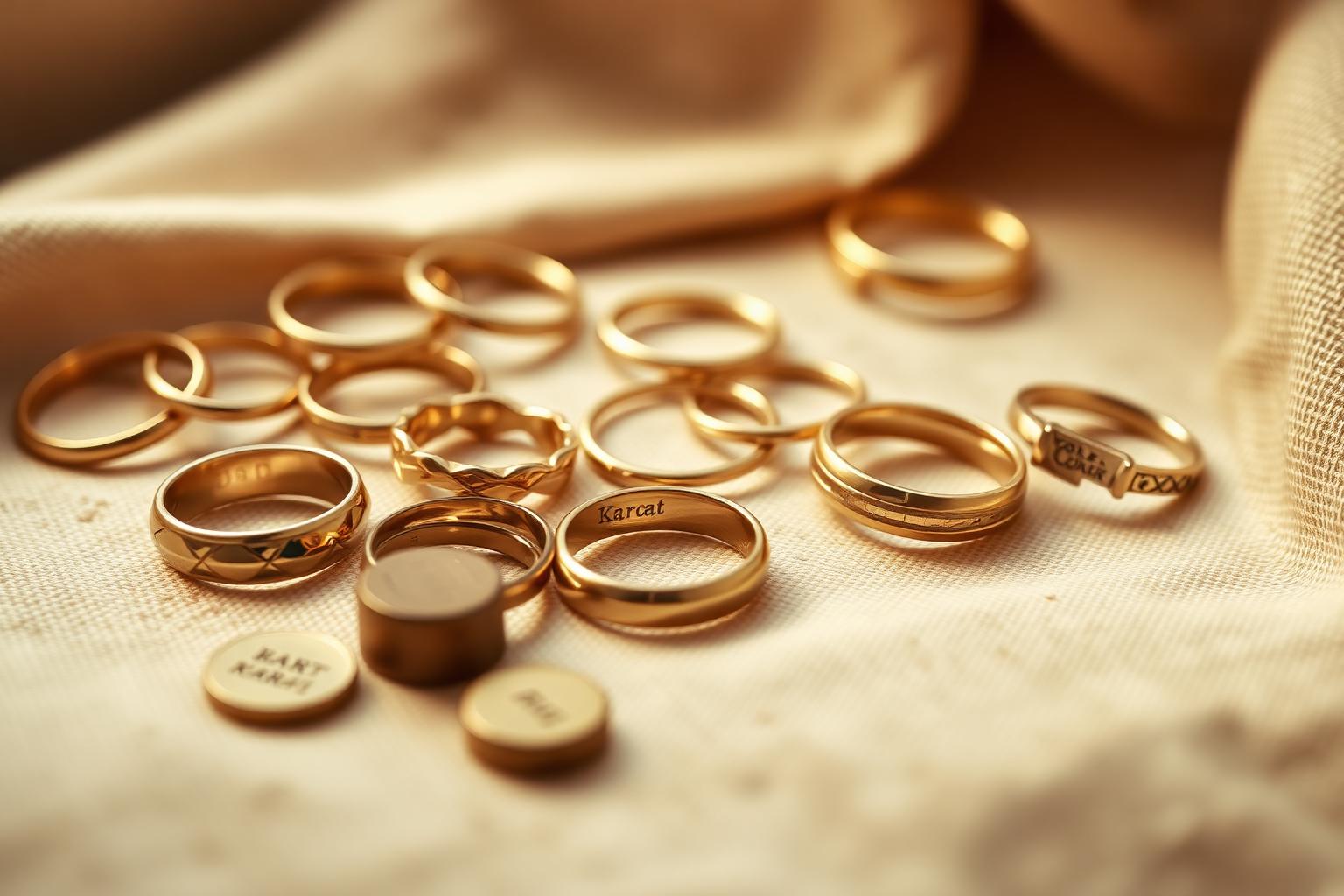
Carat expresses the proportion of pure gold in twenty-fourths. 24 carat is 100 percent gold, 22 carat is 91.6 percent (916/1000), 18 carat is 75 percent (750/1000), 14 carat is 58.5 percent (585/1000), and 9 carat is only 37.5 percent (375/1000). Countries historically chose different finenesses. The Netherlands and France have worked with 14 and 18 carat for centuries. Great Britain added 9, 12, 15, and 22 carat. Germany and Austria also used 8 carat (333).
For vintage jewellery, these differences are not a curiosity but a determination tool. A 15-carat brooch is by definition British and dates from before 1932, as the British assay office abolished this standard after that year. A 12-carat piece is also British and from before 1932. A 22-carat yellow ring indicates Indian, Portuguese, or early British origin. 8 carat is almost exclusively found in German work from the first half of the twentieth century and is rarely a positive sign for a Dutch appraiser: the fineness is below the Dutch hallmark threshold, and the piece cannot be traded as gold here without further ado.
The historical reason for this multiplicity is the tension between two goals: the higher the carat, the purer and thus softer the gold; the lower, the harder and more workable. For solid court jewels and Asian savings gold, you choose high (22 or 20 carat); for wearable, everyday jewellery, you choose medium-high (18 or 14); for affordable mass-produced goods, you choose low (9 or 8). Each tradition sought a different balance, and that balance is still reflected in the hallmarks today.
Carat expresses the proportion of pure gold in twenty-fourths.
Colour and alloy
The colour of gold does not come from the gold itself but from the alloy. Yellow gold is mixed with copper and silver in roughly equal parts: this gives the warm, slightly reddish yellow hue associated with vintage work. Modern industrial yellow gold is often cooler because the copper/silver ratio is chosen differently. Rose gold (or pink gold) contains significantly more copper, which is particularly visible in Russian and French art nouveau; the deep, almost orange-red rose gold is a signature of late nineteenth-century Russian work.
White gold only came into existence in the 1920s. It was originally alloyed with nickel as a cheap alternative to platinum when the latter became scarce during the First World War; later, and today, palladium is used because nickel causes skin allergies in some wearers. Vintage white gold from before 1920 simply does not exist: anything white that appears older is platinum or silver. A 'white gold' art nouveau brooch is almost always an incorrect description of a platinum or silver piece.
Green gold (with a high silver content, little or no copper) occasionally appears in art nouveau foliage and in certain Swiss and German Jugendstil works. Tricolour work, incorporating yellow, pink, and green gold in one piece, is typically French, from the second half of the nineteenth century. On a brooch, you might see a flower in rose gold, leaves in green gold, and stamens in yellow gold, all set in one piece.
Platinum, palladium, and modern white metals
Platinum became popular around 1900 for Edwardian and art deco work. The metal is considerably heavier than white gold (specific gravity 21.45 versus 15-16 for white gold) and has a cooler, slightly greyer sheen. Early platinum often contains 10 percent iridium; later alloys 5 percent. The hallmark is usually PT950, PT900, or the word PLAT. French platinum hallmarks from the art deco period include a dog's head (Paris) or a closing hallmark with variations per assay office.
Weight is one of the most reliable initial tests: hold an Edwardian brooch next to a modern white gold version of the same size, and the difference is immediately palpable. For an appraiser, that weight combined with the setting style (fine wirework, filigree, millegrain edges) is a strong indication of platinum from around 1910.
Palladium as an independent precious metal in jewellery is a post-war phenomenon and only appeared on the Dutch market around the turn of the millennium (2000). In vintage work, it is practically never encountered as a main material.
Silver: standards, region, and use
Silver was primarily used for jewellery in Scandinavia, Mexico, Germany (Jugendstil), the Netherlands (regional jewellery and Amsterdam School), and for Bohemian garnet work. Sterling silver (925/1000) is the most common standard and the British norm. The Netherlands also has 835 (large silver) and 800 (small silver); Germany often uses 800, France 950 (first standard) or 800 (second standard).
Silver with gilding is called vermeil (in France, required to be based on fine silver) and is no less valuable when it comes from a recognisable period: nineteenth-century vermeil pieces of French or Russian manufacture have independent collector's value. Distinguish vermeil from gilt metal: vermeil is silver-with-a-gold-layer (precious core), gilt metal is base-metal-with-a-gold-layer (no precious core) and wears through more quickly because the supporting layer breaks through.
Bohemian garnet pieces from the second half of the nineteenth century are often made in low-grade silver or tombac (copper-zinc with a thin layer of gilding) with a dense pattern of rose or pyrope garnets. The metal is secondary there: the value lies in the garnets and the setting, not in the metal.
Pinchbeck, doublé, rolled gold, and gold-filled
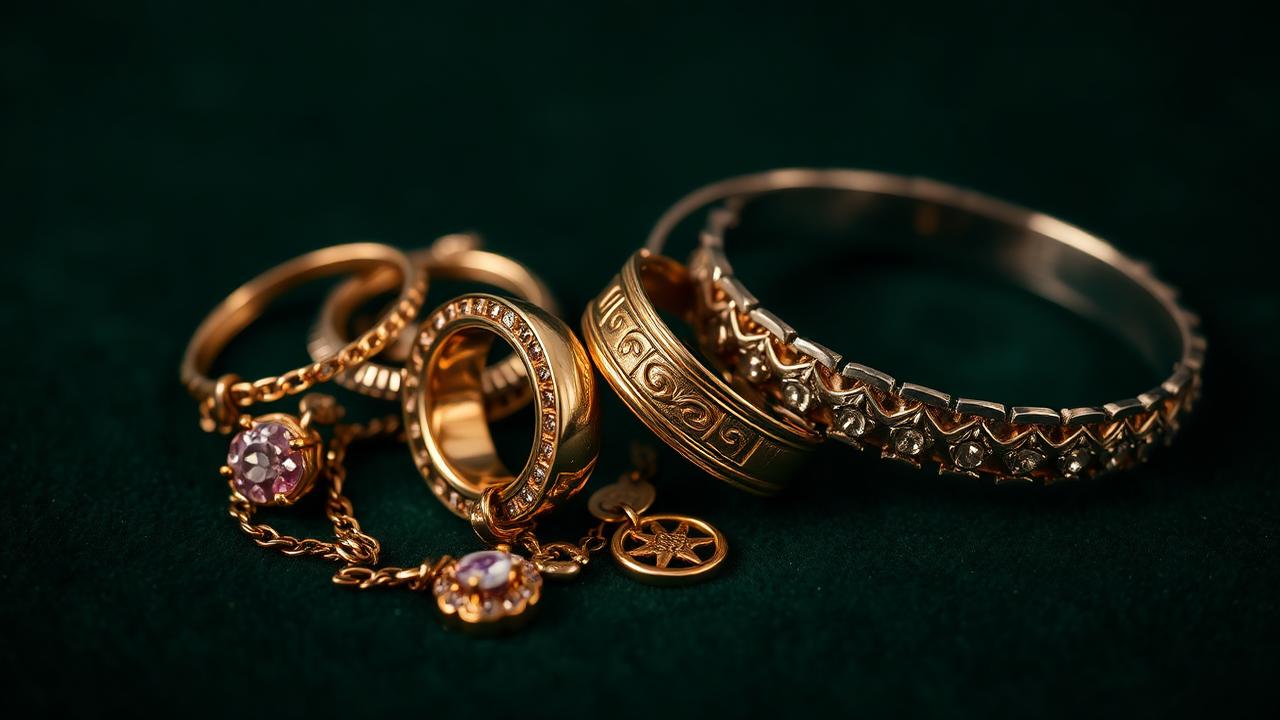
Pinchbeck, developed by London watchmaker Christopher Pinchbeck around 1720, is a copper-zinc alloy that resembles gold but contains no gold. Early pinchbeck (before about 1850) has collector's value as a historical document, especially when incorporated into Georgian or early Victorian clasps and cameos. Later nineteenth-century work with the same appearance is usually called gilt metal, doublé, or rolled gold and is less sought after.
Doublé (French) and rolled gold (English) refer to a mechanically applied gold layer on a base metal core; the layer is thicker than gilding but thinner than the gold part of vermeil. American gold-filled (GF, 1/20 12k or 1/10 14k) has a gold layer of at least one-twentieth of the total weight and is a normal material choice for American late Victorian and art deco jewellery.
For the vintage market, the distinction is important: a 'gold' brooch from 1900 that, after weighing and testing, turns out to be rolled gold, does not suddenly become rubbish, but its intrinsic value is fractional. The collector's value then lies in the form, the maker, or the set gemstone. So be careful with sales texts that state 'in gold'; always ask for the fineness hallmark or, if absent, for a test result.
What weight tells you
An 18-carat ring weighing four grams feels different in the hand than a 9-carat ring of the same size: higher carat is heavier because gold has a high specific gravity. Vintage pieces are often heavier than modern equivalent work: solid shank, thick bands, robust settings. Modern boxwork is hollower and lighter, designed to give an impression of volume without the associated material use.
Those who regularly weigh jewellery develop a feel for what a period-authentic weight is. An Edwardian platinum pendant brooch weighing 12 grams feels heavy for its size; a modern white gold imitation would weigh the same only if extra material were incorporated that negates the original fineness. So weight is not only an indication of preciousness but also of the manufacturing period.
Always weigh without gemstones and without pearls if you want to estimate the intrinsic value; with gemstone-rich pieces (necklaces with many diamonds or pearls), the weight of the stones is sometimes higher than that of the metal, and the simple division calculation then goes completely awry.
Self-testing: what you can do and what you should leave to others
There are three testing methods you can use at home or at the counter. The magnet test rules out the piece being made of magnetic base metal: gold, silver, platinum, and brass are all non-magnetic, so a positive result (the piece sticks) means steel or iron, full stop. A negative result only means it's not steel, not that it's a precious metal: many gold doublé pieces have a copper core that also doesn't magnetise.
The acid test (Aqua Regia or specific carat testing liquids) works on a scratched mark on a touchstone and is the classic goldsmiths' method, but visibly damages the surface in an inconspicuous spot. Do not do this yourself on enamel work, on pieces with a patina that contributes to the value (Bohemian garnet, Victorian mourning jewellery), or on anything with a signature on the edge.
XRF measurement (X-ray fluorescence) is non-destructive: a measuring gun on the surface provides an assay analysis per alloy component within ten seconds. Any goldsmith, appraiser, or precious metal company with an XRF can do this for a few euros. For pieces worth a few hundred euros or more, this is the standard method; never blindly trust only the hallmark, as fakes (imitation hallmarks on base metal) do occur.
What the hallmark does and does not mean
A fineness hallmark on a Dutch jewel indicates that the piece has been tested by Waarborg Holland at the time of assay and meets the stated fineness. For work from 1987 onwards, a sponsor's mark (maker's mark or company mark) is mandatory in addition to the fineness and hallmark; for older work, historical hallmarks appear that vary by period and city (see the hallmark and assay marks guide).
A jewel without a fineness hallmark is not automatically non-precious: many foreign pieces have never been assayed in the Netherlands (import pieces from family ownership), and very small work (under 1 gram) is exempt from hallmarking. What to do with unhallmarked work: have it tested. What to do with a suspicious hallmark: have it tested. The hallmark is the start of the investigation, not the end.
Imitation hallmarks primarily appear on base metal offered as 'antique gold' on online marketplaces. Recognisable by blurry edges, incorrectly placed additional marks, or hallmarks that do not historically occur together (for example, '585' combined with a nineteenth-century punch from the Waarborg that did not know the fineness 585).
Brief workflow for an unknown piece
Weigh the piece and record its weight. Examine it under a 10x loupe from all sides, paying particular attention to the clasp, the inside of the band, and the back of brooches: that's where hallmarks are located. Photograph all hallmarks separately, large and sharp. Perform the magnet test. Check if the metal has a consistent colour at wear points (on the edge of a ring, on the inside of a clasp): a translucent copper core reveals doublé or gold-filled.
Based on this first round, you usually know whether the piece falls into the gold, silver, platinum, or imitation category. For definitive fineness and origin determination, XRF measurement by a goldsmith or appraiser follows, combined with style determination via our style guides and, where possible, recognition of a maker via the makers guides or brand guide.
Overview in one table
| Hallmark | Fineness | Typical origin |
|---|---|---|
| 333 | 8 carat | Germany, Austria (20th century) |
| 375 | 9 carat | Great Britain, Ireland |
| 417 | 10 carat | United States |
| 585 | 14 carat | Netherlands, Germany, USA |
| 625 | 15 carat | Great Britain (before 1932) |
| 750 | 18 carat | France, Netherlands, Switzerland |
| 916 | 22 carat | India, Portugal, early British |
| 950 | Platinum | International, from 1900 |
Fineness indications in thousandths, as they appear on modern hallmarks. Historical hallmarks often use alternative marks — see the Hallmarks & Assay Marks section.