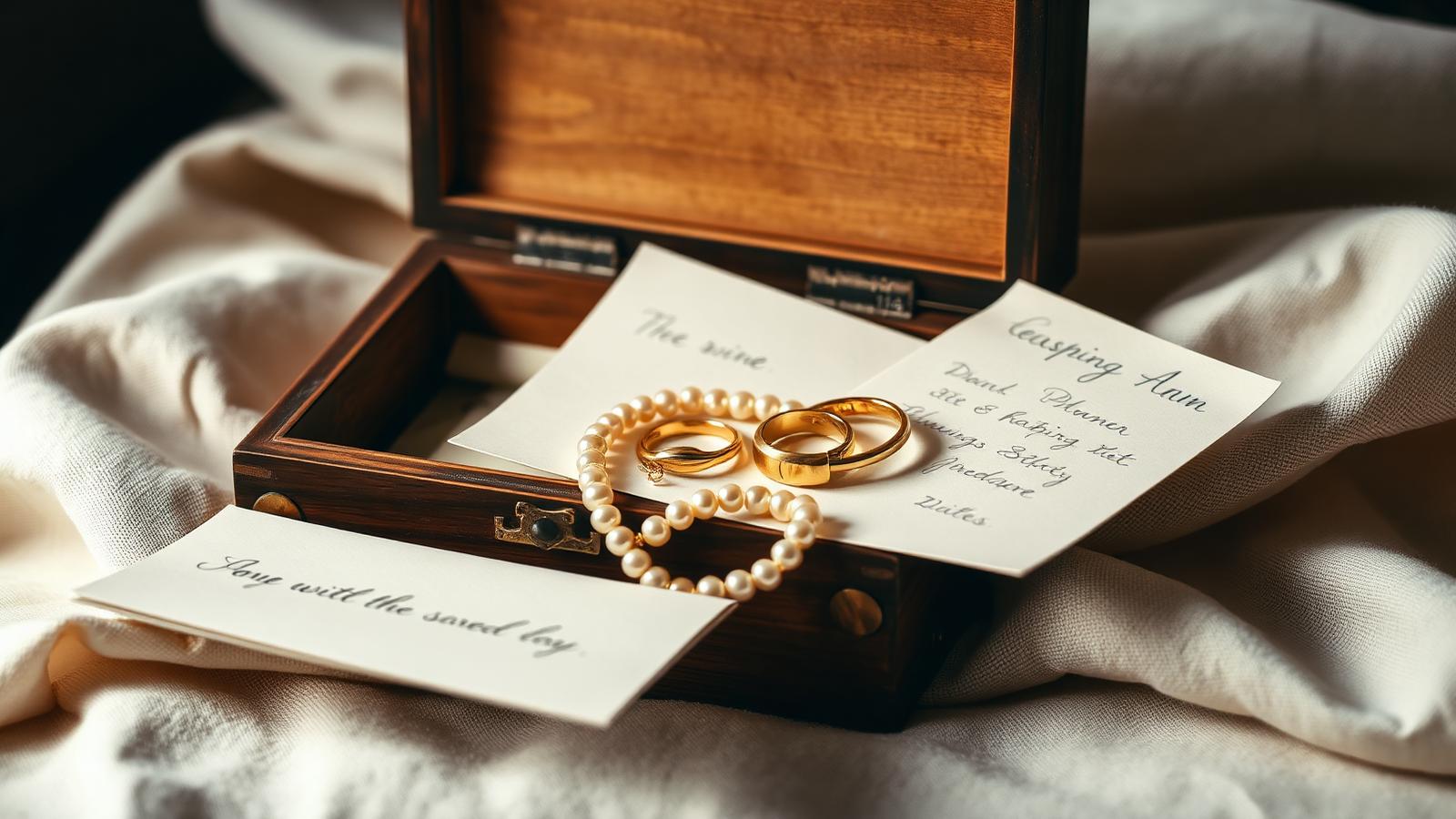
First, inventory, don't touch anything
The biggest mistake in the first week after a death is the tendency to clean everything. Do not polish. No silver polishing cloth, no ultrasonic bath at the corner jeweller, no toothbrush with toothpaste. Patina — the warm, somewhat darker layer that decades of wear produce — is for most pieces actually part of their value. Removing it also removes fine engraving and old marks that are later needed for determination.
Carefully lay everything out on a soft cloth and photograph it piece by piece. Front and back, and where possible a macro shot of any marks on the inside of rings or on the back of brooches. Note what you know: whose it was, when it was worn, or if there are stories attached to it. Provenance — increases value for collectors and is often the only thing that truly matters when distributing within the family.
The biggest mistake in the first week after a death is the tendency to clean everything.
Emotional value and market value are not the same
In an inheritance, two types of value intertwine. Emotional value is what a jewel means to those who were present: your grandmother's wedding ring, the brooch your mother only wore on birthdays. Market value is what an average collector or a jeweller would reasonably pay today. For family pieces, the first is often greater than the second — and that's perfectly fine. Selling because it seems financially logical is rarely a good reason.
What determines market value is a sum: the weight in precious metal (gold, silver, platinum), the quality and origin of any stones, the period and style, the condition, and whether it is signed by a well-known maker. A 14-karat plain wedding ring from 1958 has almost only intrinsic gold value. A signed art deco brooch from the same year can fetch many times more, even if it weighs less. The overall value guide explains this logic by category — useful to read before someone comes to the table with an appraisal proposal.
When you need a sworn appraisal
For three situations, you need an official appraisal report, drawn up by a sworn appraiser. For the distribution of the inheritance among heirs — an appraisal report prevents discussions and stands up to any inspection by the Tax Authorities; how such a distribution appraisal works in practice (which value concept, who can sign, what should be in the report) is explained in having jewellery appraised. When insuring it under a household insurance policy with a valuables clause — insurers do not accept self-estimated amounts. And for a sale involving a bank, notary or liquidator.
The cost logic and bandwidths are in the appraisal guide; general lines: simple work per piece, complex work on an hourly basis, volume discounts for larger collections. For jewellery you want to get rid of yourself without insurance or legal reason, a full report is usually overkill.
When an estimate suffices
For most heirs, it starts simpler. You first want to know the order of magnitude — are we talking about tens of intrinsic value, hundreds of euros for signed deco work, or a piece worth having appraised separately? A free, no-obligation value estimate based on photos usually provides that answer within a few working days.
An estimate is not an official appraisal. It binds no one, is not usable for insurance, and does not hold up in a distribution if a dispute arises. It is, however, the perfect starting point to determine which piece deserves to be truly appraised and which piece you can simply give to a family member without further ado. On our page free value estimate, you will find how it works.
And then: keep, distribute or sell
What you do next is a family choice, not a technical one. Those who sell would do well to compare between a specialised vintage jeweller, an online auction and a purchase address. They work in fundamentally different ways and rarely yield the same amount. The step-by-step plan for selling and the section selling and purchase explain these routes. Those who keep, prefer to do so in separate cotton bags, far from moisture and perfume — see the section maintenance and care for this.