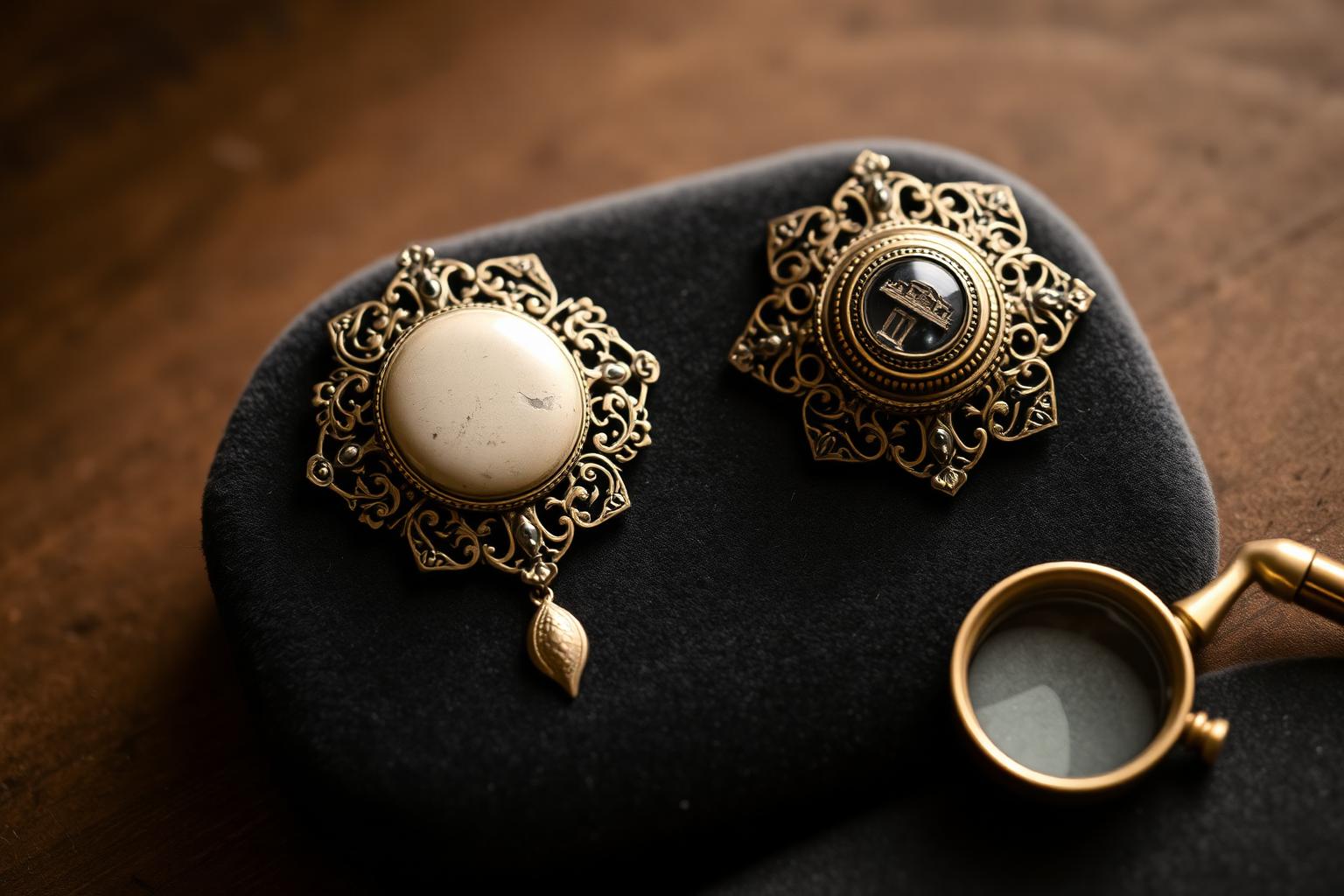
Victorian revival pieces
Regarding revival work in two senses. Original revival is nineteenth-century work that refers to older styles — Etruscan, Greek, Gothic, and Renaissance revivals. These pieces are now antique themselves (150 years old), fully collectible, and not reproductions in the usual sense. A Castellani-style brooch from 1870 that refers to Etruscan work is an authentic Victorian piece.
Later revival reproductions — pieces from the 1960s to today that aim to look 'Victorian' — reveal themselves on four points. First: the casting quality. Original Victorian work is hammered, chased, or soldered from components; the relief is sharp and the underside irregular. Later reproductions are cast from a single mould with a smooth, evenly matte underside. Second: the colour of gold. Victorian 15-carat yellow gold (British) or 14-carat Dutch gold has a warm, somewhat reddish hue; post-war alloys are cooler and lighter.
Third: the hallmarks. British Victorian brooches bear a complete hallmark (fineness mark, assay office, date letter, sponsor's mark). If one of the four is missing, or if the marks are placed separately in illogical spots, then the hallmark was added later or is missing entirely. Fourth: the clasp. A 'Victorian' brooch with a roll-over safety catch or lobster clasp is later — see the dating guide for clasps.
Regarding revival work in two senses.
'Art Deco style' rings of today
The most actively reproduced style in the current market is Art Deco: the geometric, calibre-faceted rings with baguettes and side stones. The reason is commercial — they sell well as 'vintage engagement rings' — and creatively not difficult to imitate.
The distinction from an original Art Deco period piece (1920 to 1935) lies in three points. The centre stone: a true Art Deco piece from '1925' contains an old European or transitional cut. A modern brilliant in a 'Deco setting' is either a later reset (stone replaced) or a reproduction. The facet geometry betrays the century — see the cut guide.
The side stones: original Deco baguettes are slightly irregular, sometimes with a minimal skew and not always perfectly equal sizes. Modern calibré baguettes are perfectly symmetrical, all exactly identical in size. a 'Deco' ring with eight identical baguettes is almost certainly recent.
The hallmarks: French Art Deco work bears the eagle's head from after 1838. American Deco work bears 'PLAT' or 'PLATINUM'. Modern 'Deco style' work from India, Turkey, or Thailand often only bears '750' or '950' without an origin mark. An 'Art Deco' ring without a clear country mark and without a maker's mark is suspicious — period pieces from recognised workshops almost always bear both.
Cameo reproductions in plastic
Cameos come in three main materials: shell (helmet shell, carnelian shell), lava stone, and agate. All three are authentic natural materials and were hand-carved from the eighteenth to the twentieth century. In the 1960s and 1970s, plastic cameos — polymer or hard plastic — were mass-produced, looking identical to shell at first glance.
Identify plastic by three signs. Temperature: place the cameo against your cheek for a moment. Shell feels cool and remains cool; plastic quickly feels lukewarm upon touch and adjusts to skin temperature. Translucency: hold a shell cameo against bright light — you will see slight translucency and sometimes a fine growth line (the original shell layer). Plastic is either completely opaque or evenly translucent without a growth line.
Carving quality: on a hand-carved shell cameo, you will see minute knife marks and irregularities in the fine details (hair, eyelids, drapery). On a cast plastic cameo, every fold is identical and vertically smooth — it is from a mould and not carved from a block. Under a loupe, this difference is visible within seconds.
Background and setting provide an extra hint. Original nineteenth-century shell cameos are set in a gold or vermeil bezel, sometimes with an interposed foil. Post-war plastic cameos are often in gilded base metal with a modern safety clasp.
Marquise ring remakes
The marquise ring — the pointed oval ring with a closed field, usually in turquoise pavé or small garnets — is one of the most reproduced vintage forms. The original marquise rings come from the nineteenth century and are hand-set, usually in a foil setting.
Replica can be recognised by the casting quality of the shank: original handmade work has a slightly irregular, slightly oval shank with visible file marks on the inside. Modern cast reproductions have a perfectly round shank with a machine-finished interior.
Secondly, the stones: original marquise rings with turquoise have natural turquoise with a slight network of veins and a variable blue-green tint between the stones. Reproductions use reconstituted turquoise or dyed howlite — in which case all stones are identical in colour without veins.
Thirdly, the setting: original foil settings are closed at the back and you cannot see through the stones. Reproductions often have open settings (modern pavé) where you can see light through the stones — which also means there is no foil behind them and the colour is thus 'natural' instead of enhanced.
The hallmarks on reproductions are often merely fineness numbers (585 or 750) without a maker's mark or date. Original French or Belgian marquise rings bear an eagle's head or a local hallmark plus a maker's mark. For the context of hallmarks: the hallmark hub.
Reproduction is not an insult
The word 'reproduction' sounds dismissive, but it isn't. Revival pieces from the nineteenth century are now antique themselves and have their own place and price. Later 'in-style' pieces (1960s to present) are legitimate jewels with their own design and craftsmanship — some 1970s Art Deco homages by recognised Italian and French workshops fetch significant amounts at auction.
The problem is misrepresentation, not the piece itself. An honest 'in-style' jewel, correctly named 'in the style of' or 'circa 1970 art deco revival', is a full-fledged product. The same piece sold as 'authentic art deco 1925' is a deception. The honesty about the year of manufacture is what counts.
When purchasing above one or two thousand euros, an independent second opinion — or a certified sales report — is worthwhile. When in doubt: do not buy. Large international auction houses (Sotheby's, Christie's, Bonhams) are cautious in this regard; they always note 'attributed', 'in the style of' or 'circa'. Smaller traders and online marketplaces are less strict.
Legally, a reproduction is only punishable if it is deliberately sold as an original. The making and selling of 'in-style' work is legal and a normal part of the jewellery industry for four generations.
Related categories
- → Clasps and construction
- → Hallmarks and fineness marks
- → Cuts through the centuries
- → Motifs: marquise ring
- → To the hallmark guide
- → Gemstones: jet — Whitby jet, glass, vulcanite, and onyx
- → Gemstones: amber, ambroid, and plastic imitations
- → Gemstones: paste and strass — glass as an independent craft