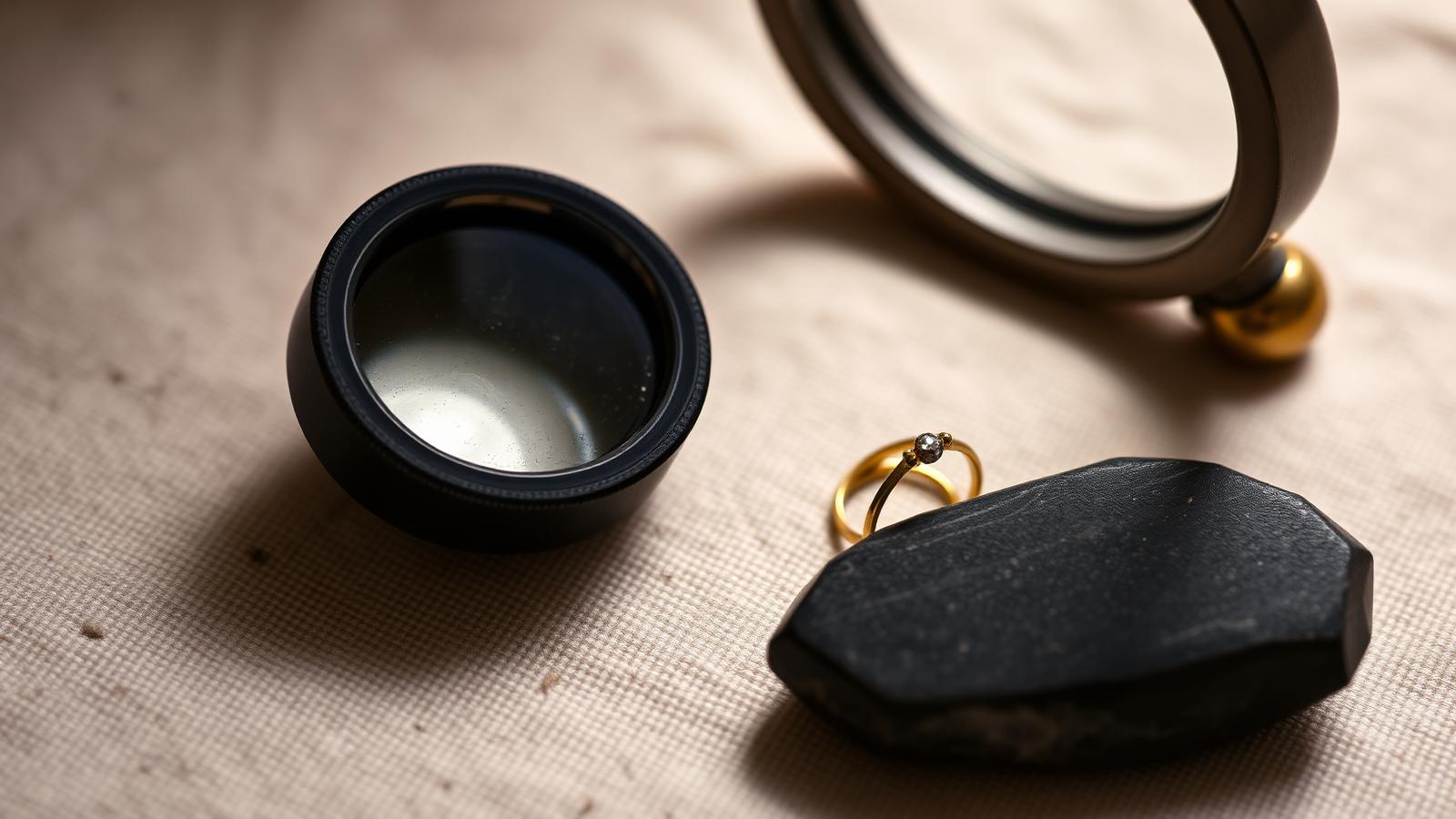
Check one — the hallmark
By far the most important indication. Every gold jewel brought to trade in Europe is obligatorily hallmarked with a fineness mark as soon as it exceeds the legal weight threshold (in the Netherlands, one gram for gold). So first look for numbers: 375 (9 carat), 585 (14 carat), 750 (18 carat), 916 or 917 (22 carat), or 999 (fine gold). Old unnumbered marks — the Dutch sword, the French eagle head, the British crown with a lion — also signify real gold.
Where to look: inside of ring shanks, on the back of brooches, on earring posts, on necklace clasps. Often very small — a loupe or macro mode on your phone helps enormously. For explanations per country, see the hallmarking guide.
Important caveat: a hallmark can be faked. For high value or in cases of doubt, a hallmark alone is not enough — an XRF measurement at a jeweller is then necessary. Conversely: the absence of a hallmark does not prove that a jewel is false (small or thin work did not have to be hallmarked).
By far the most important indication.
Check two — the weight
Gold is remarkably heavy. 18 carat gold has a density of approximately 15 grams per cubic centimetre, 14 carat approximately 13, and gilded brass or bronze around 8 to 9. You can feel the difference: a gold ring feels distinctly heavier in the hand than a plated equivalent of the same dimensions. Those with a kitchen scale and a measuring jug can even measure the density by immersing the jewel in water and comparing displacement.
This test is useful for comparison (if you have two rings, which one is precious metal?) but less so for an absolute judgment. Some modern hollow jewels are light despite being gold; old pinchbeck can feel surprisingly heavy. Always combine with a hallmark and visual check.
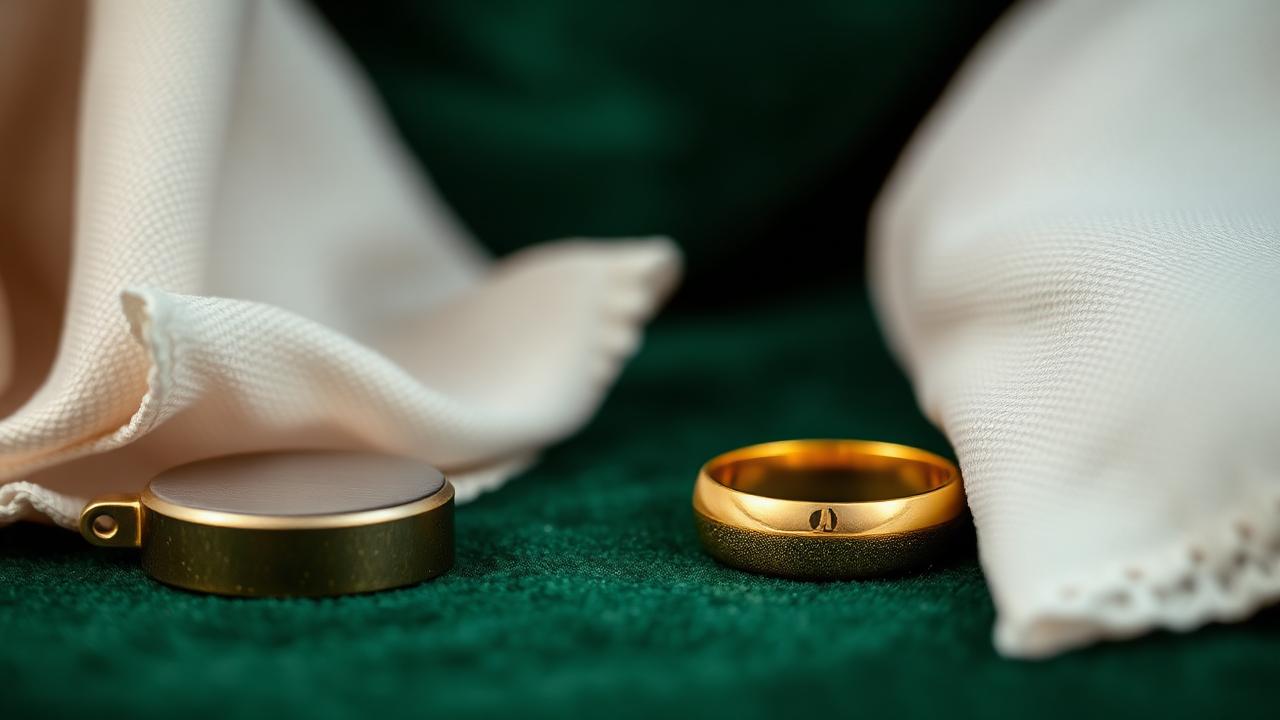
Check three — discolouration and wear
On plated work, the gold layer wears away in areas that have a lot of contact — inside of ring shanks, bracelet snap fasteners, necklace clasps. What emerges underneath is usually yellow brass or grey silver, with a distinctly different colour from the rest of the piece. Gilded work often also has a slightly more meagre, harder yellow sheen than real gold, which is warmer and softer.
Solid gold wears evenly and does not discolour. However, it can oxidise to a dull layer (especially 9 carat, which contains a lot of copper), but that is a surface issue, not a colour change beneath the surface. Green skin discolouration when worn almost always indicates plated or low-carat work with a lot of copper — real high-carat gold does not cause skin discolouration.
Check four — the magnet test
Simple but informative. Gold is not magnetic. Neither are silver and platinum. A strong magnet (for example, a neodymium magnet from an old hard drive) should not cause any attraction. If you feel the slightest pull, there is a ferromagnetic metal in the core — iron, steel, or a cheap alloy. Almost certain indication that it is not solid gold.
Note: clasps, springs, and hinges can be magnetic without the jewel itself being fake (goldsmiths sometimes used steel for these to maintain elasticity). So test on the bulk of the jewel, not on the clasp alone.
What you should NOT do at home
The acid test — a drop of nitric acid on a scraped surface — gives reliable results but causes irreparable damage to your jewel. The scraping itself, the acid stain, the after-treatment: everything leaves marks that permanently reduce its value. For the intrinsic check you suspect at home, you lose more value with a wrong piece than the test provides in certainty.
The 'bite test' (biting into the metal to feel if it is soft) is an old legend with no scientific basis and risky for your teeth. The 'ceramic scratch test' also damages old work. For certainty: have a jeweller perform an XRF measurement — free of charge or at a very low rate at most vintage-specialised addresses. See the address guide.