What Makes Regional Jewellery Different
Regional jewellery belongs to traditional costume, and traditional costume was, well into the twentieth century, everyday attire in large parts of the Netherlands. Within this context, jewellery fulfilled a social function: it indicated civil status, prosperity, religion, and region. An unmarried woman wore different ear irons than a married one. Mourning had its own pieces. And the difference between a South Beveland and a Walcheren costume could be read from the clasp of a necklace.
Unlike fashion jewellery, regional jewellery was made to last for generations. It is heavy, technically well-executed, and often in solid gold or silver. Upon death, it would pass to daughters or nieces; when renewed, the old gold was often melted down into a new piece in the same tradition. This is why eighteenth-century Zeeland gold still circulates within families today.
For collectors and heirs, this means two things. Provenance can usually be reconstructed: there is almost always a family story underpinning a regional piece. And the value is rarely purely material — sentimental and cultural-historical significance play a role, often more heavily than the weight in gold.
Regional jewellery belongs to traditional costume, and traditional costume was, well into the twentieth century, everyday attire in large parts of the Netherlands.
Red Coral Necklaces with Gold Clasps
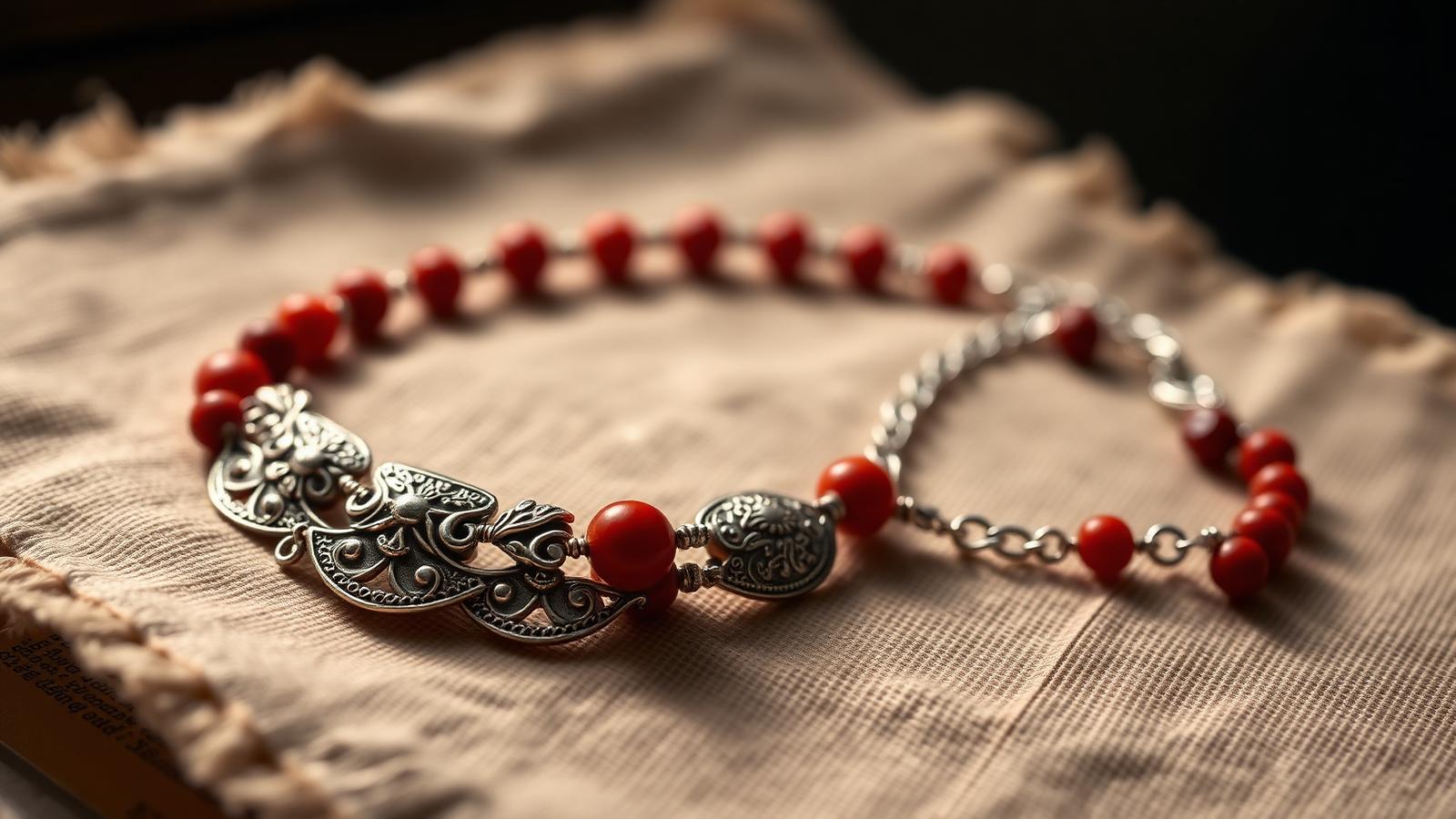
Red coral is the precious red coral (Corallium rubrum) from the Mediterranean Sea. From the seventeenth century onwards, affluent Dutch women — in Volendam, Marken, Bunschoten, Spakenburg, in Zeeland, in Friesland — wore necklaces of these corals around their necks. Usually in five, seven, or nine strands, with a large gold clasp at the front and sometimes a small cross or pendant beneath.
The corals themselves were imported from Naples, Sicily, or Sardinia; the clasp was made by the local goldsmith. This gold clasp is usually the most valuable part of the complete necklace: made of solid 14 or 18 carat gold, with ornamentation characteristic of the region (Frisian clasps are different from Zeeland ones, and those again different from Bunschoten). For sale or appraisal, red coral and clasp are often weighed separately, but the completeness of the whole is essential for collector's value.
More about the value and recognition of genuine red coral can be found in the red coral price guide.
Ear Irons and Bonnet Pins
An ear iron is the gold or gold-plated frame that women in traditional costume regions wore under their lace bonnets, folded around the head. The ends — the so-called head needles or curls — protruded visibly at the temples, often executed as spirals, rosettes, or curved curls. In Friesland, the ear iron first appeared (seventeenth century); from there, it spread to North Holland (Volendam, Marken) and Overijssel (Staphorst).
The appearance of the ear iron revealed the family's wealth. A light silver one for a poor family; a wide gold ear iron with pearls or enamelled ends for a wealthy one. For a male audience, however, there was no ear iron — this was strictly women's work. Upon marriage, the bride often received a new or familial ear iron; in mourning, it was simplified.
Bonnet pins — long gold or silver pins used to attach the lace to the bonnet — were found in the same regions. They often had an elaborate head (sphere, cross, heart, hand) and are now popular among collectors of Dutch silver.
Regional Silverware as a Mark of Identity
In addition to personal jewellery, there was regional silverware used or worn during ceremonies: brandy bowls, christening corals, Bible fittings with tiny chains. Much of this work was made by local silversmiths who used their own maker's mark and date letter. The Netherlands has an extensive system of hallmarks (sword, city mark, date letter, maker's mark) with which each piece can be precisely dated and attributed to a region — see the hallmark guide.
For the link between regional work and the Dutch silver city of Schoonhoven, see Dutch silver in jewellery.
Recognising Provenance from Clasp and Workmanship
For those who inherit a regional piece, the first question is usually: which region does this come from? There are a few good indications. The shape of the clasp is the clearest: Frisian clasps are often rectangular with embossed floral work, Zeeland clasps have more filigree, Bunschoten clasps are wide and flat, Volendam clasps are more richly decorated with colourful enamel inlays. The size of the corals (and the number of strands) also differs by region.
Furthermore, look at how the clasp works: hook-and-eye, carabiner, or a slide clasp with a spring. Eighteenth-century work often has simpler mechanical clasps; nineteenth-century work already features the modern carabiner. Maker's marks and fineness marks on the clasp are the definitive confirmation — these can be found on the inside with a loupe.
In case of doubt about dating, region, or authenticity, a specialist is indispensable. The Zuiderzeemuseum, the Zeeland Museum, and the Dutch Silver Museum in Schoonhoven all have catalogues and experts who can provide assistance upon request. For a visit to the silver city itself: shops and workshops in Schoonhoven; for broader addresses, also see the address guide.
What You Can Do with a Regional Piece
Regional jewellery is a sensitive category. It represents not only money but also family and cultural history. Before doing anything — selling, melting down, dismantling — reflection is appropriate. Many families only discover after two generations how much an ear iron or a red coral necklace functioned as a link between elders and grandchildren.
If sale is considered, selling to a specialised dealer or a museum-related circle is almost always preferable to the melting pot. Museums rarely actively buy from private individuals but do have networks of trusted addresses. For a no-obligation value estimate, our editorial team is available; for an official appraisal, we refer to sworn appraisers in the address guide.