De waardefactoren
Een taxateur weegt bij deze categorie een vast aantal criteria. Hieronder leggen we ze uit, in de volgorde waarin ze doorgaans worden bekeken.
Recognising Bohemian pyrope
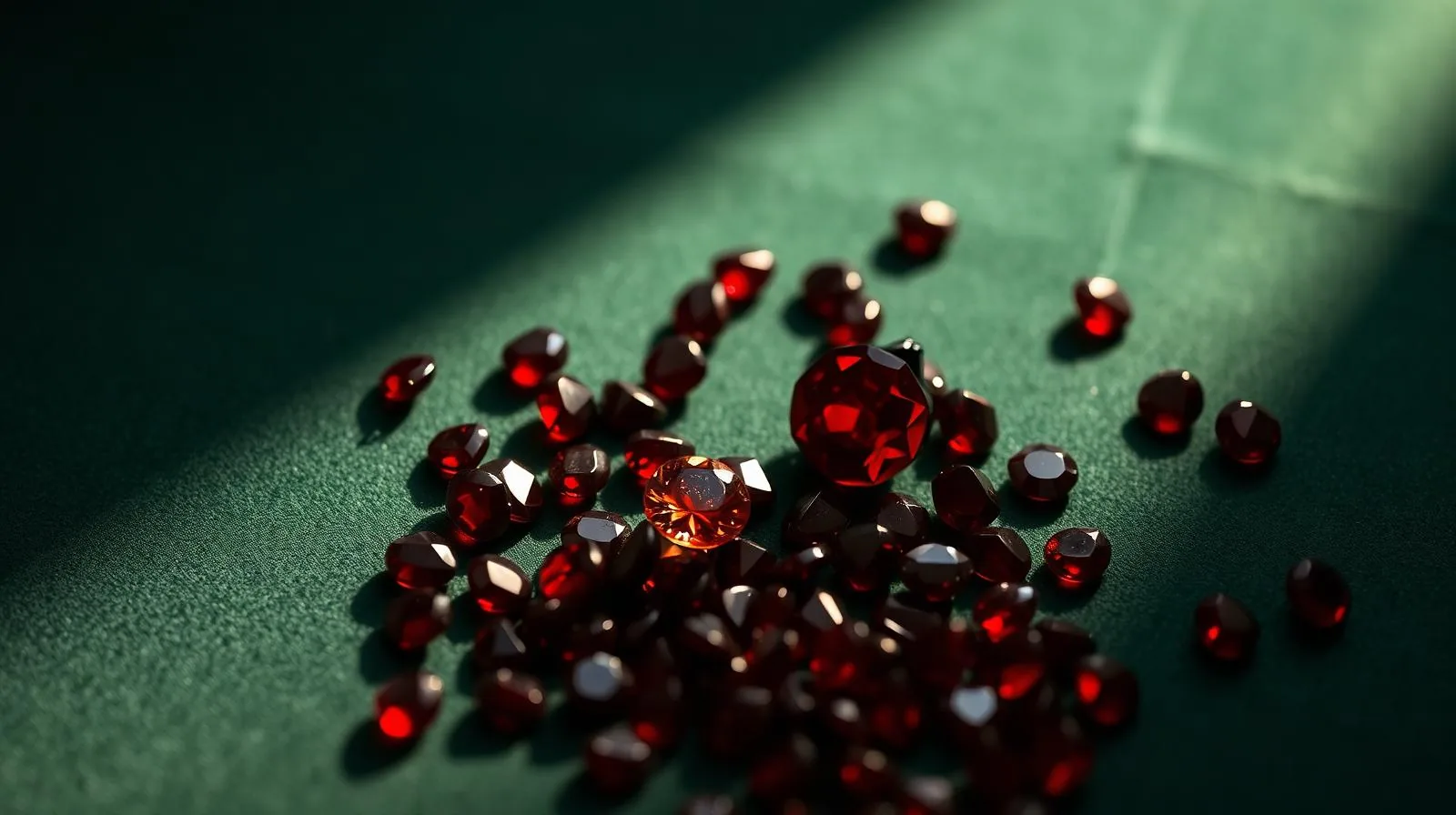
Bohemian pyrope is small (2–4 mm), bright red with a slight orange undertone. Under magnification, you often see fine inclusions that confirm its authenticity. The stones are closely set in a pavé-like pattern, without gaps — that is the hallmark of Bohemian work from the late nineteenth century.
Densely set pavé versus loose setting
Quality Bohemian work has a uniform, dense pavé surface. Later reproductions (1950s–1970s) often have larger gaps and machine-set stones. An original dense pavé with slightly irregular hand-setting is a strong indicator of period work for collectors.
Mounting material: tombac versus gold
The metal in Bohemian work is typically gold-plated or tombac (a brass alloy that resembles gold), with the stones closely set. The value lies mainly in its completeness and originality. Dutch garnet work from the same period is rarer: here, the garnet is more often set on solid gold (14 or 18 carat), with fewer but larger stones. Dutch pieces are appraised individually and are substantially more expensive.
Complete parures
A complete parure (necklace, earrings, brooch, bracelet, sometimes ring) from the same suite is significantly more valuable than the sum of its individual parts. Fully preserved Bohemian parures from the late 19th century are rare and command serious premiums at auctions. Original cases with city markings also add to the value.
Completeness and original clasp
A Bohemian necklace can easily have between 100 and 300 stones. One missing stone stands out and requires restoration with period-appropriate garnets — not a simple task. A complete, unaltered piece is significantly more valuable than a piece with replaced stones. Original clasps with characteristic Bohemian craftsmanship (sometimes with a central garnet as a 'clasp button') add extra value.