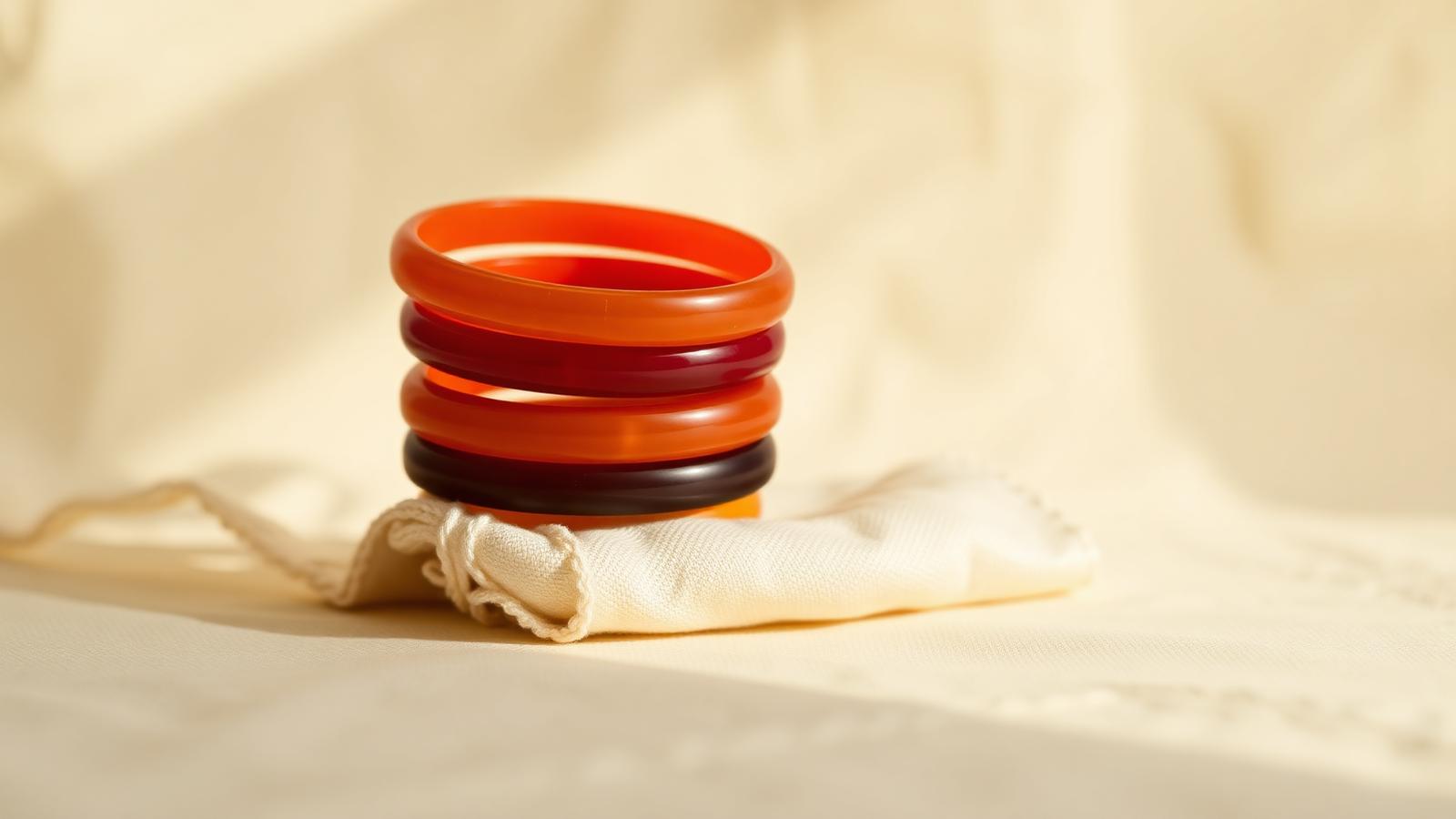
What are bakelite, celluloid, and galalith?
Bakelite is a phenol-formaldehyde resin, patented in 1907 by Leo Baekeland. It was the first fully synthetic plastic and was widely used for jewellery between the World Wars: bracelets, brooches, beads, rings. Characteristic features include deep, warm colours (cherry red, orange, mustard yellow, jade green, black, marble patterns) and a slightly oily feel.
Celluloid (nitrocellulose, developed from 1856) is older and was mainly used to imitate ivory, horn, and tortoiseshell. Brooches and hair combs from the late nineteenth and early twentieth centuries are often celluloid. The material is lighter and more brittle than bakelite and discolours (yellow) under UV light.
Galalith (casein resin) is made from milk protein and formaldehyde and became popular in the 1930s as an alternative to amber and horn. Its identification range partially overlaps with bakelite, but galalith is generally slightly softer and has different scent characteristics.
Bakelite is a phenol-formaldehyde resin, patented in 1907 by Leo Baekeland.
Identifying by weight and sound
Bakelite is surprisingly heavy in the hand. Compare a bakelite bracelet with a modern plastic (plexiglass, acrylic): the bakelite feels substantial, the modern lighter. Gently tap two bakelite pieces together: the sound is dull and warm, more 'wood-on-wood' than 'plastic-on-plastic'. Modern plastics produce a higher, harder click.
Celluloid is considerably lighter and sounds harder and hollower when tapped. Galalith falls between bakelite and celluloid in weight and has a slightly softer feel.
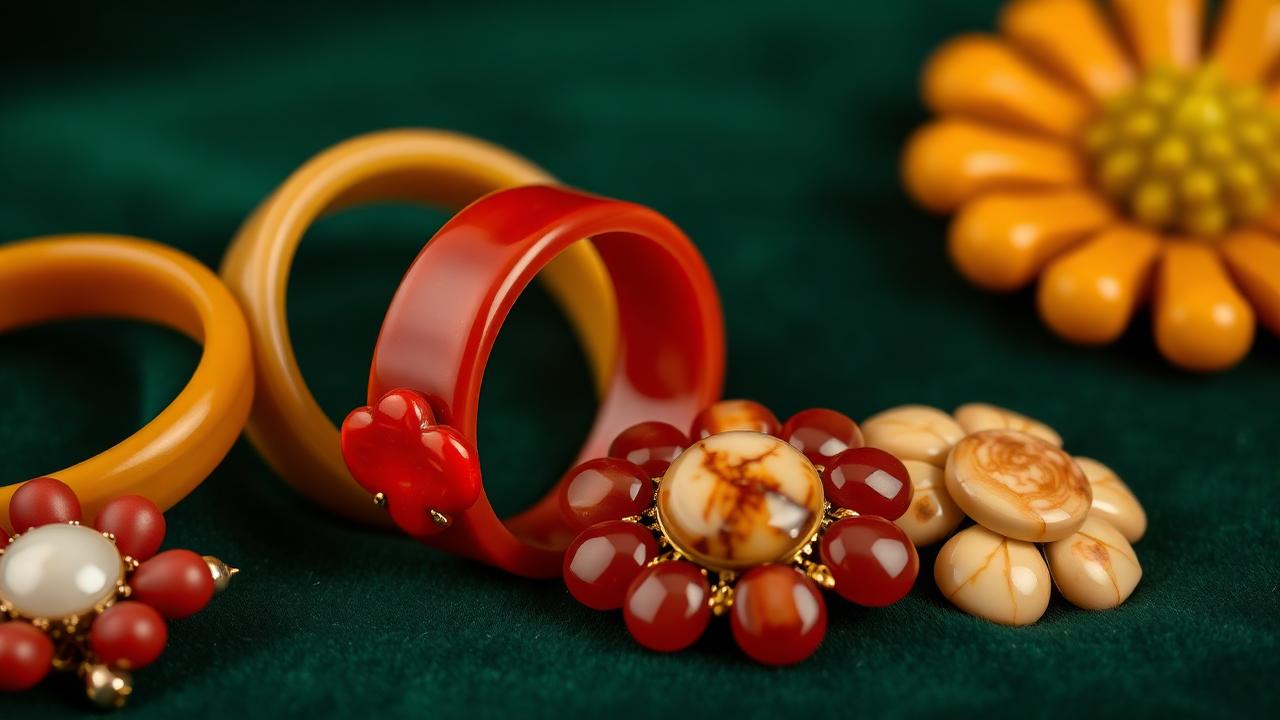
The rub test — gently
Collectors use a rub-and-sniff test to confirm bakelite: rub your thumb vigorously over an inconspicuous spot until you feel warmth, then sniff the spot. Bakelite emits a characteristic phenolic smell (associations: old bakelite telephone, formaldehyde). Celluloid gives off a faint camphor scent. Galalith produces a smell reminiscent of burnt milk or horn.
Important note: do this with caution. On old or cracked pieces, rubbing can damage the surface or cause discolouration. Avoid the test on high-value collector's pieces and on items with enamel, paint, or gold-coloured coating. If you want to be sure without risk: have a specialist perform a non-destructive check.
Other tests (in hot water, with Simichrome polishing paste) circulate in collector circles. They work, but each has its risks. In this article, we stick to the safest variant.
Why bakelite has its own collector's market
Bakelite jewellery from the interwar period — particularly American production from the 1930s — forms a vibrant international collector's market. Large, sculpted bracelets ('carved bakelite') with floral or fruit motifs fetch four to five figures in the specialist market; good brooches and necklaces are in the hundreds. The reason is a combination of historical significance (first synthetic plastic), aesthetic power (deep colours, sculptural potential), and scarcity of quality pieces.
This market overlaps with the broader costume-jewellery-collecting market and with specific designers who worked with bakelite. For the Dutch public, this segment is relatively underexposed — meaning pieces from Dutch estates are sometimes purchased below market value.
Condition and treatment
Bakelite and related plastics are more fragile than they seem. Avoid high temperatures (hot water, heating radiators, car dashboards in summer) — the resin can warp or crack. Avoid solvents (acetone, strong cleaning agents) — they attack the surface. For cleaning, a lightly damp soft cloth is usually sufficient; for dull pieces, a specialist polishing paste can restore the shine without removing material.
Cracks and hairline fractures are often irreparable. Restoration is limited to careful surface work; larger repairs by gluing or filling are visible and reduce collector value. For purchase: always check against daylight for fine hairline cracks around openings (e.g., around the bracelet opening).