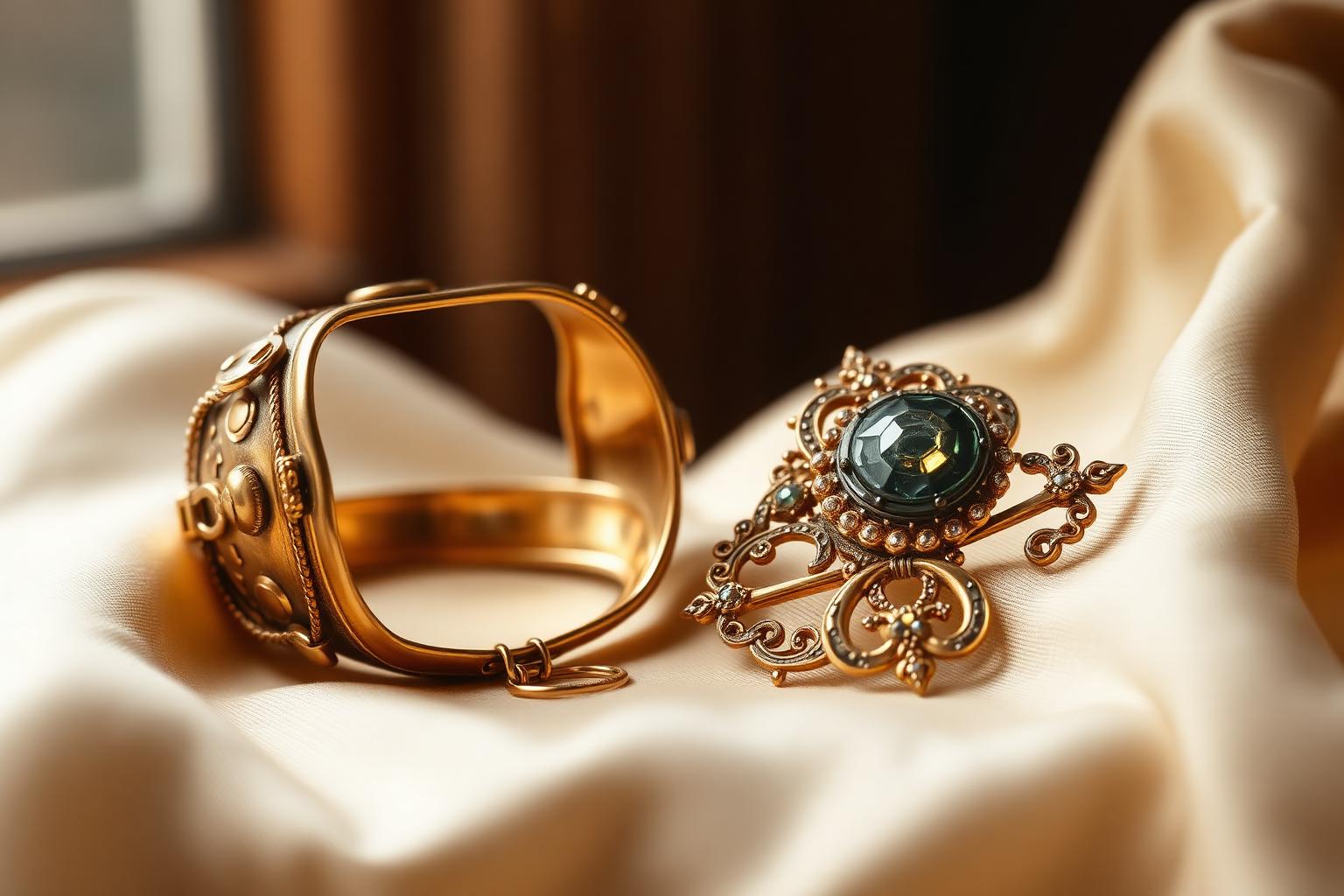
Brooches — C-clasp, trombone and safety clasp
The C-clasp is the oldest and simplest brooch clasp: an open C-shaped hook without a lock. The pin slides underneath and stays in place due to the spring tension of the pin itself. C-clasps are almost universal on brooches from before 1890. They are fragile — one unfortunate movement and the pin comes loose — which explains why many old brooches were later repaired with a modern safety clasp. If you see a C-clasp on an 'Edwardian' piece, that is a strong positive dating sign towards the nineteenth century or earlier.
The trombone clasp is a cylinder with a sliding mechanism: a small round sleeve in which a pin slides back and forth. The pin closes by sliding in and twisting. The trombone was developed around 1895 in Parisian workshops, quickly spread across Western Europe, and was used until approximately 1925 on Edwardian and early art deco work. An original trombone is one of the strongest dating indicators you have — the mechanism is too specific to accidentally link to the wrong period.
The modern safety clasp (roll-over safety catch) is a small round hook that rotates over and locks the tip of the pin. It appeared around 1910 and became standard after 1920. If you see a roll-over safety on a 'Victorian' brooch, it was almost certainly added later, or the jewel itself is later than the seller claims.
The pin itself is a second clue. Early pins are thick, longer than the brooch itself, and manually filed at the tip — you can see fine diagonal scratches. Modern replacement pins are slimmer, exactly the same length as the brooch, and machine polished without scratches.
The C-clasp is the oldest and simplest brooch clasp: an open C-shaped hook without a lock.
Trombone and roll-over safety in detail
The trombone clasp is usually on the left side of the brooch and has a small button on the side that allows the pin to slide out. The pin inserts into a hole or ring on the right side. On Edwardian brooches, the trombone is often elegantly finished with a small round escutcheon; on art deco brooches, it is sleeker and more geometric.
Roll-over safety catch
The roll-over safety catch is a small round hook that pivots over a pin. When closed, it lies flat against the brooch; when open, it stands up at approximately 45 degrees. Early safety clasps (1910 to 1930) are slightly more angular; later post-war ones are perfectly round and machine-made.
Earrings — screw, clip and post
Before 1900, pierced ears were considered common in the Netherlands; most Victorian earrings have long wire hangers (shepherd hooks) or fixed hooks without a mechanical clasp. Around 1900, the screwback appeared in the United States for unpierced ears: a screw pin that you tighten against the earlobe. Screwbacks remained popular until the 1930s and appear on Edwardian, art nouveau, and early art deco work.
The clip-on with a spring lever was patented around 1934 and spread rapidly — from the mid-1930s into the 1960s, the clip was the dominant clasp for finer earrings. Early clips are somewhat angular and visible; later clips (1950s and 1960s) are sleeker and better concealed. If you see a clip on an 'art nouveau' earring from around 1900, that clasp was added later.
Only after approximately 1960 did ear piercing become mainstream again, and posts with butterfly backings appeared. An 'antique' earring with a modern post is either re-converted or a reproduction. Truly old earrings either have a thick wire hanger, a screwback, or the hole for an original wire hanger — never a modern post.
Clip and post
The clip-on is identifiable by the hinged lever on the back, which you open and then clamp over the earlobe. The post is a straight pin with a butterfly back around it — modern and almost always post-war.
Necklaces — hook clasp, barrel, spring ring, box clasp
The hook clasp (S-hook or Greek hook) is the oldest chain clasp: an S-shaped hook that latches into a ring at the other end. It appears from antiquity to the nineteenth century. On early nineteenth-century work, the hook is often large and hand-forged; on finer work, it is smaller and elegantly finished.
The barrel clasp (or bolus) is a threaded cylinder that you unscrew into two halves. Barrel clasps are mainly found on nineteenth-century gold chains and on pearl necklaces — the screw mechanism closes without play and does not damage the knots between the pearls. Bohemian garnet work often uses a variant with a small silver cylinder.
The spring ring — a round ring with a spring-loaded opening — was developed around 1900 and became widespread from the 1910s. It is standard on Edwardian, art deco, and 1950s work. Early spring rings are small and handmade with visible solder marks; later ones are machine-made and larger.
The box clasp is a rectangular or round box with a spring tab on one side and a clamping tongue on the other. You click the tongue into the box and press the tab to release it. Box clasps appear from around 1880 and are dominant on finer twentieth-century necklaces, especially on multi-strand pearl necklaces. A good box clasp has a safety chain next to it as a second lock.
The lobster clasp — an elongated hook with a spring lever — only became popular after World War II. Anything that has one is either modern or later repaired. The lobster clasp does not appear on truly vintage work.
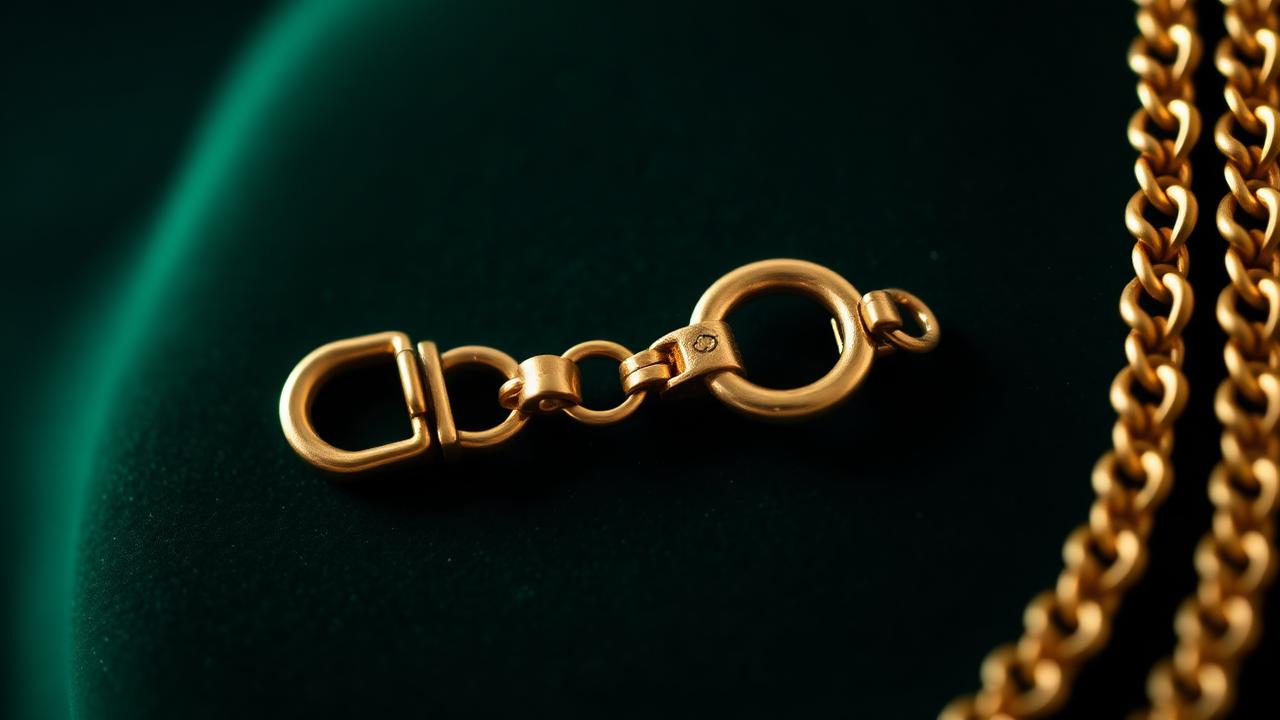
Barrel, spring ring and box clasp
The barrel clasp is a cylindrical screw clasp, usually 6 to 10 mm long. The spring ring is a small round ring with a small pin that you push aside to open. The box clasp is the most luxurious — often decorated with stones or engraving, which makes it clear that it is original work.
Spring ring and box clasp in detail
A spring ring on a vintage necklace often has a separate small gold or silver jump ring through which it hooks. A box clasp always has a safety chain on one side as a second lock — when it is missing, it was once there and removed.
Box clasp in detail
The box clasp on a pearl necklace is a dating indicator in itself. Early box clasps (before 1920) are small and plain; art deco box clasps are sleek and geometric with faceted edges or small pavé settings; 1950s and 1960s box clasps are larger and more elaborate, often with a central stone.
Bracelets — hinge work and safety chain
Vintage bracelets come in two main categories: hinged bangles and flexible link bracelets. Hinged bracelets have a small hinge on one side and a clasp on the other. On nineteenth-century work, the hinge is handmade with a visible pin that you can push out with a pointed tool; on post-war work, the hinge is machine-made and invisible.
Every good vintage piece has a safety chain: a thin chain between both halves of the clasp that prevents the jewel from falling if the main clasp accidentally opens. A bracelet without a safety chain in a place where it clearly used to be (visible solder residue) is either later damaged or repaired without restoration.
Link bracelets usually use a box clasp or a concealed barrel clasp. Heavier pieces sometimes have a slide clasp with a safety pin.
Construction as evidence — handmade versus cast
Handmade construction is recognisable by irregularities: slightly uneven setting claws, visible file marks on the underside, warm-yellow solder lines that sometimes deviate slightly from the surrounding gold colour, and asymmetrical decoration. For Victorian, Edwardian, and art deco work, these irregularities are not a defect — they are the mark of quality that proves the piece was made by human hands in a period when everything was handcrafted.
Modern machine construction (dominant from approximately 1960 onwards) is perfectly smooth, with almost invisible seams. CAD-made reproductions (from approximately 2005 onwards) are perfectly symmetrical — each setting exactly identical, each facet exactly parallel — which betrays them against period work.
Solder seams are the signature of handmade work. Every link, every attachment, every piece of appliqué is connected with solder. On old work, you see the seams as thin lines of slightly different gold (solder gold is usually a little softer and a little more yellow). On modern cast work, there are no seams — the piece is cast in one go.
Hollow versus solid bands: nineteenth-century gold bracelets and link chains are often hollow (made from thin rolled gold to save weight); this is not a defect and not less valuable — it is a period-typical technique. If you feel with your fingernail that a link bends under light pressure, it is hollow. Solid links of comparable thickness are heavier and stiffer.
Note — replaced clasps
A later replaced clasp does not make a piece inauthentic. Clasps are functional components; they wear, they break, they were replaced more often than anything else on a piece of jewellery. A carefully replaced clasp is better than a broken original — the rest of the piece remains from the original maker and period after all.
It does, however, change the valuation. For average vintage pieces, a well-replaced clasp hardly depreciates value — only a few per cent. For showpieces and signed work (Cartier, Van Cleef, signed Dutch silver), originality counts more heavily, and a replaced clasp can cost ten to twenty per cent of the value. For museum-quality work, originality is almost absolute: a later replaced clasp can sometimes halve the auction price.
What to look for: a goldsmith with vintage experience who works with solder gold of the same karat and who does not touch the original hallmarks. Ask for photos of the process beforehand. Poor repairs with incorrect karat solder will permanently damage the metal and will be visible later in appraisals.
If you see on a brooch both a modern safety clasp and a modern pin and modern solder marks next to old decoration, then it is a married piece: a jewel composed of parts from different pieces. The form is old, the construction partly new — this is a grey area in which appraisers become more cautious.
Why this guide reappears on other pages
Clasps are briefly discussed on almost every price and value guide. From those guides, the author links to THIS page for the complete dating route. Anyone reading 'trombone clasp indicates 1895-1925' on a price guide will come here for the broader context and the other clasp mechanisms used during the same period. For clasp-specific bandwidths per jewellery type: vintage earring value guide (screw, clip, post), vintage necklace value guide (hook, barrel, spring ring, box clasp) and vintage bracelet value guide (hinge, safety chain). For the next step: dating cuts and recognising reproductions.