The four fixed components of a British hallmark
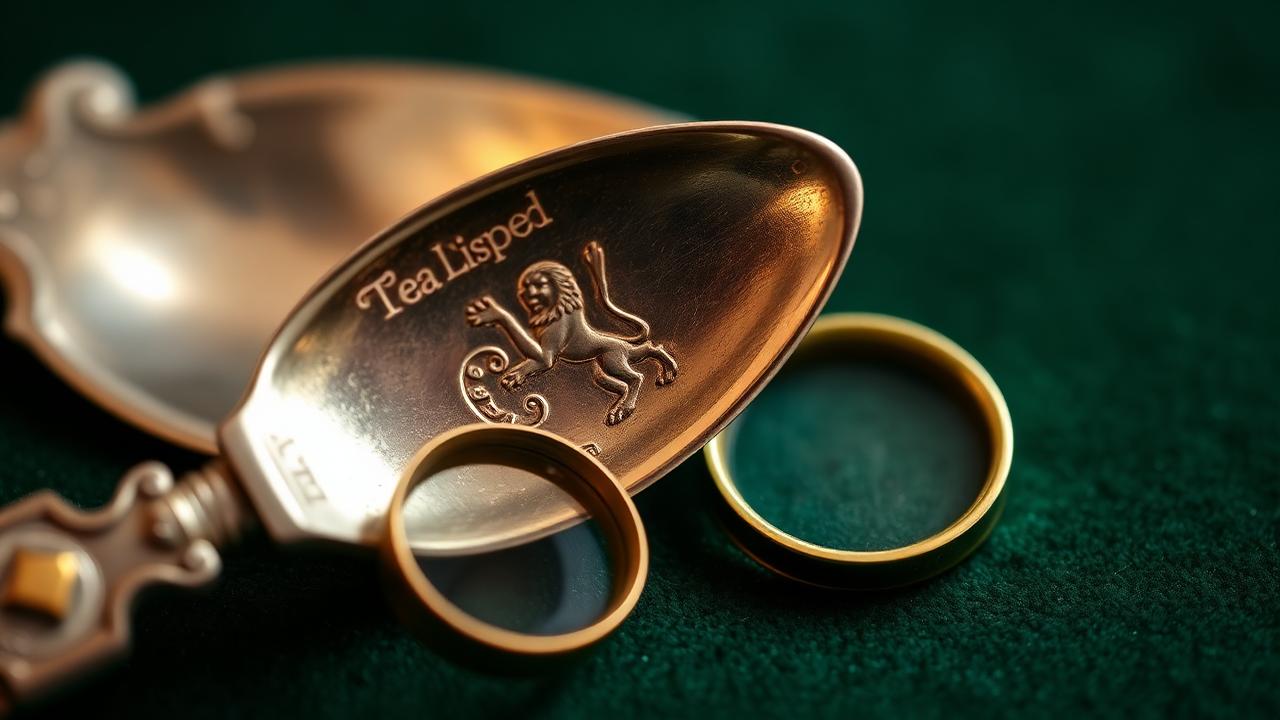
A complete British hallmark consists of four marks that are almost always adjacent to each other. The fineness mark indicates the purity of the metal — for silver, the lion passant (sterling, 925), for gold, a number in thousandths (375 for 9ct, 585 for 14ct, 750 for 18ct, 916 for 22ct). The assay office mark indicates the city where the piece was assayed: the leopard's head represents London, the anchor for Birmingham, and the castle for Edinburgh. Sheffield used a crown as an assay mark until 1975, and only after that the Tudor rose that the office uses today — so on vintage British silverwork, the crown is the mark you will practically encounter. The date letter is a single letter within a shield, the shape of which varies per office. Finally, the sponsor's mark is the registration of the maker or workshop — a set of initials in a small cartouche.
These four marks do not have to be in a fixed order, but they are always present together on work that has been officially assayed. If a mark is missing, the piece was either made below the legal weight threshold or repaired later without re-assaying.
A complete British hallmark consists of four marks that are almost always adjacent to each other.
Dating with the date letter: use the official registers
The date letter is the most powerful dating tool in the British system. Each assay office has its own cycle, where a typeface and the outline of the shield change after each cycle (usually 25 years). An A in a Georgian shield means something different than an A in a sans-serif letter in a modern cartouche.
The official registers of the four current assay offices (London, Birmingham, Sheffield, and Edinburgh) publish the complete date letter tables. These registers are the only reliable source: use them and never invent a date yourself based on a letter alone. This guide does not include tables — the assay offices do that better and keep their own data up-to-date.
Typically British purities: 9ct gold and 22ct
Where the continent largely works with 585 and 750, Great Britain has two of its own purities that you will find on almost every piece. 9ct gold (375) is the traditional entry-level quality — historically the best-selling gold wedding ring in the United Kingdom, recognisable by a slightly warmer and softer surface than 14ct. 22ct gold (916) appears primarily on older British wedding rings and on goldwork from the colonial period; it is remarkably soft and has the deeper, reddish glow of a high gold purity.
If you encounter a British piece without a fineness number but with the mark of an assay office plus the lion passant, it is sterling silver — the lion is the fineness mark itself and does not need to be combined with 925.
Chester and Glasgow: closed offices on antique work
In addition to the four current assay offices, offices also existed in Chester and Glasgow until the twentieth century. Chester closed in 1962, Glasgow in 1964. On late-Victorian, Edwardian, and art nouveau British work, you will regularly encounter their marks — Chester used three wheat sheaves (a variation on the city's coat of arms), Glasgow with a small shield depicting a tree, fish, and bell. Both are good indicators for work from those specific regions, and valuable information for collectors of British provincial pieces.
Optional additional marks: duty marks and commemorative marks
Between 1784 and 1890, a duty mark was struck on British work — the profile head of the reigning monarch, which showed that tax had been paid. These marks date a piece within that period of over a century and help to make a general placement within the reign of the monarch concerned; they do not date to the year. For exact years, the date letter remains leading. Commemorative marks (coronation, jubilee, platinum jubilee) are different: they are never mandatory, but when present, they do date the piece exactly to that specific jubilee year.