Four marks that together form the hallmark
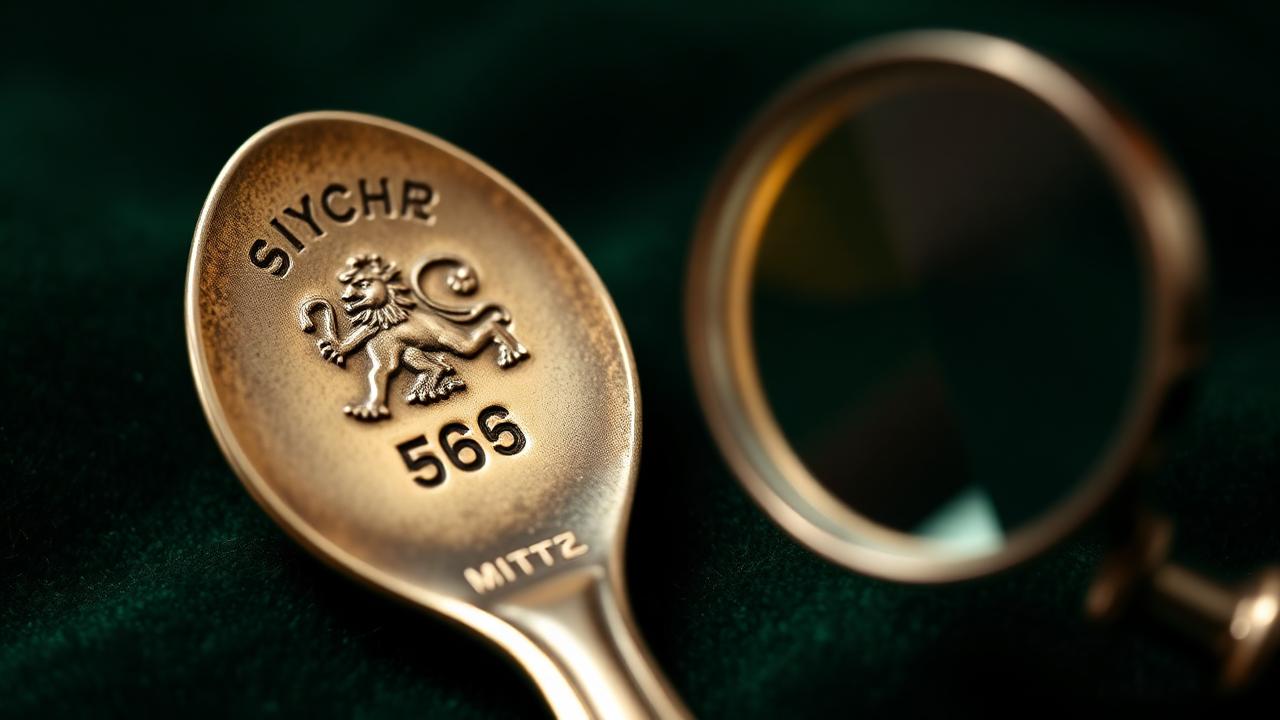
Since 1814, a complete Dutch grand hallmark consists of four marks that are almost always adjacent. The fineness mark for silver is a <strong>standing lion</strong> for first fineness and a <strong>walking lion</strong> for second fineness; for gold, separate marks apply (traditionally swords, since 1953 a fineness number). The <strong>Minerva head</strong> is the assay office mark: the letter in the helmet identifies the office (e.g., K for Gouda). The <strong>date letter</strong> is a single letter in a shield that indicates the calendar year of hallmarking; the cycle runs through the alphabet and is maintained by the hallmarking institutions. Finally, the <strong>maker's mark</strong> (sponsor's mark) is the administrative registration of the maker or importer — usually a set of initials or a symbol in a small square or oval. Small silver work too light for the full set instead bears the <strong>sword mark</strong> as a small-work mark.
Anyone who sees these four marks together on a jewel thus knows within seconds: what metal and fineness, which maker, which year, and which office. This is considerably more information than most owners ever extracted from their jewel — and the basis for any serious determination.
Since 1814, a complete Dutch grand hallmark consists of four marks that are almost always adjacent.
Older Dutch hallmarks versus the current system
The fineness mark for silver — the standing or walking lion — has existed since 1814, but the notation below it was adjusted in 1953. Until 1953, an Arabic numeral (1 or 2) appeared below the lion, and the finenesses were <strong>934</strong> (first, standing lion with 1) and <strong>833</strong> (second, walking lion with 2). From 1953, this numeral was replaced by a Roman <strong>I or II</strong>, and the finenesses became <strong>925</strong> (sterling, first) and <strong>835</strong> (second). This difference — Arabic vs. Roman numeral below the lion — immediately provides a useful dating point: before or after 1953. For gold, before 1953, the figurative sword mark in a shield (14 carat) or crossed swords (18 carat) applied; from 1953, this was replaced by the fineness in thousandths (585 and 750).
If you encounter both an old figurative mark and a modern fineness number on one piece, this is almost always the result of a later intervention — a repair, a remounting, or a resizing — where the new component was re-submitted and hallmarked.
The legal weight threshold: why small work may be unhallmarked
The Dutch Hallmarking Act stipulates a lower limit below which hallmarking is not mandatory. Historically, this was one gram for gold and four grams for silver. Fine wirework, thin chains, light stud earrings, and small brooches fell below this limit and were never brought to the assay office. They are technically unstamped and legally entirely permissible for trade.
For some categories — early nineteenth-century work, fine filigree, Bohemian garnet — the lack of a stamp is more the rule than the exception. Never immediately conclude that an unstamped piece is false; the weight threshold is a common explanation.
Import hallmarks and double stamp sets
Jewellery imported into the Netherlands from abroad and destined for trade here receives an import mark at the hallmarking institution. This mark appears alongside the original foreign hallmark of the piece. Two sets of stamps on one jewel — a French eagle's head plus a Dutch import mark, for example — are therefore not a sign of forgery, but rather proof of correct export and import administration.
What to do in case of doubt: the designated hallmarking institutions
The Netherlands has two government-appointed hallmarking institutions that can hallmark individual pieces. WaarborgHolland in Gouda and Edelmetaal Waarborg Nederland are both authorised to perform fineness determinations and apply official hallmarks. For doubtful cases — a worn mark, a missing hallmark on a heavier piece, a suspicious fineness number — hallmarking by one of these two is the most reliable path to certainty. Both institutions publish information about fees, delivery, and turnaround times on their websites.
Three practical examples of marks
The following three examples are <strong>fictional but realistic case studies</strong> — this is how an experienced reader interprets a mark presented. Work in the same order: what do I literally see, what can I conclude based on what is visible, what can I not yet conclude, and what is the next step.
Case one — a ring with only '585'
On the inside of a plain ring, there is only one mark: the number 585. No sponsor's mark, no date letter, no assay office mark. What you can conclude: the metal is 14 carat gold (58.5 percent) and the piece almost certainly dates from after 1953, when the thousandths notation was introduced. What you cannot yet conclude: who the maker is, in which country it was hallmarked, and in exactly which decade. 585 is an international fineness number and is found in the Netherlands, Germany, the United States, and many other countries.
A ring with only a fineness number without the other three marks may have fallen below the weight threshold (plausible for a thin ring), may have come from outside the Netherlands and entered without an import hallmark, or may have been re-polished, removing the other marks. Next step: have the piece assessed by one of the two hallmarking institutions if you want certainty about the metal — XRF measurement is inexpensive and non-destructive. Such a measurement does not help with dating; that requires additional style research.
Case two — a necklace with a full Dutch hallmark
On the box clasp of a gold necklace, four marks are neatly placed next to each other: '750' in a shield, a Minerva head, a letter 'K' in a small shield, and a set of initials 'JvB' in a small square. What you can conclude: this is 18 carat gold, hallmarked by a Dutch assay office, and the maker is registered under the initials JvB. The date letter K is placed in WaarborgHolland's cycle — a legible year that you can trace back to the calendar year with a single search on their website.
What you cannot yet conclude: whether this is a piece from a small Dutch workshop or from a large firm; and whether the piece is in its original state or was later restored. Next step: look up the sponsor's mark JvB in WaarborgHolland's maker-register (publicly accessible for recent registrations; older work requires archival research). Additionally, examine the clasp and construction: do they match the dated date letter, or is there a discrepancy of decades?
Case three — an inherited piece with a worn foreign hallmark
A gold pendant from an estate has a semi-illegible hallmark on its edge: something resembling an eagle's head, next to a set of initials in a rhomboid frame. The fineness number is illegible due to wear. What you can conclude: the eagle's head points towards France (the fineness mark for 18 carat gold since 1838), and the rhomboid shape of the sponsor's mark fits French conventions. The piece is therefore almost certainly French and hallmarked after 1838.
What you cannot yet conclude: the exact fineness, the maker, or the decade of hallmarking. Worn work often leaves only the silhouettes of marks, while finer lines (date letters, maker's mark details) have disappeared. Next step: have an import hallmark added in the Netherlands if you want to sell it — then a second, fresh set of marks will appear next to the original French hallmark. For maker determination itself: a specialist appraiser with French archival work or one of the Dutch appraisers who work with the French Musée de la Poinçon registers. Avoid suspicious quick conclusions — the worn eagle's head is not proof, only a strong indication.