The Animal Heads: Gold, Platinum, and Silver
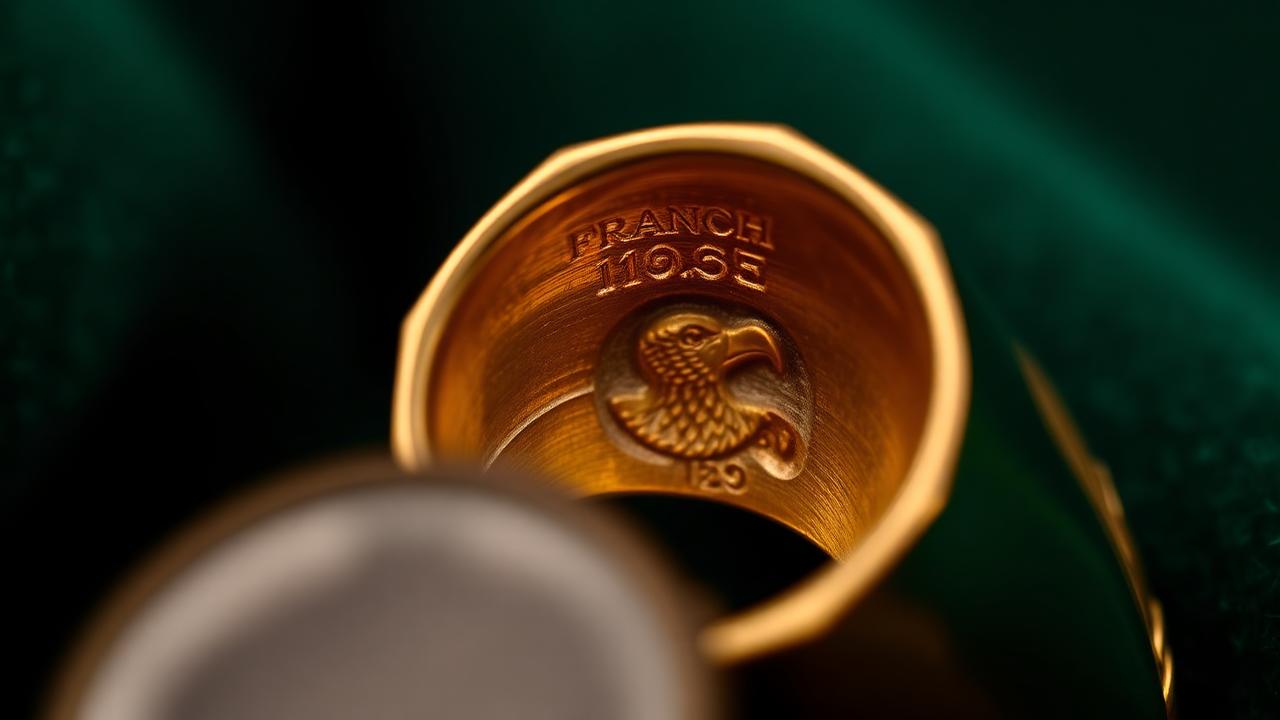
The most famous French mark is the tête d'aigle – the eagle's head, introduced in 1838 as a fineness mark for 18-carat gold from the Assay Office in Paris. For work from the departments (the provinces outside Paris), a different variant for 18-carat applied during the same period: the horse's head (tête de cheval), in use until 1919. The eagle's head and horse's head therefore represent the same fineness but belong to different jurisdictions. For the smallest components (links of a chain, earrings), a small animal head – the ant, for example – sometimes appeared as a condensed fineness mark.
Silver received the Minerva head from 1838 onwards, recognisable by the helmeted goddess in profile. For small pieces, a ferret was used instead. For platinum, France introduced its own fineness mark in 1912: the dog's head (tête de chien) as a domestic hallmark. The mercury head is also the export mark, and the swan is the mark used for work whose origin or fineness is not certain – often foreign work traded via France. The choice of animals and mythological figures makes French work immediately visually recognisable, even without a loupe.
The most famous French mark is the tête d'aigle – the eagle's head, introduced in 1838 as a fineness mark for 18-carat gold from the Assay Office in Paris.
Why French stamps are so small and hidden
French workshops have traditionally preferred extremely small stamps in inconspicuous places. On rings, the hallmark is often on the inside against the shank; on brooches, on the reverse side under a pin-mount; on necklaces, on a single link or on the clasp. The reason is partly aesthetic (French jewellery craftsmanship values an intact surface) and partly practical (the stamps are small to displace little material).
Anyone who encounters a French piece and sees no hallmark on first inspection should therefore systematically continue their search: under a loupe, with side lighting, on all clasps, on the inside of every ring, against every pin. In almost all cases, there *is* a hallmark, just not where you would immediately expect it.
No Date Letter: Dating via Style and Maker's Mark
Unlike the Netherlands and the United Kingdom, the French system does not have a continuous date letter. Dating French work, therefore, follows two other tracks. The style of the jewel – the design language, the types of stones used, the cut of any diamonds – provides a period estimate of approximately a decade. The poinçon de maître, the maker's mark of the goldsmith or workshop, refines that dating.
French maker's marks for gold are always in a lozenge (losange) and for silver in an oval. Within that frame are the maker's initials plus often a small symbol: a star, a cloverleaf, a crescent moon. Anyone who can link the maker's mark to a registered maker (via public registers in French antique shops) can establish both dating and provenance.
Reading a poinçon de maître
A French maker's mark consists of three parts: the frame (lozenge for gold, oval for silver), the initials (usually two letters), and a distinguishing symbol. The symbol is essential – different workshops used the same initials, and the symbol distinguishes them. An LC with a star is a different maker than an LC with a cloverleaf.
For major names (Cartier, Boucheron, Van Cleef & Arpels), the marks are well-documented. For lesser-known workshops, the search is more difficult; specialist publications and museum collection databases are then the designated sources. Never invent a maker based on initials alone – that is one of the most common determination errors.