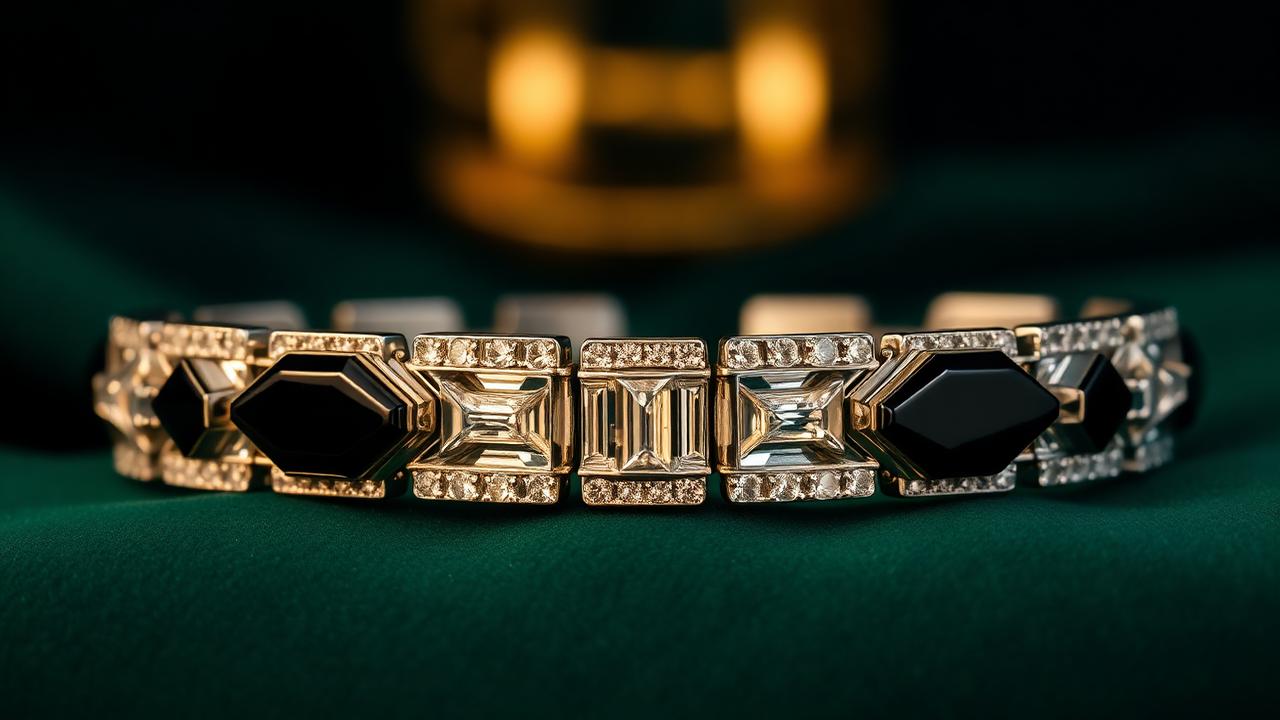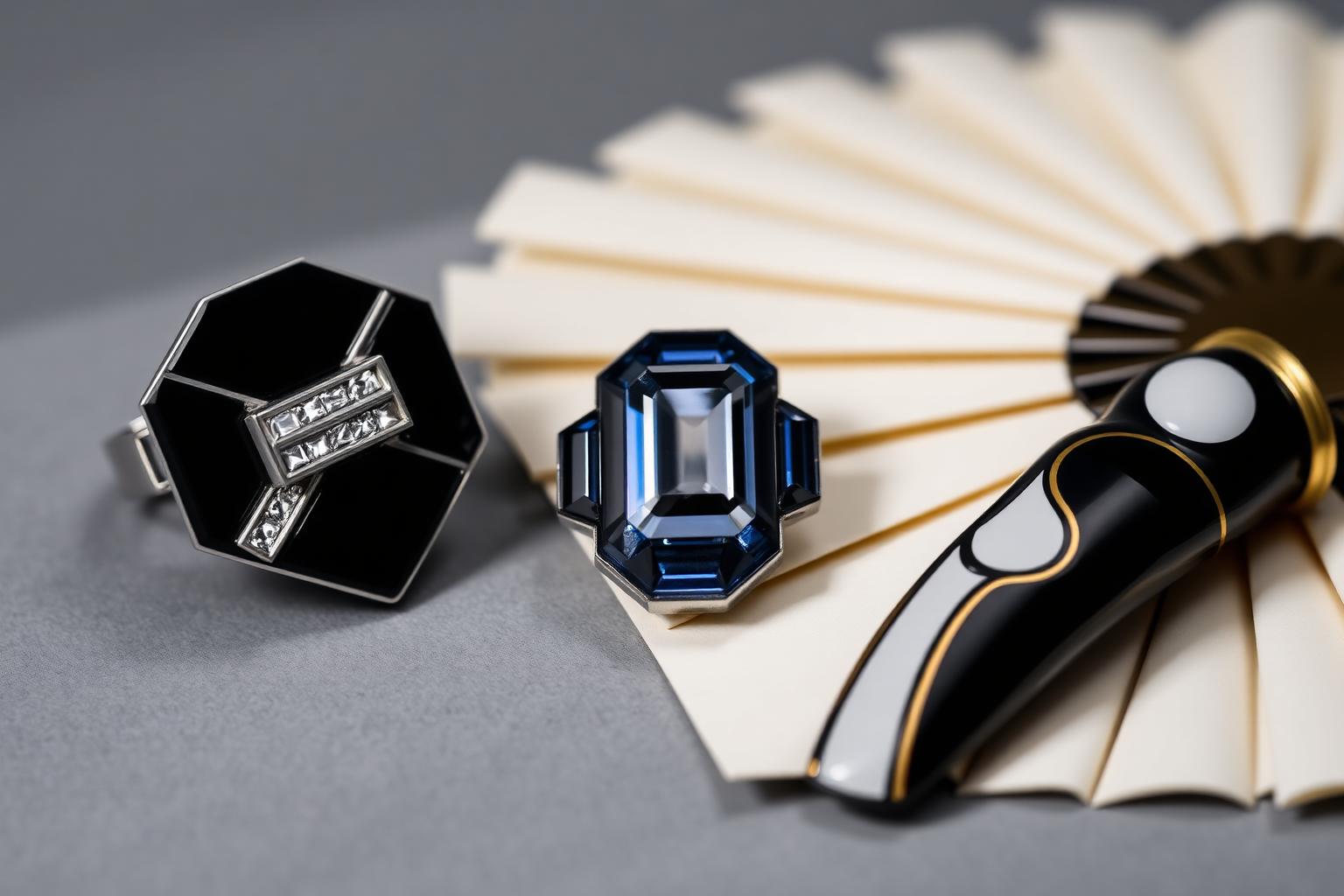
New York, 1926. A woman enters the Waldorf-Astoria, throws her fur stole over the railing, and removes long black gloves. On her wrists: two wide platinum bracelets with baguette diamonds and calibré-cut onyx. On her ears: geometric pendeloques falling to her shoulders. In her hand a cigarette holder, also with onyx. She orders a dry martini. The pianist plays Gershwin. This is the moment when art deco is no longer a style, but a way of life.
The official birth of art deco is 1925, the Parisian Exposition Internationale des Arts Décoratifs et Industriels Modernes — where the style name originates. But the prelude begins around 1920, and the afterglow continues until 1935. Fifteen years in which the art of jewellery for the first time moved with modernity: faster, sleeker, more colourful, bolder.
The world in which this emerged
After the First World War, the generation that survived turned everything upside down. Women cut their hair short, wore knee-length dresses, smoked in public, and danced the Charleston. In Paris, Coco Chanel opened the first boutique in beige jersey, in New York the stock exchange set new records every day, in Berlin the Kabarett was at its peak. It was the era of jazz, ocean liners, streamlined trains, art-deco cinemas, and the art-deco apartment.
Egypt was fully involved. In 1922, Howard Carter opened Tutankhamun's tomb, and Egyptomania swept the world. Scarabs, pyramids, lotus flowers, and hieroglyphic motifs appeared on every lapel and earring — at Cartier, Van Cleef & Arpels, Lacloche.
The Far East equally so. Chinese and Japanese influences arrived via the colonies: jade in flat tablets, coral in polished blocks, black lacquer. Cartier's 'Tutti Frutti' style (engraved emeralds, rubies, and sapphires in an Indian style) belongs to the same movement.
After the First World War, the generation that survived turned everything upside down.
How to recognise it
Platinum is the precious metal of the period. From 1930, white gold began to emerge as a cheaper alternative, but true art deco from the core years (1920–1929) is almost without exception made of platinum. Yellow gold often appears in combination: a gold bracelet with a platinum central element, for example.
Cuts tell the decade. Old brilliant and old European cut dominate until around 1925, after which baguette and trapezoid cuts appear — rectangular, angular cuts that perfectly match the geometry of the design. Calibré-cut (custom-cut) coloured gemstones — onyx, coral, emerald, ruby — fill the spaces with no millimetre to spare.
Composition is always geometric: chevrons, circles within squares, sunbursts, fans, steps. Symmetry along one or two axes. Where art nouveau flows, art deco stands still in a strict grid.
Platinum is the precious metal of the period.