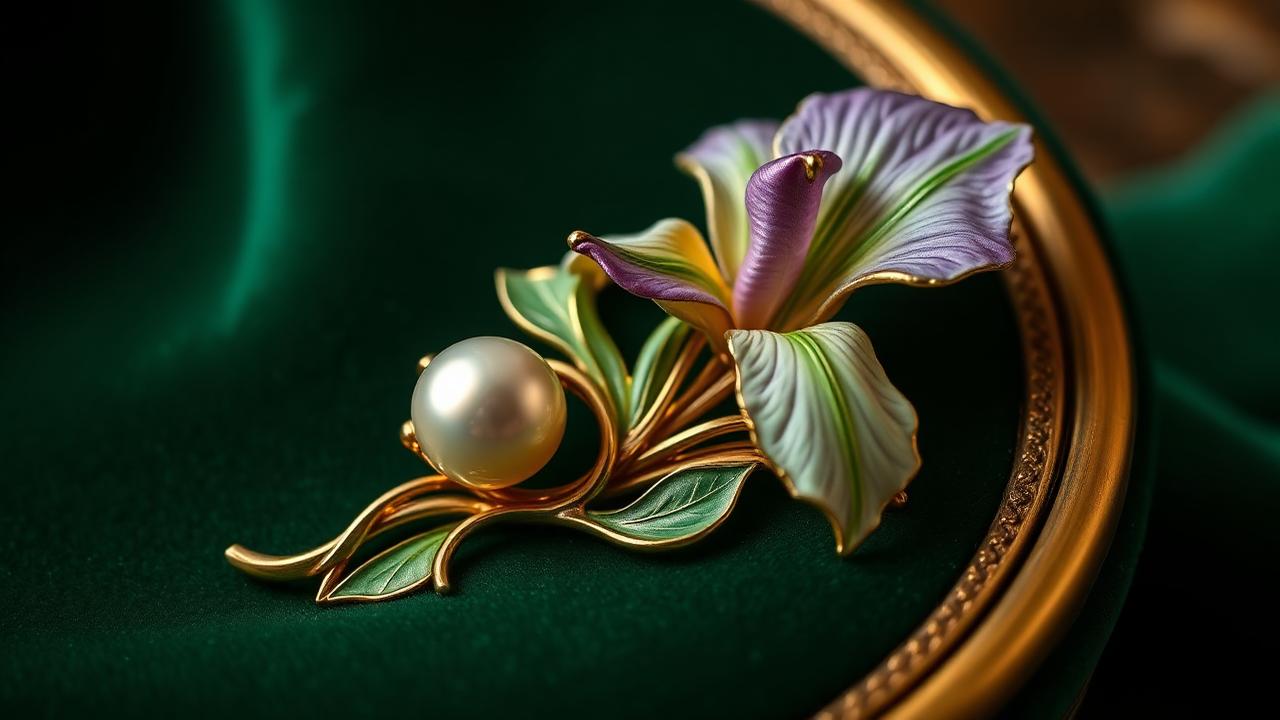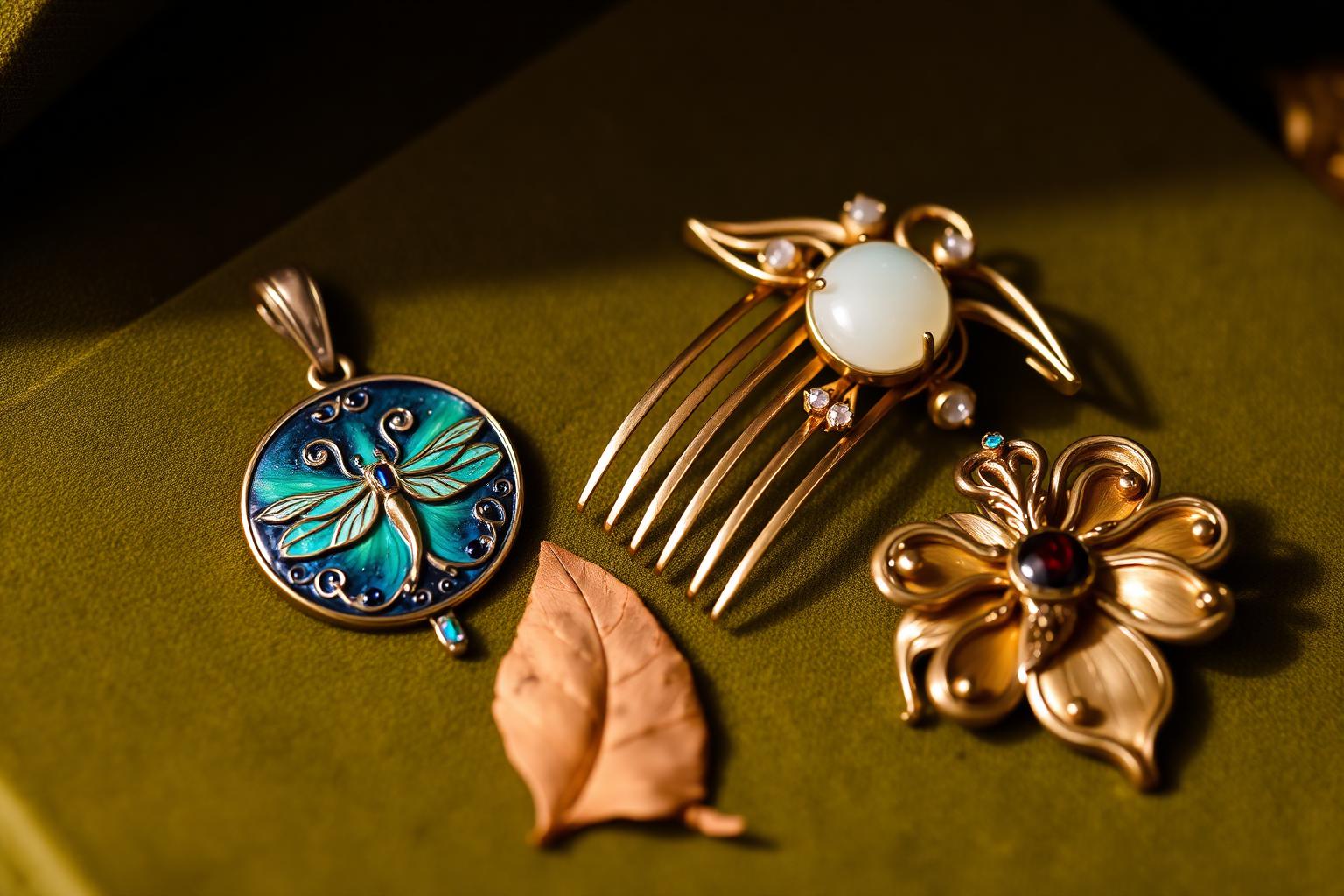
Paris, World's Fair 1900. Visitors queue for one display case: René Lalique's pavilion. Behind the glass lies no jewel in the classical sense, but a small sculptural creature — a dragonfly with a female body, with plique-à-jour enamel wings so thin that light passes right through them. Newspapers write about 'a new art', an art nouveau. For the first time since the Renaissance, a jeweller is an artist, and no one is looking solely at carat weight anymore.
Art nouveau is a short, intense movement. It flourishes from 1890 to about 1910, breaks with everything the nineteenth century had built up in symmetry and weight, and disappears almost as quickly as it appeared. What remains is a handful of masters — Lalique, Vever, Fouquet, Wolfers — and a language that is being re-read today as if it were just invented.
The world in which this emerged
At the end of the nineteenth century, Europe is weary of industry. Factory towns are black with smoke, the bourgeoisie is materially saturated. A generation of artists returns to nature — not as a romantic landscape, but as an organic force. Iris, thistle, ivy, water lily, dragonfly, snake, peacock: everything that grows, twists, and changes becomes the subject of decorative art.
In Paris, the leading jewellers are Lalique and Vever, in Brussels Philippe Wolfers, in Nancy the school around Émile Gallé. They work outside the traditional hierarchy of precious metal and gemstone. For them, a good opal is more valuable than a mediocre diamond, and an enamelled horn-pendant is worth as much as a classic gold piece — because expression leads, not intrinsic value.
Women wear loose-fitting reform clothing, S-line corsets, and the first tailored jackets. They want jewellery that says something, not costs something. Art nouveau precisely serves that desire.
At the end of the nineteenth century, Europe is weary of industry.
How to recognise it
Asymmetry is the rule. Where Victorian and Edwardian strive for mirror images, art nouveau chooses the curved, uneven line — the so-called 'whiplash curve'. A pendant has a left and a right half that clearly differ. A brooch can be heavier on one side than the other.
Materials are unconventional. In addition to gold, the art nouveau jeweller uses ivory, horn, tortoiseshell, polished hardwood, and glass. Enamel in all forms: plique-à-jour (without a backing, translucent like stained glass), basse-taille (over engraved metal), champlevé, guilloché. Opals and moonstones — stones with inner movement — are preferred over diamonds.
Motifs are never purely decorative. A dragonfly represents ephemerality, a peacock represents vain beauty, an iris represents the messenger. Female figures are dreamy, with long hair that merges into waves, tendrils, or flames — a direct quote from the paintings of Alfons Mucha.
Asymmetry is the rule.