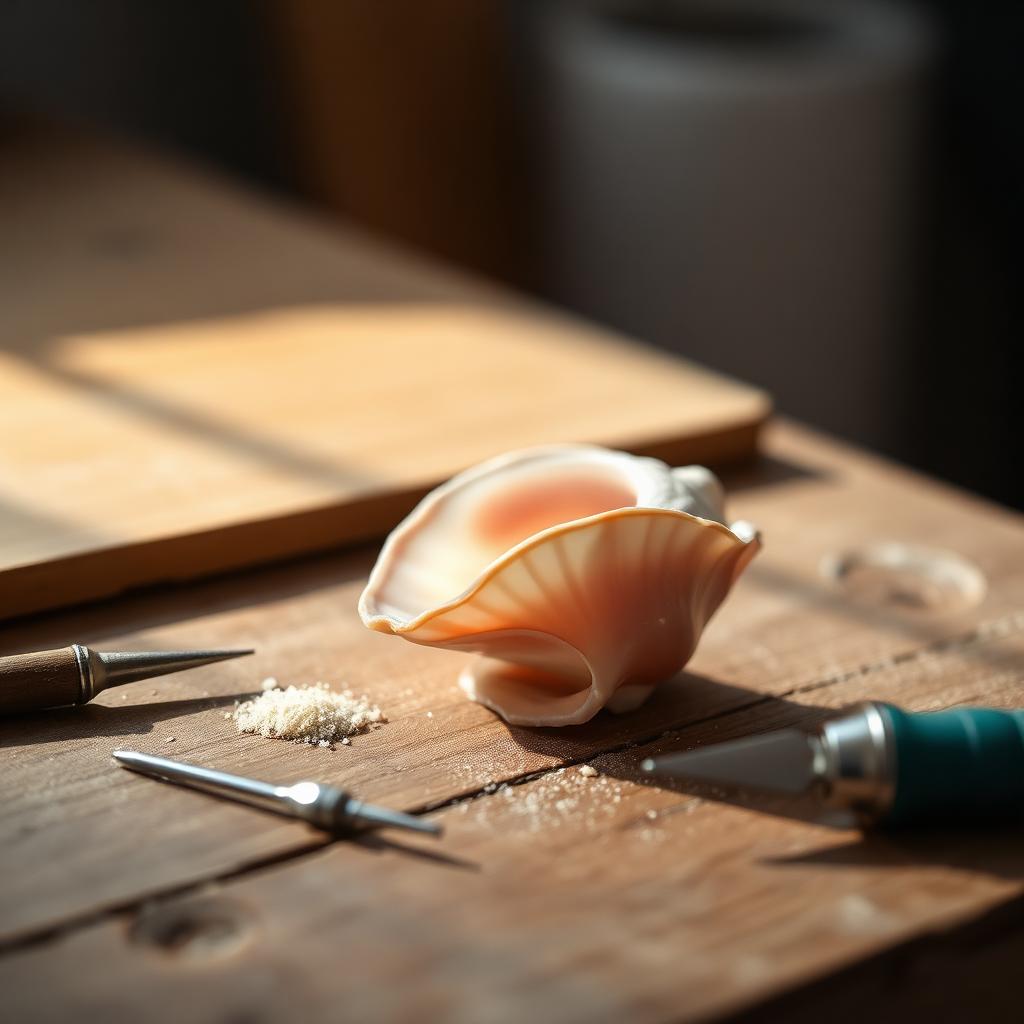
Torre del Greco, at the foot of Vesuvius, mid-nineteenth century. In a half-open workshop, an old man sits with a small rod in front of him, held in a small vice. It's a piece of shell — the thick outer edge of a Cypraea, a cassis, or a strombus, brought in by Caribbean fishermen. With a needle-sharp drill, he carves a woman's profile inch by inch from the brown top layer, until the white inner layer becomes visible. The face slowly rises from the shell, as if it had always been there and only needed to be freed.
For over a century, the world market for cameos was supplied in this way. Torre del Greco was the undisputed centre: Neapolitan traders shipped the shells, carvers carved them, and British and German tourists took them home as souvenirs of their Grand Tour. Anyone who holds a nineteenth-century cameo today almost certainly holds a piece of Southern Italian craftsmanship — and with a bit of luck, the signature of the master who carved it.
Het gezicht rijst langzaam uit de schelp op, alsof het er altijd al in zat en alleen bevrijd moest worden.
The Meaning
Cameos have existed since Greco-Hellenistic antiquity. The earliest are carved from multicoloured hardstones such as sardonyx or agate, where the carver uses the colour layers: the figure light, the background dark. Roman emperors wore rings with cameos of their own profile; medieval popes owned cases full of antique pieces that served as amulets. In those centuries, the cameo was a status symbol: small, precious, and visible to those who knew how to interpret it.
De camee was in die eeuwen een statussymbool: klein, kostbaar, en zichtbaar voor wie het wist te lezen.
It wasn't until around 1800 that the emphasis shifted from hardstone to shell. The reason was economic: shells were cheaper, faster to carve, and lightweight, making them ideal for large brooches and bracelet links. Napoleon III and Empress Eugénie wore them, Victoria bought dozens, and soon the affluent bourgeoisie and the broad tourist market followed. What was once an aristocratic object became the flower on the blouse of the bourgeois lady on Sunday.
Important to know: cameo means relief rising from the background, where the figure protrudes. The opposite is called intaglio — a figure carved into the stone, thus sunken. Intaglios were used as seals: pressed into warm wax, they left a relief impression. Cameos were decorative, intaglios functional. When examining an antique piece, it's wise to first answer this basic question.
Through the Periods
In the early Victorian period, cameos are often made of agate or onyx and mounted in solid yellow gold with thick, decorated borders. The profiles depict classical themes: goddesses, muses, personifications of the seasons. For the context of this mounting style, see the Victorian style guide. Quality varies enormously: good pieces show fine hair work, individual eyelids, and a detailed earlobe; quickly made souvenir pieces have coarse features and a uniformly flat background.
The mid-Victorian years (1855–1880) saw the rise of the shell cameo as a mass product. Brooches become larger, oval, and often depict not one but two or three figures — a mother with child, three graces, an Amazon. Mounts become lighter, in 15 carat or rolled gold, with rope edges and small spheres along the border.
This period also saw the creation of rare lava cameos, carved from solidified Vesuvius lava in shades of beige, grey, and reddish-brown. They are easily recognizable by their matte, porous surface and the muted colour of the figure. Glass cameos also appeared — cast in moulds, thus without the individual carving characteristics of true handwork — and that is the quickest distinction when in doubt: a cast cameo always has a slightly convex, glassy structure on the back.
In the art nouveau (1890–1910), the cameo experienced a brief artistic revival. Carver-artists such as Georges Lemarchand carved women's profiles with flowing hair and flowers — the classical profile was replaced by a more sensual, dreamy figure. See the art nouveau style guide for the spirit of the time in which this occurred. After 1920, the market split into two tracks that still exist side-by-side today: industrially cast mass-produced items in resin and plastic (sometimes hardly distinguishable from carved work at a distance, but immediately recognizable under a loupe by the absence of chisel marks), and continuously hand-carved shell cameos that are still made today in Torre del Greco near Naples by carvers in family traditions. A signed or workshop-marked piece from that Neapolitan tradition is still a living craft object, not an antique that disappeared.
How to Recognise an Original
The first test is light. Hold a shell cameo against a strong light source: if it's thin, you'll see the light shine through the background as a warm orange-pink glow. That's unmistakably organic material. A cast resin cameo completely blocks the light or lets it through in a dull, even glow without veins or irregularities. A stone cameo (agate, onyx) lets no light through at all.
The second test is temperature. Briefly place the cameo against your cheek: resin immediately feels warm and 'plastic', shell and stone remain noticeably cool and warm up slowly. This may sound unscientific but is one of the first reflexes for experienced dealers when in doubt.
Then look at the carving details under a ten-power loupe. In handwork, you'll see irregular lines along the eyebrow, small imperfections in the bridge of the nose, and a slightly asymmetrical earlobe. In cast cameos, these details are graphically identical left and right, and you often see a thin casting seam along the side of the figure. Also important: the profile of the nose dates it. Straight, classical noses indicate the early nineteenth century; slightly larger, more romantically drawn noses indicate mid-Victorian; small, upturned noses indicate the late Belle Époque.
For brooches, pay attention to the clasp on the back. A simple C-clasp without a safety mechanism indicates pre-1900. A pin clasp with a spring lock ('safety catch') is almost always twentieth-century — although it could be a later repair. For clasp types, also see the knowledge base guide on clasps. Finally, look for a signature: good Italian carvers signed on the edge of the shell or on the mount — often only initials, and sometimes barely visible.