VintageSieraden.nlKnowledge · provenance · value
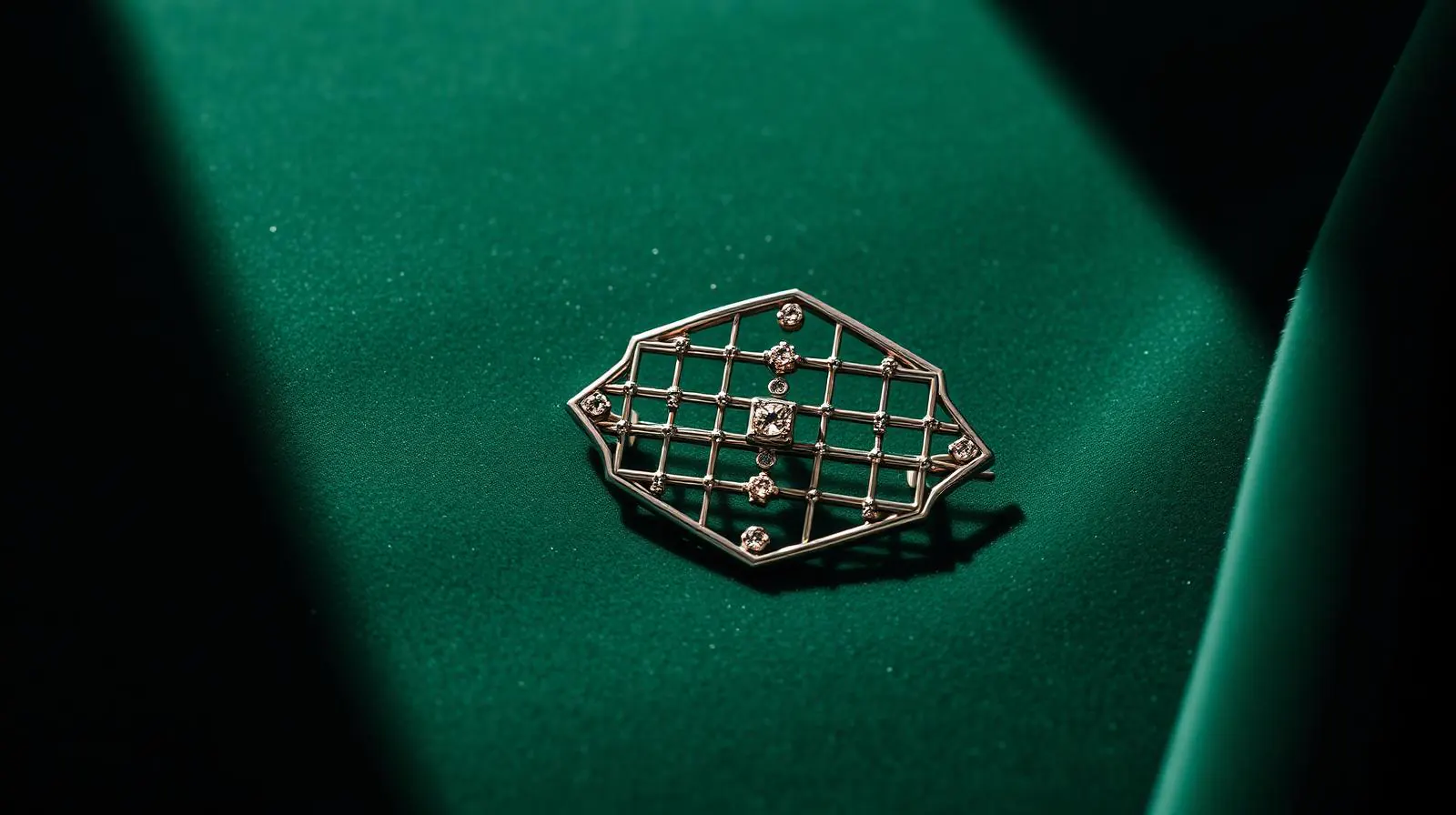
Geometrische Wiener Werkstätte broche met stringente rasterstructuur op flessengroen fluweel; sfeerbeeld, geen determinatievoorbeeld.
International masters
Vienna · 1903–1932
Wiener Werkstätte

Wiener Werkstätte: Weense geometrie vóór art deco

Door de redactie · Vakinhoudelijk getoetst · Bijgewerkt juli 2026

In 1903 Vienna, Josef Hoffmann and Koloman Moser established a workshop that put the idea of "gesamtkunstwerk" into practice: from building to teaspoon, from table to brooch, everything was brought under one design language. That language was austere, geometric, and usually in silver: square and circle as the foundation, semi-precious gemstones (coral, malachite, opal, lapis) as colour accents, and a stamped WW monogram as a quasi-signature. It is an idiom that still looks modern today, and precisely for this reason, it is also one of the most heavily imitated collecting areas of the twentieth century.

The Wiener Werkstätte (1903–1932) is the Viennese workshop for applied arts that gave the Art Nouveau idiom a radically geometric turn, thereby becoming one of the pioneers of art deco. This editorial guide describes the jewellery production at a general level, places it alongside the Art Nouveau style guide and Art Deco style guide, and offers an explicit warning: this is a heavily forged collecting area, and without specialist verification, every purchase is a risk.

In 1903 Vienna, Josef Hoffmann and Koloman Moser established a workshop that put the idea of "gesamtkunstwerk" into practice: from building to teaspoon, from table to brooch, everything was brought under one design language.
Wiener Werkstätte

Life and workshop

The workshop was founded in Vienna in 1903 by Josef Hoffmann (architect and designer), Koloman Moser (painter and designer), and financier Fritz Waerndorfer. The model: a single workshop for all applied arts (furniture, textiles, glass, metal, jewellery), with permanent designers and specialised craftspeople, and with an uncompromising artistic direction. At its peak, dozens of designers and artisans were associated with it, with a production ranging from complete interiors (Palais Stoclet in Brussels) to small pieces of jewellery.

In 1907, Moser left the workshop after a conflict with Waerndorfer; Hoffmann remained artistic director, and jewellery production continued until its closure in 1932. In the interim, the idiom evolved with broader European developments (from geometric Jugendstil to early art deco), but the core remained recognisable: austere, handcrafted, with colour accents from semi-precious gemstones and an explicit preference for silver over gold.

The closure in 1932 was definitive; anything made under the name is therefore, by definition, from before that year. What was traded later under related names falls outside the historical oeuvre.
Recognising the style

Jewellery from this workshop is immediately recognisable by its geometric composition: squares and circles as flatwork, stitched line patterns, and a sober colour palette built from a handful of semi-precious gemstones (coral, malachite, opal, chrysoprase, lapis lazuli). The metal is almost always silver, sometimes gilded; gold occurs but is an exception.

Compared to contemporary Parisian art nouveau (Lalique, Fouquet), the idiom is radically different: no figurative motifs, no theatrical scale, no plique-à-jour, and a production consciously made in small series. Compared to later art deco (from approx. 1920 onwards), the workshop is early and artisanal, with an explicit grounding in manual execution.

For the broader style range and the position of this workshop alongside other Art Nouveau and early Art Deco productions, we refer to the Art Nouveau style guide and the Art Deco style guide.

Jewellery from this workshop is immediately recognisable by its geometric composition: squares and circles as flatwork, stitched line patterns, and a sober colour palette built from a handful of semi-precious gemstones (coral, malachite, opal, chrysoprase, lapis lazuli).
Wiener Werkstätte — stijl
Geometric Wiener Werkstätte brooch on bottle-green velvet — atmospheric image, not a determination example.
Sfeerbeeld — atelier-impressie

Known pieces

Part of the work from this workshop is documented and displayed in public collections. Below is a general description of types; museum websites show the pieces themselves.

  • Square silver brooch with semi-precious gemstones

    Brooches in silver with a geometric grid and a central or asymmetrical setting of coral, malachite, or opal. The type that most often represents the workshop in Viennese and international collections.

    Work from this category is included in the MAK (Museum of Applied Arts) in Vienna.

  • Pendant with stitched linear work

    Small pendants with a geometric line pattern and a single stone. Small in size, widely collected and widely imitated.

  • Belt buckle or belt ornament

    Silver buckles in the same geometric language, functional and at the same time a bearer of style. Desired by the vintage market as a "wearable" category.

  • Cutlery and table silver (related production)

    From the same workshop comes cutlery and table silver with the same geometric signature. Not jewellery in the strict sense, but the context in which the jewellery was made and which makes the core of the "gesamtkunstwerk" idea tangible.

    Examples are included in the MAK in Vienna and the Metropolitan Museum in New York.

Naslag — toeschrijving

Signature and attribution

Original work from this workshop generally bears several marks: the WW monogram (two W's in a cartouche), a designer monogram (e.g., JH for Hoffmann, KM for Moser), a maker's mark (the individual silversmith), and the Viennese fineness and hallmarks (Diana head for Austrian silver, with carat indication). The absence of one of these elements is a reason for caution; the absence of several is a reason for exclusion.

This is one of the most heavily forged collecting areas of the twentieth century. Even before the workshop closed, unauthorised pieces were in circulation; since then, millions of "in the style of" objects have been made, and the geometric idiom lends itself exceptionally well to convincing counterfeits. Anyone wishing to offer a piece as original requires independent expertise and, where possible, a connection to the WW archive (preserved at the MAK in Vienna). The presence of a WW monogram alone is not proof; monograms are forged, transferred, and post-stamped.

Collecting and value

For documented work from this workshop, international auction prices range from several thousands of euros for a small brooch to six-figure sums for exceptional pieces. For "in the style of" without documentation, the trade value is based on the intrinsic quality of the piece and not on the name.

Our advice is explicit and sharper than for other makers: a Wiener Werkstätte piece without independent authentication is not a Wiener Werkstätte for the vintage market. Treat the name as a hypothesis until a specialist proves otherwise; the risk of counterfeiting in this category is substantially higher than for other international masters.

→ Art deco in the style guides
Veelgestelde vragen

Wat lezers vaak vragen

Is this art nouveau or art deco?

Formally, it is Jugendstil (the German-Austrian variant of Art Nouveau), but the geometric signature makes the workshop one of the pioneers of art deco. Both style guides are relevant.

Why is counterfeiting such a big problem here?

The idiom is consciously simple and geometric, making it technically easy to reproduce; the WW monogram is a small stamp that can be quickly applied to new pieces; and the workshop's reputation makes counterfeiting commercially attractive. The combination is exceptionally toxic.

Where can I see authentic work in public?

At the MAK (Museum of Applied Arts) in Vienna, which manages the workshop's archive, and in major applied arts collections (Metropolitan Museum, V&A). Current exhibitions are listed on the museum websites themselves.

I have a "WW" brooch from an estate — now what?

Treat the attribution as a hypothesis. Document all stamps with clear photographs, check for designer and maker's marks in addition to the WW monogram, and submit the piece to a specialist who can consult the WW archive. Without that step, a responsible appraisal is not possible.

Verder lezen

Curious what you have in your hands?

Twijfel je of een stuk uit dit atelier komt — of gewoon wat je precies in handen hebt? Stuur foto's; een specialist bekijkt het en adviseert binnen twee werkdagen over een logische vervolgroute.

Request free advice

Independent advice about what you have and your options — not a purchase offer, not a formal appraisal.

Andere makersgidsen
Voorschoten · Zeist · Zoetermeer
Van Kempen & Begeer
Amsterdam · Kalverstraat
Bonebakker
Amsterdamse School · Nieuwe Kunst
Frans Zwollo
Parijs · 1890–1930
René Lalique
Sint-Petersburg · voor 1917
Fabergé
Londen · Cymric · 1900–1910
Liberty & Archibald Knox
Den Haag · Hofleverancier
Steltman
Utrecht · 1856–1961
Edelsmederij Brom
Parijs · art nouveau
Georges Fouquet
Pforzheim ↔ Londen · 1896–1916
Murrle Bennett & Co.
Kopenhagen · skønvirke
Deens zilver (skønvirke)
Vintagesieraden.nl is niet verbonden aan de genoemde makers, ateliers of hun rechtsopvolgers.