VintageSieraden.nlKnowledge · provenance · value
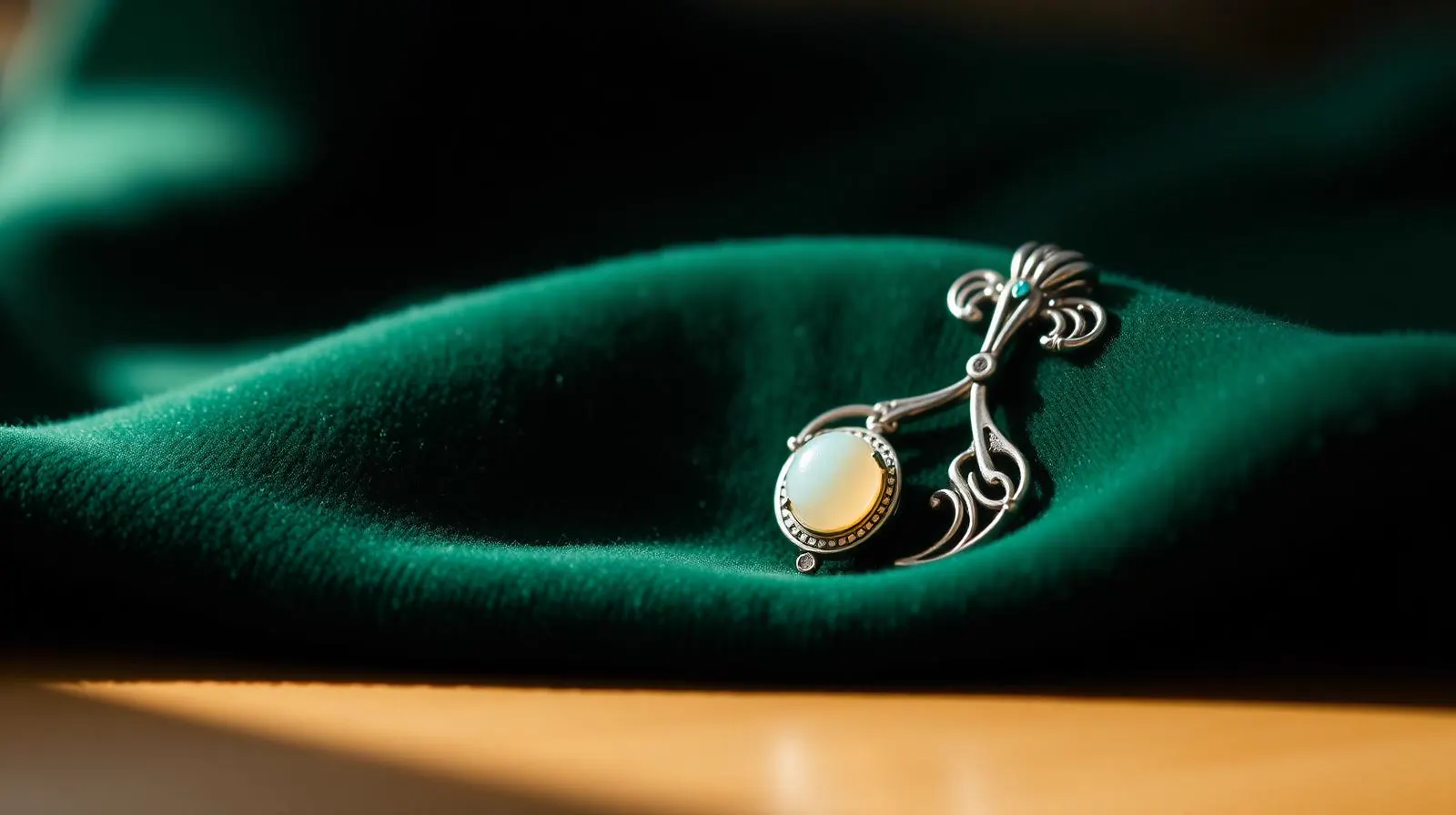
Jugendstil zilveren hanger met opaal-cabochon op flessengroen fluweel; sfeerbeeld, geen determinatievoorbeeld.
International Masters
Pforzheim ↔ London · 1896–1916
Murrle Bennett & Co.

Murrle Bennett & Co.: Pforzheim en Londen

Door de redactie · Vakinhoudelijk getoetst · Bijgewerkt juli 2026

In the German 'Schmuckstadt' (Jewellery City) Pforzheim, at the end of the nineteenth century, a jewellery industry was running at full capacity. Machines rolled gold, presses embossed reliefs into thin sheets, and dozens of workshops produced for a European middle class that wanted to afford Art Nouveau. One such production almost entirely travelled to London, where a trading partner had the pieces hallmarked under a shared company name and sold them to the British market. This is how a brand was created, made in Germany and sold in Great Britain, with a monogram that can be found on the back of brooches and pendants in thousands of Dutch drawers.

Murrle Bennett & Co. (1896–1916) is one of the most interesting chapters in European Art Nouveau jewellery art. The firm was a collaboration between the Pforzheim-born Ernst Mürrle and the British Bennett, with production in Pforzheim and sales from London. The house made Art Nouveau (the German-Austrian variant of art nouveau) accessible to the broad middle class, thereby supplying a substantial portion of the jewellery purchased in North Europe (including the Netherlands) during this period. This guide describes the idiom and recognition at a pattern level.

In the German 'Schmuckstadt' (Jewellery City) Pforzheim, at the end of the nineteenth century, a jewellery industry was running at full capacity.
Murrle Bennett & Co.

Life and Workshop

The firm was registered in London in 1896 by Ernst Mürrle (born in Pforzheim) and his British partner named Bennett. Production mainly took place in Pforzheim, in collaboration with existing German workshops, including for a long period Theodor Fahrner (see our brand guide Theodor Fahrner, which covers the same industrial logic and many overlapping design forms). The pieces were imported into London, provided with British hallmarks, and offered to the British market through their own sales channel.

In 1916, during the First World War, the firm was dissolved under pressure from anti-German sentiments in Great Britain. What was subsequently traded under a related name falls outside the brand's historical oeuvre. The relatively short production time (twenty years) plus the industrial scale mean that much has been preserved, but the better pieces clearly stand out from the common production.

For the Dutch trade, this brand is relatively prominent for historical reasons: the Netherlands was geographically and trade-politically situated between Pforzheim and London, and much of the production entered the Dutch market via German and British routes. As a result, the firm appears more often in appraisals and inheritances than its public recognition would suggest.
Recognising the style

The work is explicitly Art Nouveau: geometrically accentuated, with plant forms set in strict linear frames, and with a preference for Celtic-inspired knot motifs and stylised floral and foliage designs. Compared to French art nouveau, the idiom is calmer and less theatrical; compared to Liberty's British Cymric line, it is more commercial in execution.

Materials: predominantly silver, less often 9- or 15-carat gold (typical British finenesses), with semi-precious gemstones (turquoise, opal, chrysoprase, matrix-turquoise) and occasionally enamel in muted tones. Brooches, pendants, and belt buckles are the common categories; rings and necklaces are less common.

Compared to related Pforzheim productions (such as Theodor Fahrner), Murrle Bennett is slightly more restrained in decoration and with a stronger British accent in material choice (for example, 9-carat gold, which is less common on the continent). For the broader style context, please refer to our art nouveau style guide.

The work is explicitly Art Nouveau: geometrically accentuated, with plant forms set in strict linear frames, and with a preference for Celtic-inspired knot motifs and stylised floral and foliage designs.
Murrle Bennett & Co. — stijl
Art Nouveau pendant with opal on bottle-green velvet — mood image, not a determination example.
Sfeerbeeld — atelier-impressie

Well-known pieces

A large production from this brand has been preserved; below is a general description of types that consistently reappear in Dutch and British collections.

  • Silver brooch with Celtic knot and turquoise

    Rectangular or round brooch in silver with a repoussé or cast knot composition and a central turquoise or chrysoprase. This type most often represents the brand in Dutch collections.

  • Pendant in 9- or 15-carat gold with opal

    Small pendants in British gold with a single opal or pearl in an asymmetrical composition. Recognisable by the combination of German design with British hallmarks.

  • Belt buckle and girdle piece

    Silver belt buckles in the same design language, often as a two-piece item with hook and eye. A popular genre in Art Nouveau, functional as an accessory and simultaneously a carrier of style.

  • Brooch with stylised plant motif and enamel accent

    More elaborate brooches featuring a stylised tulip or iris executed with muted enamel. This category is scarcer and more sought after than the common knot-style brooches.

Naslag — toeschrijving

Signature and attribution

Work by this brand generally bears the MB&Co (Murrle Bennett & Co.) monogram plus British hallmarks (lion for Sterling, assay office mark, and date letter), or, for gold pieces, the caratage with the usual British set of marks. The monogram is located on the reverse or along the edge; for gold pieces, the signature can be small and sometimes partly worn.

Attribution is usually unambiguous when the monogram is present. What can cause confusion: related German workshops from the same period (especially Theodor Fahrner) worked in a similar design language, and without a signature, stylistic attribution is only justifiable as "Pforzheim Art Nouveau". The Theodor Fahrner brand guide offers the counterpart for this.

Collecting and value

The collecting market for this brand is stable and international, with a clear price distinction between common silver brooches (in the hundreds of euros) and the better gold or enamelled pieces (which can reach towards a thousand and, for exceptional examples, even more). Complete sets (brooch plus pendant from the same design line) are rare and valued separately.

For this category, British and Dutch auction houses and specialised Art Nouveau dealers are the logical channels. When selling, it pays to photograph the British hallmarks keenly; date letter and assay office mark often provide more precise dating than a stylistic argument.

→ Brand guide: Theodor Fahrner
Veelgestelde vragen

Wat lezers vaak vragen

Is this a German or a British brand?

Both. Production in Pforzheim, sales and hallmarking in London. For the vintage market, it is usually considered a German-British Art Nouveau brand.

Why is this work often found in Dutch drawers?

The Netherlands was geographically and trade-politically situated between Pforzheim and London. Much of the production entered the Dutch market via German and British trade routes, which is why the brand appears relatively often in inheritances.

What is the difference with Theodor Fahrner?

Both are Pforzheim Art Nouveau productions with much stylistic similarity; Murrle Bennett was sold to the British market via London, Fahrner focused more broadly on continental Europe. For details, please refer to our separate brand guide.

How do I recognise the monogram?

As "MB&Co" (or a variant with dots) in a small cartouche, usually on the back of a brooch or along the clasp. For British silver pieces, the complete British hallmark set should accompany it.

Verder lezen

Curious what you have in your hands?

Twijfel je of een stuk uit dit atelier komt — of gewoon wat je precies in handen hebt? Stuur foto's; een specialist bekijkt het en adviseert binnen twee werkdagen over een logische vervolgroute.

Request free advice

Independent advice about what you have and your options — not a purchase offer, not a formal appraisal.

Andere makersgidsen
Voorschoten · Zeist · Zoetermeer
Van Kempen & Begeer
Amsterdam · Kalverstraat
Bonebakker
Amsterdamse School · Nieuwe Kunst
Frans Zwollo
Parijs · 1890–1930
René Lalique
Sint-Petersburg · voor 1917
Fabergé
Londen · Cymric · 1900–1910
Liberty & Archibald Knox
Den Haag · Hofleverancier
Steltman
Utrecht · 1856–1961
Edelsmederij Brom
Parijs · art nouveau
Georges Fouquet
Wenen · 1903–1932
Wiener Werkstätte
Kopenhagen · skønvirke
Deens zilver (skønvirke)
Vintagesieraden.nl is niet verbonden aan de genoemde makers, ateliers of hun rechtsopvolgers.