VintageSieraden.nlKnowledge · provenance · value
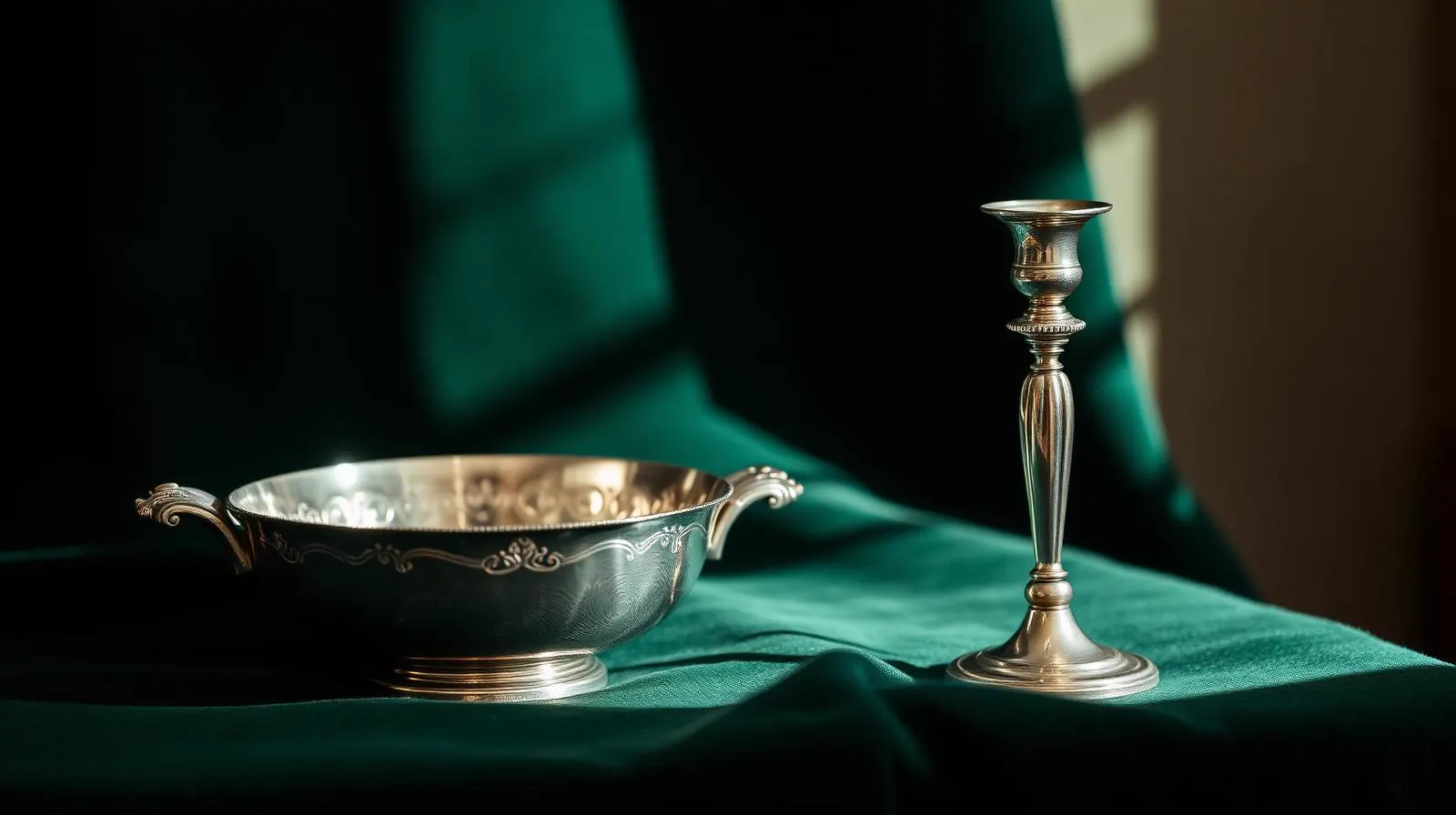
Antiek Hollands zilverwerk — schaal en kandelaar — op flessengroen fluweel; sfeerbeeld, geen determinatievoorbeeld.
Dutch makers
Voorschoten · Zeist · Zoetermeer
Van Kempen & Begeer

Van Kempen & Begeer: het Nederlandse zilverhuis

Door de redactie · Vakinhoudelijk getoetst · Bijgewerkt juli 2026

In the factory halls on the Vliet in Voorschoten at the end of the nineteenth century, the scent of polished silver and coal dust hangs in the air. Master silversmiths bend leaf patterns over wooden moulds, engravings run across trays, and at the end of the day, coffee pots, christening bowls, and cutlery sets leave the workshop for Amsterdam and The Hague notables. What is made here, within two generations, will find its way into almost every Dutch home with a somewhat set table — and much later, after three generations of inheritance, into the drawers of grandchildren wondering about the 'value of those old things'.

For the Dutch collecting market, Van Kempen & Begeer is not a single workshop but a family history of manufacturer's silver — with the smithies of Van Kempen in Voorschoten and Begeer in Utrecht and later Zeist at its core, and in a position ranging from middle-class to royal suppliers. This editorial guide describes the context in which this silver was created and what characteristics can be recognised in the work. We refer to the name exclusively as text, do not show trademarks, and describe signature and hallmark patterns at a general level; for verification of an individual piece, an independent specialist with auction experience is the appropriate route.

In the factory halls on the Vliet in Voorschoten at the end of the nineteenth century, the scent of polished silver and coal dust hangs in the air.
Van Kempen & Begeer

Life and workshop

The oldest branch began in the early nineteenth century in Utrecht, where Johannes Mattheus van Kempen operated a gold and silver smithy. In 1858, the company moved to Voorschoten and grew into one of Europe's largest silver factories — with its own factory complex on the Vliet, hundreds of employees, and machines that increasingly complemented the master's hand without replacing it.

In parallel, the house of Begeer operated, from 1868 in Utrecht and later in Zeist, with a similar formula of factory-made but reasonably high-quality work. In the 1920s, both houses merged and continued as one enterprise. In the decades that followed, collaborations and takeovers — with Gerritsen & Van Kempen, later also with other silver variants — continually allowed the brand to persist under a partially altered constellation.

For the vintage market, this history is relevant because the same name covers silver produced over more than a hundred years: from late nineteenth-century neo-rococo to post-war, austere modernism. Anyone acquiring a piece should therefore first look at its style and hallmark set before asking 'what is it worth'.
Recognising the style

Early work follows the tradition of historicising styles — neo-rococo, neo-empire, neo-renaissance — with chased foliage, cartouches, and sometimes figurative reliefs. This is the silver that came out of the cupboard for birthdays and anniversaries and that is typically described in appraisal descriptions as 'chased Voorschoten silver'.

During the interwar period, part of the collection shifted towards art deco: stricter geometry, polished surfaces, less decoration. After the war, the aesthetic became even more austere, with post-war modern dinnerware often produced in large series, representing more use value than collector's value.

The material is almost always Dutch silver — finenesses 833/1000 for utility silver and 925/1000 for better series — sometimes with gilded interiors for drinking vessels. The presence of a complete set of Dutch hallmarks is the norm for this house, not the exception; for the reading context, see our guide on Dutch hallmarks and the broader background on Dutch silver.

Early work follows the tradition of historicising styles — neo-rococo, neo-empire, neo-renaissance — with chased foliage, cartouches, and sometimes figurative reliefs.
Van Kempen & Begeer — stijl
Dutch silver work on bottle-green velvet — atmospheric image, not an identification example.
Sfeerbeeld — atelier-impressie

Famous pieces

This house has produced an enormous output; the descriptions below are categories in which the work consistently reappears in Dutch collections and auction catalogues. For visual material and catalogue descriptions, we refer to the collections themselves.

  • Official table silver for the state guest

    Complete cutlery sets and table centrepieces made as state gifts or for official receptions. Characteristic is the combination of classic lines with a finely chased monogram or coat of arms, executed in high-quality silver with matte contrasts between smooth and chased work.

    Comparable work is included in the collections of the Rijksmuseum and Museum Paleis Het Loo.

  • Christening bowl and cup as family heirloom

    Small utility pieces — a chased christening bowl with rim decoration, a smooth cup with engraving — represent the broad middle-class production. Often dated by the date letter in the hallmark and bearing an inscribed name and date.

  • Neo-rococo trays and serving dishes

    Larger presentation pieces from the late nineteenth century with cast floral borders and chased central panels. These pieces mark the peak of the historicising repertoire and are recurring material in Dutch auction catalogues.

  • Interwar dinnerware in clean lines

    Teapots, coffee pots, and sugar bowls from the 1920s and 1930s in the art deco style: cylindrical bodies, angular handles of ebony or ivory-like material, minimal engraving. In appraisal terms, often valued separately because the design language appeals to a specific collecting market.

Naslag — toeschrijving

Signature and attribution

Work from this house generally bears a full set of Dutch hallmarks — fineness mark (lion or duckling depending on fineness), assay office mark, date letter — plus a maker's mark or factory mark in its own cartouche. The presence of this complete set is the strongest indication that it is factory-made Dutch silver from one of the established workshops.

Attribution to a specific designer within the house (e.g., work from the interwar line designed by an individual designer) is specialist work: it requires archival material, design drawings, and a tactile comparison with documented examples. For Dutch collections, reading the date letter is usually a better first step than speculating about the designer's hand.

Be careful with 'style of' or 'in the manner of' designations in advertisements: these cover diverse objects and are rarely a guarantee that the piece comes from the factory itself.

Collecting and value

For utility silver from this house, the intrinsic precious metal value is often paramount, with an addition for style, completeness of a service, and the presence or absence of monograms. Complete table services (24 or 48 pieces) are valued differently from individual pieces; monograms can either add to or detract from the trade value depending on how representative they are.

For special pieces — early neo-rococo of high quality, interwar designs with an assignable hand, state gifts — there is a separate collecting market where catalogue reference and provenance become relevant. For this category, an independent appraisal is always worthwhile.

→ The brand side of signed pieces
Veelgestelde vragen

Wat lezers vaak vragen

Are 'Van Kempen', 'Begeer' and 'Van Kempen & Begeer' the same house?

Historically, they were separate workshops that merged from the 1920s onwards. On older pieces, you might find a single mark; on later work, the combined mark or a variant thereof. So it's the same tradition, but not always the same hallmark set.

Can you identify my piece from a photo of the hallmark?

No. We publish editorial background information and describe hallmarks at a pattern level; individual identification is the work of an independent specialist. However, we can provide guidance via the free value estimate based on photos of the complete piece.

Why does the precious metal value often carry so much weight for this brand?

Because a large part of the production is functional utility silver made in large series. The scarcity per piece is limited, meaning weight and fineness play a greater role in the trade value than for unique items or designer work.

Is a monogram bad for the value?

Not by definition. A contemporary monogram in the original technique is part of the piece's biography and can even enhance its value during provenance research. A later etched or laser-engraved monogram is a different story and is usually considered distracting.

Verder lezen

Curious what you have in your hands?

Twijfel je of een stuk uit dit atelier komt — of gewoon wat je precies in handen hebt? Stuur foto's; een specialist bekijkt het en adviseert binnen twee werkdagen over een logische vervolgroute.

Request free advice

Independent advice about what you have and your options — not a purchase offer, not a formal appraisal.

Andere makersgidsen
Amsterdam · Kalverstraat
Bonebakker
Amsterdamse School · Nieuwe Kunst
Frans Zwollo
Parijs · 1890–1930
René Lalique
Sint-Petersburg · voor 1917
Fabergé
Londen · Cymric · 1900–1910
Liberty & Archibald Knox
Den Haag · Hofleverancier
Steltman
Utrecht · 1856–1961
Edelsmederij Brom
Parijs · art nouveau
Georges Fouquet
Pforzheim ↔ Londen · 1896–1916
Murrle Bennett & Co.
Wenen · 1903–1932
Wiener Werkstätte
Kopenhagen · skønvirke
Deens zilver (skønvirke)
Vintagesieraden.nl is niet verbonden aan de genoemde makers, ateliers of hun rechtsopvolgers.