VintageSieraden.nlKnowledge · provenance · value
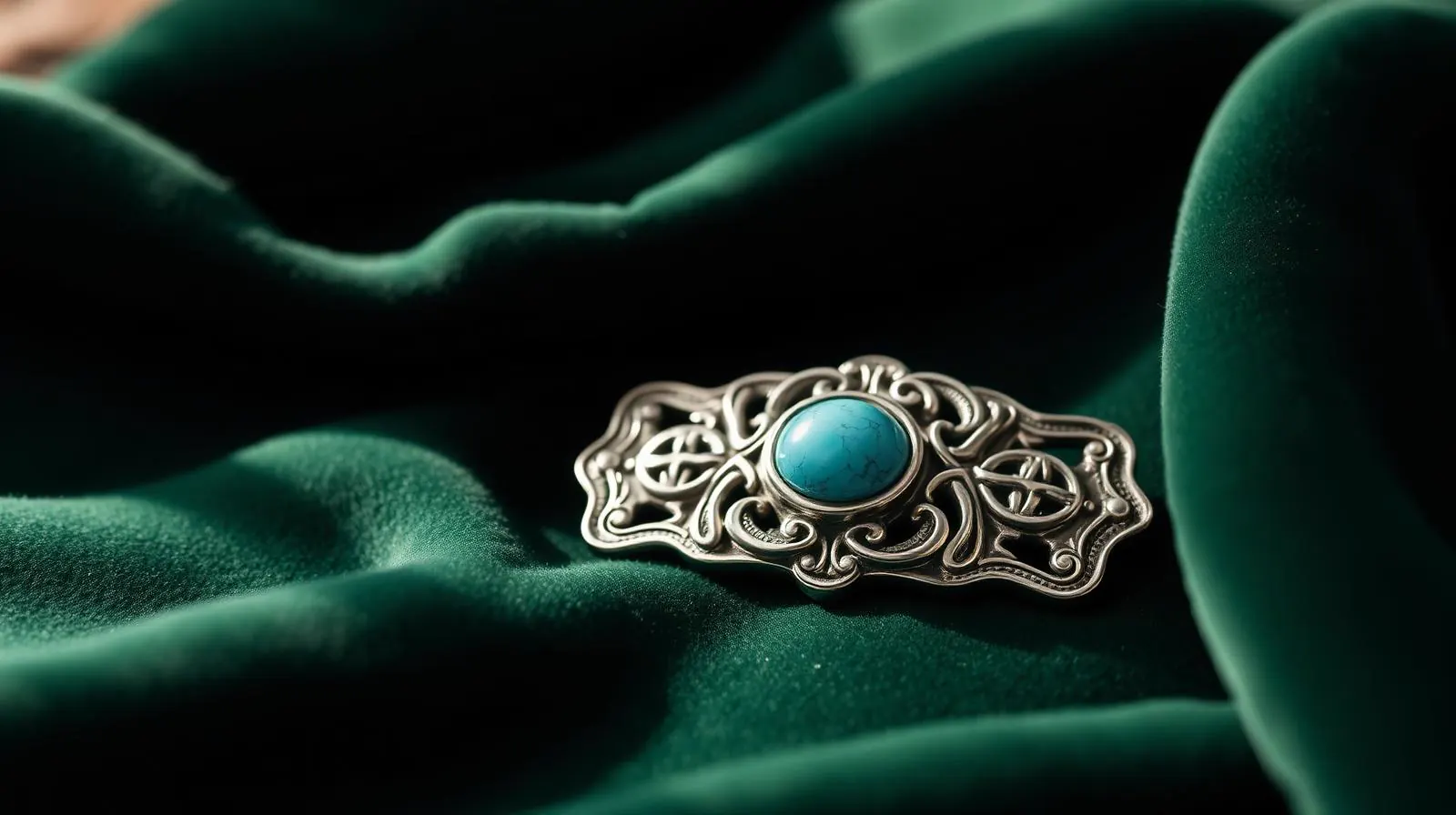
Arts and crafts gordelgesp met turkoois en Keltisch vlechtwerk op flessengroen fluweel; sfeerbeeld, geen determinatievoorbeeld.
International masters
London · Cymric · 1900–1910
Liberty & Archibald Knox

Liberty & Archibald Knox: de Cymric-lijn

Door de redactie · Vakinhoudelijk getoetst · Bijgewerkt juli 2026

At the end of the nineteenth century, a department store opened on Regent Street in London with a more ambitious plan than just selling goods. It aimed to introduce its customers to the taste of a new style — the Celtic design language, rediscovered in illuminated manuscripts and early metal objects. From 1899, a jewellery line (Cymric) appeared under the department store's name, where linear work as an almost abstract composition defined the aesthetic. The designer in the background — a draughtsman from the Isle of Man — did not publish under his own name, but his hand in the work is unmistakable.

The Cymric line from the London department store Liberty is one of the clearest examples of 'commercial' high-quality art nouveau. Under the artistic direction of Archibald Knox (1864–1933), a serial production of jewellery in silver and gold was created, combining Celtic design with a pronounced art nouveau feel. This guide describes the idiom and context.

At the end of the nineteenth century, a department store opened on Regent Street in London with a more ambitious plan than just selling goods.
Liberty & Archibald Knox

Life and workshop

Liberty & Co. was founded in London in 1875 as a department store for oriental goods and reinvented itself around 1900 as a proponent of the new style. In collaboration with British goldsmiths (including the firm W.H. Haseler in Birmingham), the department store launched the Cymric jewellery line in 1899 — the name refers to Wales — and the Tudric tableware line in 1901. Both lines were intended for commercial production: serial instead of unique pieces, but with a strong artist-driven signature.

Archibald Knox was, from approximately 1899, the dominant designer's hand behind both lines. He grew up on the Isle of Man and made the Celtic tradition present there the central theme of his work. Under the department store's conventions, he did not publish under his own name — his designs were sold as 'Liberty' — so his oeuvre was only recognised as an independent chapter in art history later in the twentieth century.
Recognising the style

Cymric line jewellery is immediately recognisable by the combination of interlaced, flowing lines (Celtic knots as a starting point) with sober enamel accents — usually in muted shades of blue, green, and purple — or with semi-precious gemstones such as opal and turquoise. The metal (silver, less often gold) explicitly carries the linear work rather than being decoration in itself.

Compared to continental European art nouveau, these pieces are more structured and less figurative: no dragonflies or female figures, but abstracted tendrils, knotted bands, and sometimes a sober floral motif. The price range was deliberately accessible to a broad middle class at the time — which has influenced the vintage market as a relatively large number of pieces have been preserved.

Cymric line jewellery is immediately recognisable by the combination of interlaced, flowing lines (Celtic knots as a starting point) with sober enamel accents — usually in muted shades of blue, green, and purple — or with semi-precious gemstones such as opal and turquoise.
Liberty & Archibald Knox — stijl
Arts and crafts belt buckle with turquoise on bottle green velvet — atmospheric image, not a determination example.
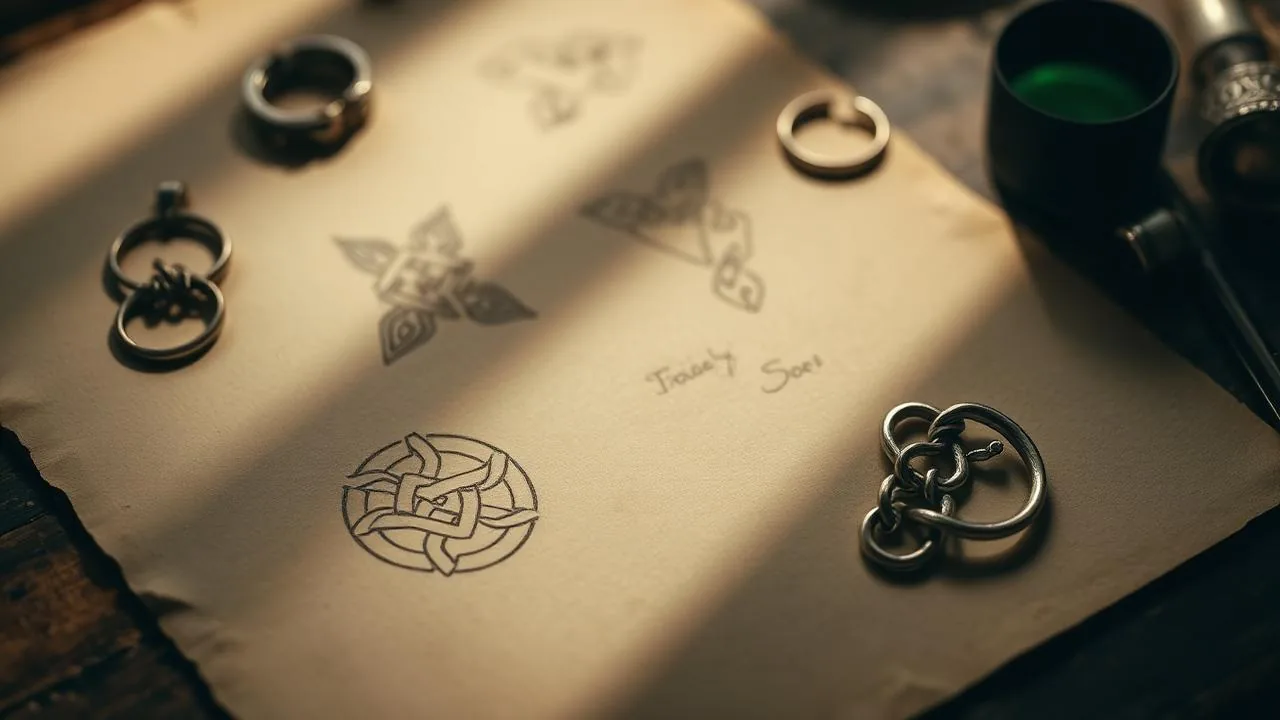
Sfeerbeeld — atelier-impressie

Known pieces

A large production from this line has been preserved; below is a general description of types.

  • Cymric brooch with Celtic knot motif

    Round or rectangular brooch in silver with a central repoussé or cast knot composition, often with enamel in muted shades. The type that most often represents the line in Dutch and British collections.

    Work from this category is included in the Victoria & Albert Museum and the Manx Museum on the Isle of Man.

  • Cymric pendant with opal or turquoise

    Pendants in which a single opal or turquoise is set in an asymmetrical composition, with enamel or gold accents. Small size, widely collected.

  • Tudric table piece (related line)

    The Tudric line comes from the same designer's hand — pewter tableware with a related design language. Collectible in its own right, but strictly speaking not a jewellery category.

  • Belt with silver buckle

    Silver buckles and chain belts in the same design language, often in combination with textiles — the boundary between jewellery and accessory is deliberately blurred in this production.

Naslag — toeschrijving

Signature and attribution

Cymric pieces generally bear a 'Cymric' inscription, the Liberty monogram, and British hallmarks (lion for Sterling, with assay office mark and date letter). When all three are present, the attribution to the line is clear; individual attribution to Archibald Knox as designer requires style comparison and, where possible, alignment with published design drawings.

Be cautious with pieces that are only 'in the style of', or with later British silver production that adopts the idiom without the original line connection. The date letter in the British hallmark (see our guide on British hallmarks) is a crucial dating indicator for this category.

Collecting and value

The collecting market for this line is stable and international, with a clear price distinction between documented pieces (Cymric inscription plus hallmark) and anonymous 'in the style of' pieces. Complete sets (brooch plus pendant from the same design line) are rare and valued separately.

For this category, a British auction house with knowledge of Arts-and-Crafts and Cymric material is generally the strongest market connection; Dutch auction houses often refer larger pieces elsewhere.

→ Art nouveau in the style guides
Veelgestelde vragen

Wat lezers vaak vragen

Was Archibald Knox the sole designer for this line?

No, but he is the dominant hand and by far the most recognisable style. Other designers worked anonymously; attribution to Knox is the most important quality marker for the collecting market.

Why is Knox's name not on the pieces?

Department store convention: the line was sold under the brand name, not under the individual designer's name. This was common practice at the time and only much later made his name visible in jewellery historiography.

Is Cymric the same as Tudric?

No. Cymric is the silver jewellery line; Tudric is the pewter tableware line from the same stylistic tradition. Both fall under the same artistic direction, but are separate categories.

Can I wear this work well?

Yes — the line was consciously designed as wearable jewellery, not as a display curiosity. Avoid chemical polishing (enamel is delicate) and have any loose settings checked by a specialist.

Verder lezen

Curious what you have in your hands?

Twijfel je of een stuk uit dit atelier komt — of gewoon wat je precies in handen hebt? Stuur foto's; een specialist bekijkt het en adviseert binnen twee werkdagen over een logische vervolgroute.

Request free advice

Independent advice about what you have and your options — not a purchase offer, not a formal appraisal.

Andere makersgidsen
Voorschoten · Zeist · Zoetermeer
Van Kempen & Begeer
Amsterdam · Kalverstraat
Bonebakker
Amsterdamse School · Nieuwe Kunst
Frans Zwollo
Parijs · 1890–1930
René Lalique
Sint-Petersburg · voor 1917
Fabergé
Den Haag · Hofleverancier
Steltman
Utrecht · 1856–1961
Edelsmederij Brom
Parijs · art nouveau
Georges Fouquet
Pforzheim ↔ Londen · 1896–1916
Murrle Bennett & Co.
Wenen · 1903–1932
Wiener Werkstätte
Kopenhagen · skønvirke
Deens zilver (skønvirke)
Vintagesieraden.nl is niet verbonden aan de genoemde makers, ateliers of hun rechtsopvolgers.