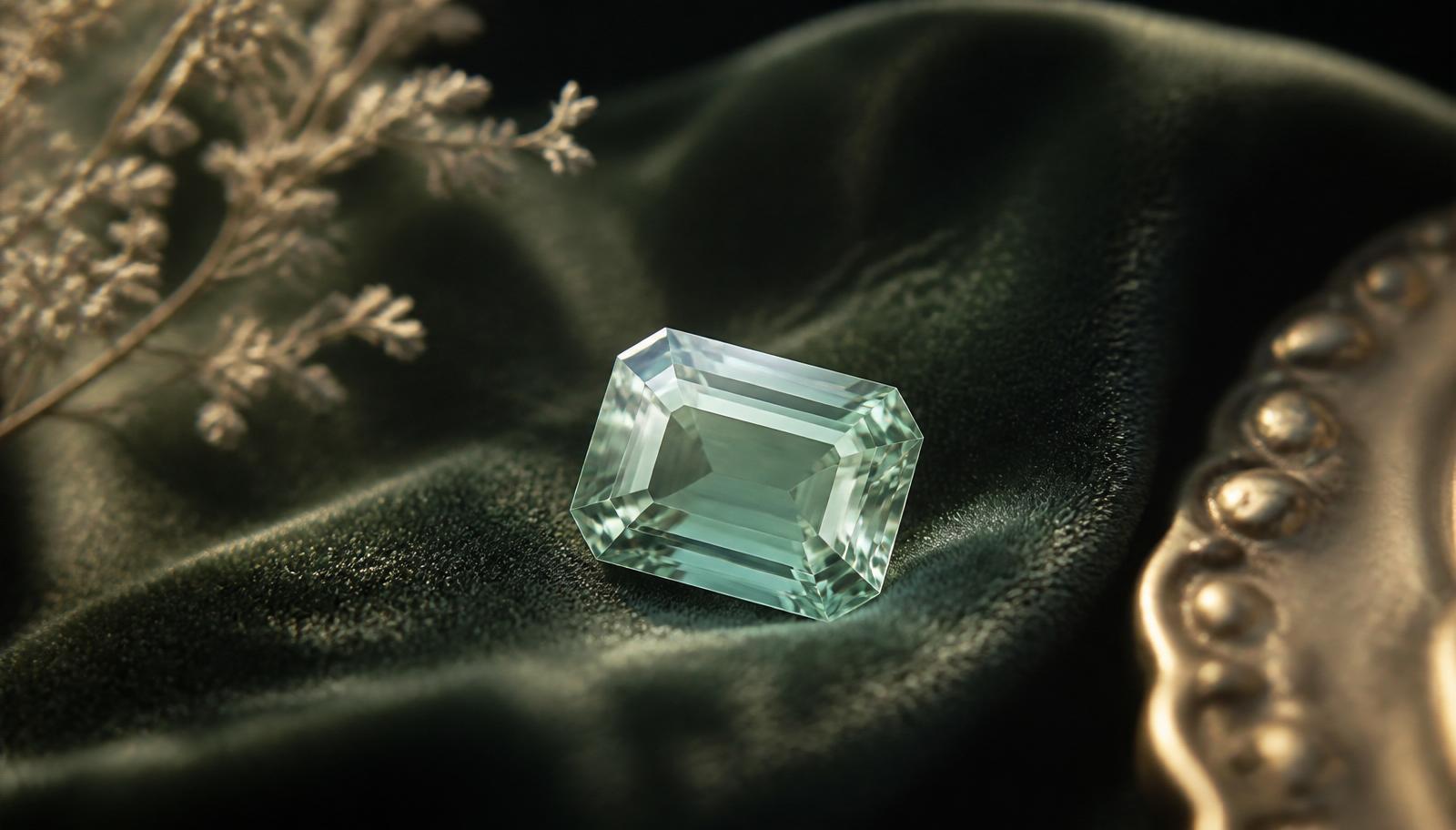
New York, 1937. In an apartment on the Upper East Side, a cocktail is served; on the hostess's hand is a thirty-carat emerald-cut aquamarine, set in yellow gold with two wide diamond shoulders. The stone is almost too large for the finger, but that's precisely the point: retro cocktail creations had to be legible from a distance. Aquamarine lent itself like no other stone to that gesture — large clean crystals came from Brazil, the colour was cool and modern, and the price per carat was far below that of sapphire.
Aquamarine is the blue variety of beryl, the same mineral family as emerald. Hardness 7.5 to 8 on the Mohs scale, tough, and usually remarkably clean of inclusions — a technical difference from emerald which gave the cutter freedom to create substantial, polished facets. Hence the dominance of rectangular and square emerald-cuts in vintage work.
The gemstone in brief
The name aquamarine (Latin: seawater) is old, but the commercial dominance of the stone is a twentieth-century phenomenon. Large clean crystals primarily came from Minas Gerais in Brazil, later also from Mozambique, Madagascar, and Nigeria. The classic untreated material has a slight green tinge; since approximately 1930, systematic heat treatment has been common to shift the colour to pure sea-blue or sky-blue.
For value inquiries per item, we refer to the price guides; a strongly colour-performing stone in a period-correct mounting outweighs carat weight alone. Large stones (10 carats and more) were not uncommon in art deco and retro, which sometimes makes them surprisingly accessible for modern collectors.
Periods in which you will encounter this gemstone
Aquamarine is rare in Victorian work. Its bloom coincides with the opening of Brazilian mines at the end of the nineteenth century. Edwardian platinum work (1901–1910) features fine oval or round aquamarines in millegrain settings, combined with diamond.
Art deco (1920–1935) is the first heyday. Large emerald-cut or asscher-cut aquamarines in sleek platinum or white gold mountings, often surrounded by diamond and combined with onyx or black enamel for the characteristic contrast. See the art deco style guide. Colombian and Brazilian suppliers were dominant during the same period.
Retro (1935–1950) is the second and often most striking peak. See the retro style guide. Massive emerald-cut stones are now in yellow or rose gold, flanked by wide ribbed bands or scrollwork. The aquamarine cocktail ring became a statement in itself in American and European workshops — legible from a distance, affordable per carat, with a clean cool colour that maintained its beauty in evening light.
Aquamarine is rare in Victorian work.
Old vs modern
Colour is the clearest difference. Untreated vintage aquamarine has a slight green tinge — 'seawater blue' in old commercial jargon. From the retro period onwards, heat treatment (around 400–450 degrees Celsius) was systematically applied to expel that green component and shift the colour to pure blue. Both are period-correct in vintage work. Extremely deep blue, vibrant stones typically date from after 1950 and are almost without exception thermally treated.
Cut follows the period. Edwardian aquamarines are still round or oval with a smaller table. Art deco places the emerald-cut at the centre: sleek rectangular, with step-cut facets that showcase the beauty of the material without sparkling. Retro work often uses substantial variations of this cut — wide table, shallower angles, optimised for size effect over brilliance.
Change of origin is a third factor. Early twentieth-century stones almost always come from Minas Gerais; from the 1960s, Mozambique material entered the market en masse, later Nigeria and Madagascar. For vintage work, this only plays a role for large solitaire stones; for most jewellery, the setting and period outweigh mine origin.