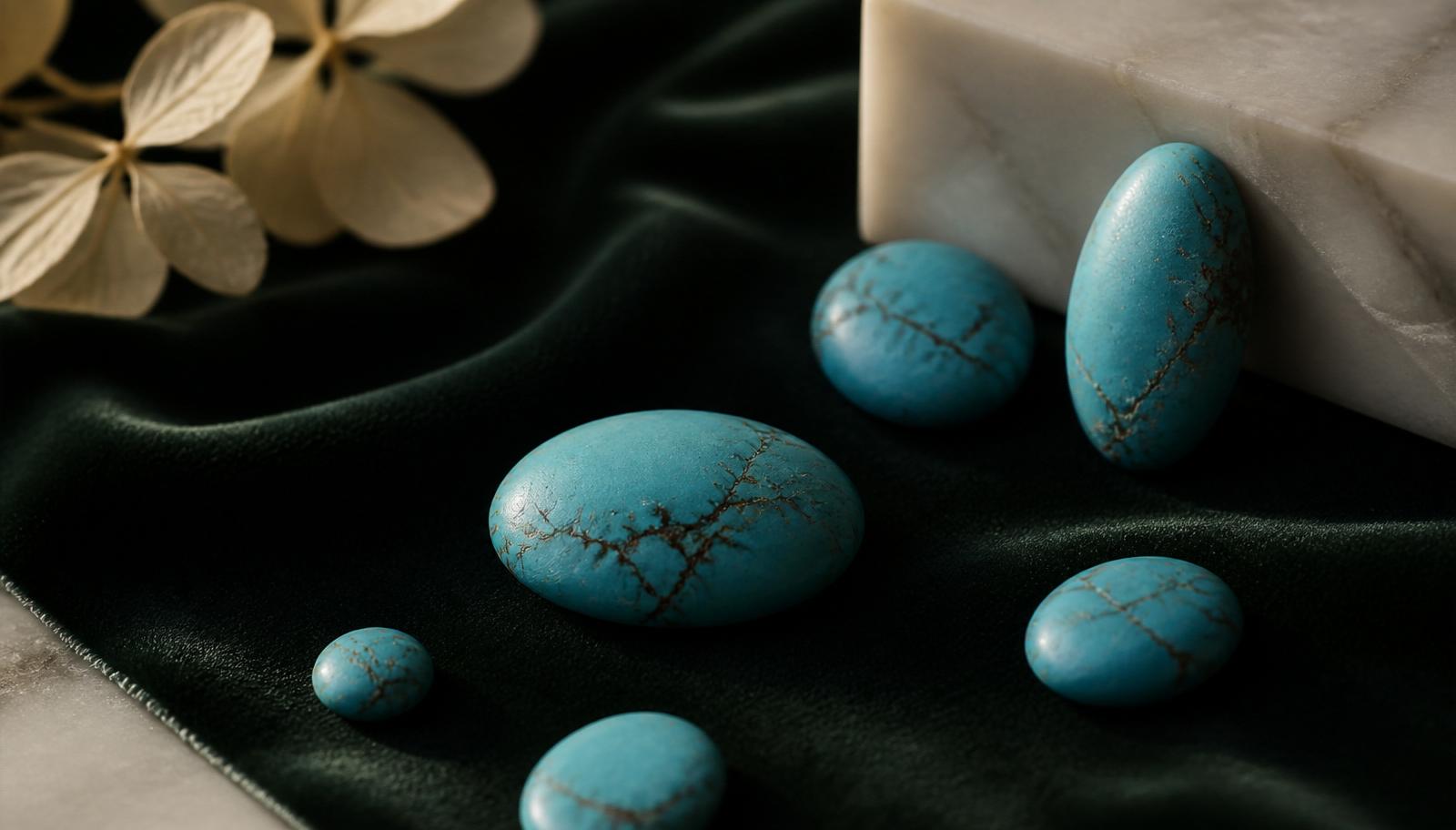
Nishapur, in northeastern Iran, around 1875. A camel caravan departs with wooden chests in which thin paper separates the finest cabochons: sky-blue, without visible matrix, with a velvety sheen seen only in this one level of Persian material. At the end of the journey, months later, traders in Constantinople distribute the chests among buyers in Vienna, Paris and London. There, turquoise appears in widows' rings, in forget-me-not brooches for young lovers, and in serpent rings as a cabochon. The trade via Turkey is why we still call this stone turquoise — its actual origin is Persian.
Turquoise is a hydrated copper-aluminium phosphate. Hardness is only 5 to 6 on the Mohs scale; porous, sensitive to skin contact, heat and chemicals. This softness is not a technical weakness but the reason why turquoise acquires so much character and 'patina' through daily wear — a greenish discolouration around the setting is a sign of age, not a flaw.
The stone in brief
In vintage jewellery, you encounter turquoise in two major traditions. The European, dominant in the nineteenth century, uses fine Persian material in pavé-work or as a cabochon in symbolic jewellery — forget-me-nots of rows of small cabochons, serpent rings, hearts and crosses. The American tradition, emerging from around 1880 in Arizona and New Mexico and dominant from the 1920s, uses larger cabochons with visible matrix in Navajo and Zuni silverwork. Both are period-correct within their own framework.
For the broader setting and construction terminology, see the clasps and construction guide. For the care of porous material: the maintenance guide.
In which periods you will encounter this stone
Early and mid-Victorian work (1837–1880) features turquoise primarily as a symbolic stone. See the Victorian style guide. Forget-me-not brooches and earrings with rows of fine Persian cabochons are iconic; serpent rings feature a turquoise as a cabochon or as an eye. Gold settings are common then, usually 15 or 18 carat, with closed bezel settings encasing the stone.
Edwardian work (1901–1910) uses turquoise in delicate platinum settings, often surrounded by rose-cut diamond halos. See the Edwardian style guide. Art nouveau composes turquoise in floral forms; see the art nouveau style guide. In art deco, the stone is less dominant — the flat geometry of that style requires harder, crisper material.
American silverwork from the late nineteenth and twentieth centuries is a collecting area of its own. Large cabochons with matrix, set in heavy silver with stamping or embossing, come from workshops in New Mexico and Arizona. Post-war Fred Harvey-style (1930s–1950s) creates turquoise jewellery for the tourist market; this work is thinner and machine-stamped, but has its own collecting value.
Early and mid-Victorian work (1837–1880) features turquoise primarily as a symbolic stone.
Old vs. modern
Persian or American is the first distinction. Fine Persian material is deep sky-blue, usually without visible matrix; it is the classic European vintage standard. American material (Kingman, Bisbee, Sleeping Beauty, Lone Mountain, Number Eight) generally has more matrix — the brown, black, or gold vein patterns that form a signature for each mine. Both are authentic; only the aesthetics and context differ.
Recognising stabilisation and reconstruction at the pattern level is the key question. Natural turquoise has a matte, slightly waxy lustre; stabilised material (impregnated with epoxy resin, a practice since the 1960s) often has a slightly more vitreous sheen. Reconstructed turquoise — crushed powder bonded with synthetic resin — shows a too uniform pattern under a 10× loupe, without the natural variation of real matrix. For vintage work before 1960, stabilisation is effectively ruled out; later restorations may contain stabilised material. For the broader logic: recognising reproductions.
Discolouration through skin contact is the thirtieth issue. Turquoise absorbs fats and salts; over decades, its colour shifts to greenish. This is not a flaw but a sign of age, and often desired by many collectors. To preserve the colour: avoid contact with perfume, sunscreen, chlorine or dish soap; store out of direct sunlight.