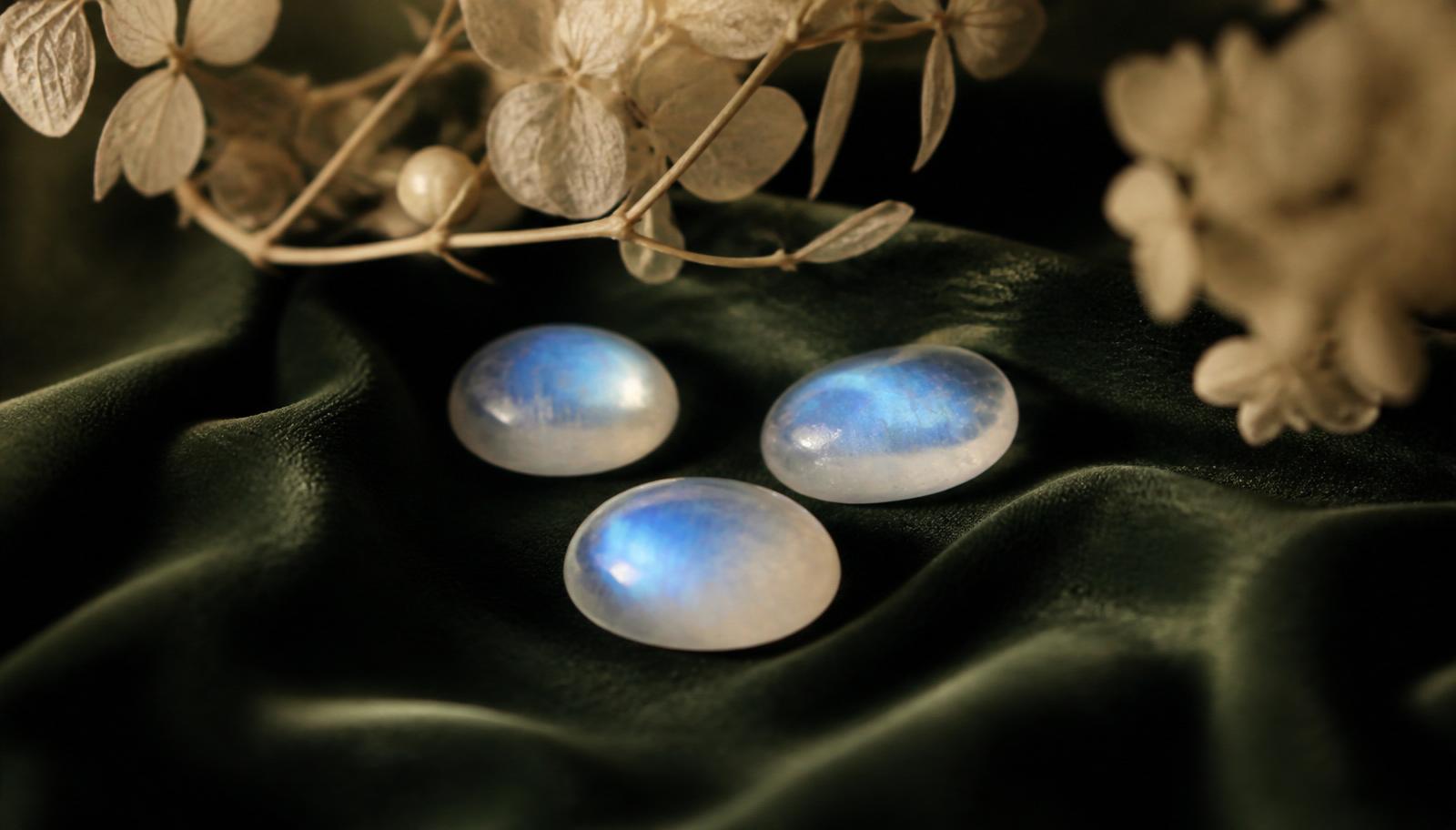
Paris, 1900. At the Exposition Universelle, a display case features work by René Lalique. In a pendant of gold, plique-à-jour enamel, and lightly patinated silver, a large moonstone floats — pale grey-blue, with a silvery-white light that slowly moves across its surface as the visitor steps aside. The effect is called adularescence, and it is the reason why Art Nouveau workshops chose this stone above almost all others. Where diamond sparkled and ruby glowed, moonstone 'breathed' — a moving light that suited the dreamy, botanical compositions of the period.
Moonstone is a variety of orthoclase feldspar in which two separated layers on a microscopic scale diffusely scatter light. This creates the silver, blue, or sometimes golden 'sheen' that appears to move across the surface. Its hardness is 6 to 6.5 on the Mohs scale — significantly softer than corundum or beryl, and susceptible to impact. Historically, the best material comes from Sri Lanka; later also from India, Burma, and Madagascar.
The gemstone in brief
In vintage jewellery, you’ll encounter moonstone mainly in Art Nouveau, in Arts and Crafts pieces, and in the later hippie fashion of the late 1960s. Cabochon cut is standard — only a curved surface properly displays the adularescence. Blue sheen is most prized; white, silvery, or golden sheen also occurs and each has its own enthusiasts.
For the broader style context, see the Art Nouveau style guide. For specific value questions: the price guides.
In which periods you'll find this gemstone
In Victorian work, moonstone only appears late. Its true flourishing began with Art Nouveau (1890–1910), where the soft adularescence matched the flowing designs of Lalique, Fouquet, and the Viennese Wiener Werkstätte. See the Art Nouveau style guide and, once live, the René Lalique guide. Cabochons in gold settings with plique-à-jour enamel or patinated silver are characteristic.
Arts and Crafts work (1890–1915), especially in Great Britain, uses moonstone in hand-forged silver settings with other cabochon gemstones — turquoise, chrysoprase, opal — in compositions that prioritize craftsmanship over perfect cutting. Edwardian work uses smaller moonstones as accents in platinum settings; Art Deco largely abandoned the stone because its soft lustre did not suit the flat geometry.
After the war, moonstone returned in the 1960s and 1970s, often in simple silver settings with India-inspired motifs. These pieces are period-correct but belong to a different collecting area than the fine Art Nouveau work.
In Victorian work, moonstone only appears late.
Old vs. modern
Adularescence is the diagnostic feature. Slowly move the gemstone under a pinpoint light: the silvery-blue light should shift, as if moving beneath the surface. In a genuine moonstone, this lustre is within the stone and moves with the viewing angle. With imitations (opalite or milk glass), the lustre lies on the surface or is absent altogether.
Opalite and milk glass are the two main confusions. Opalite is a fused plastic or glass with a bluish-white sheen, commercially available since the seventies and widely sold as 'moonstone'; its effect is uniform and lacks the moving character. Milk glass — opaque white glass — was already available in the nineteenth century and was used as a moonstone imitation in cheaper work. Both feel slightly warmer and lighter to the touch than real moonstone. For the broader logic: identifying reproductions.
Colour sheen changes per origin. Sri Lanka yields the classic blue sheen on virtually colourless material — the most sought-after variety and the dominant stone in Art Nouveau work. India more often provides white or orange sheen, sometimes on greyish or brownish material (rainbow moonstone belongs to a related orthoclase variety). Both are period-correct within their own era.