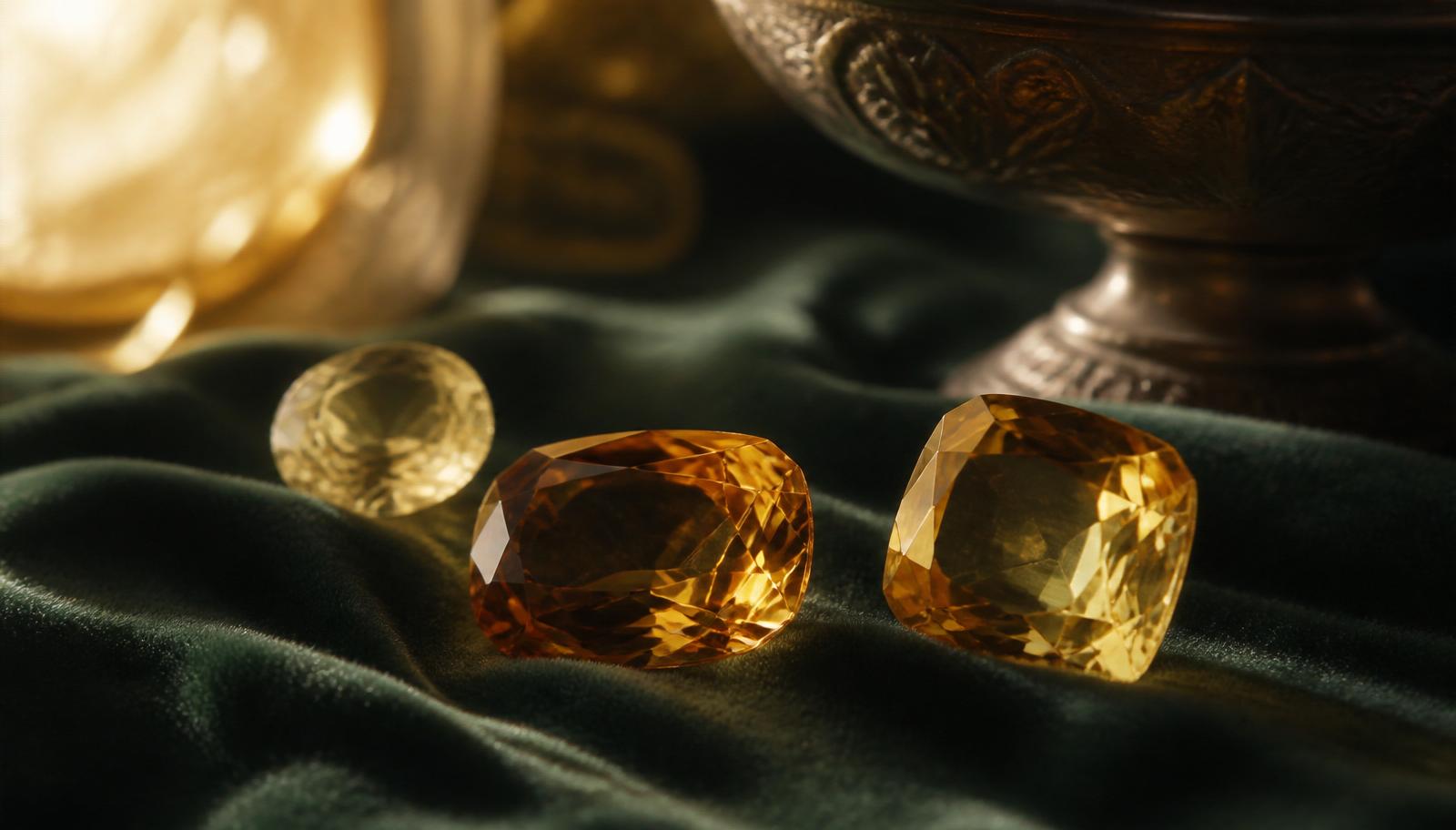
Vienna, 1885. Behind a shop window on Kärntnerstraße is a display of brooches and pendants, each price tag neatly stating 'goldtopas' or 'rauchtopas'. Some of these stones are true topaz; a larger proportion are citrine or smokey quartz — both quartz, both much cheaper than topaz, both sold under a common trade name. The customer received what they saw, the merchant called it by the name customary at the time. Only after 1900 did the requirement for precise mineralogical identification slowly become standard; anyone reading a nineteenth-century label would do well to understand that convention.
Citrine is the yellow to gold-coloured variety of quartz, the same mineral family as amethyst and smokey quartz. Topaz is an aluminium-silicate-fluoride, its own mineral family. Hardness of citrine 7; topaz 8. Chemically, optically, and physically, they are two different gemstones — yet the trade custom of calling both 'topaz' was standard for decades.
The gemstone in brief
In vintage jewellery, you encounter citrine mainly from the late Victorian period, with an absolute peak in retro (1935–1950). Large golden-yellow or orange gemstones in emerald-cut or oval cuts, set in yellow or rose gold, are typical retro cocktail pieces; the designation on old labels is almost always 'goldtopas' or 'topaz'. True topaz in antique work is rarer and usually imperial topaz (golden-orange with a pinkish hue) from Ouro Preto in Brazil.
For the broader retro context, see the retro style guide. For value questions: the price guides.
Periods in which you will encounter this gemstone
Georgian and early Victorian work (before 1860) features true imperial topaz from Ouro Preto in closed foil settings — small oval or round gemstones in yellow gold, often in necklaces with parures (matching earrings and brooches). This topaz is authentic and rare; the chance that 'topaz' on an old label is indeed topaz is higher in Georgian work than in later periods. See the Victorian style guide.
Late Victorian and Art nouveau work (1880–1910) primarily uses citrine under the name 'golden topaz'. Large oval or round gemstones in cluster settings or as a central gemstone in snake rings. Smokey quartz appears as 'smokey topaz' in Scottish granite work (Cairngorm gemstones in tartan brooches and dirk hilts) and in Viennese Jugendstil.
Retro (1935–1950) is the peak for citrine. See the retro style guide. Huge golden-yellow or orange emerald-cut or cushion-cut gemstones in solid yellow gold, flanked by wide ribbed bands — the citrine cocktail ring is one of the characteristic retro gestures. On old labels, usually 'golden topaz' or 'Madeira topaz'; in fact, almost always citrine from Brazil, usually heat-treated amethyst.
Georgian and early Victorian work (before 1860) features true imperial topaz from Ouro Preto in closed foil settings — small oval or round gemstones in yellow gold, often in necklaces with parures (matching earrings and brooches).
Old vs. modern
Historical designations are not deceptive. In the nineteenth and early twentieth century, 'golden topaz', 'Madeira topaz', and 'smokey topaz' were the common trade terminology for yellow citrine, orange-brown citrine, and smokey quartz respectively. The customer usually knew which gemstone they were buying (and paid the corresponding price); the precise mineralogical nomenclature we now demand is a twentieth-century development. Anyone reading an old label should consider the context: metal, setting, price, period.
Distinction between citrine and true topaz at a pattern level. Topaz is harder (8 vs 7) and feels heavier (density 3.5 vs 2.65). Under polarised light, true topaz shows strong double refraction; citrine is slightly double refractive, usually without a clear polarisation pattern. The colour of true imperial topaz has a slight pinkish hue; citrine is usually pure gold or orange. Certainty is only provided by a refractometer or gemmological report.
Heat treatment: the vast majority of yellow citrine on the modern market (and already in the retro period) is heat-treated amethyst. Natural citrine is rarer and usually paler yellow. Both are period-correct for twentieth-century work; the former circulated in retro cocktail rings, the latter in finer European workshop work. For blue topaz on the modern market (almost without exception irradiated), this is not vintage work, that is a post-war and especially post-1970 practice.