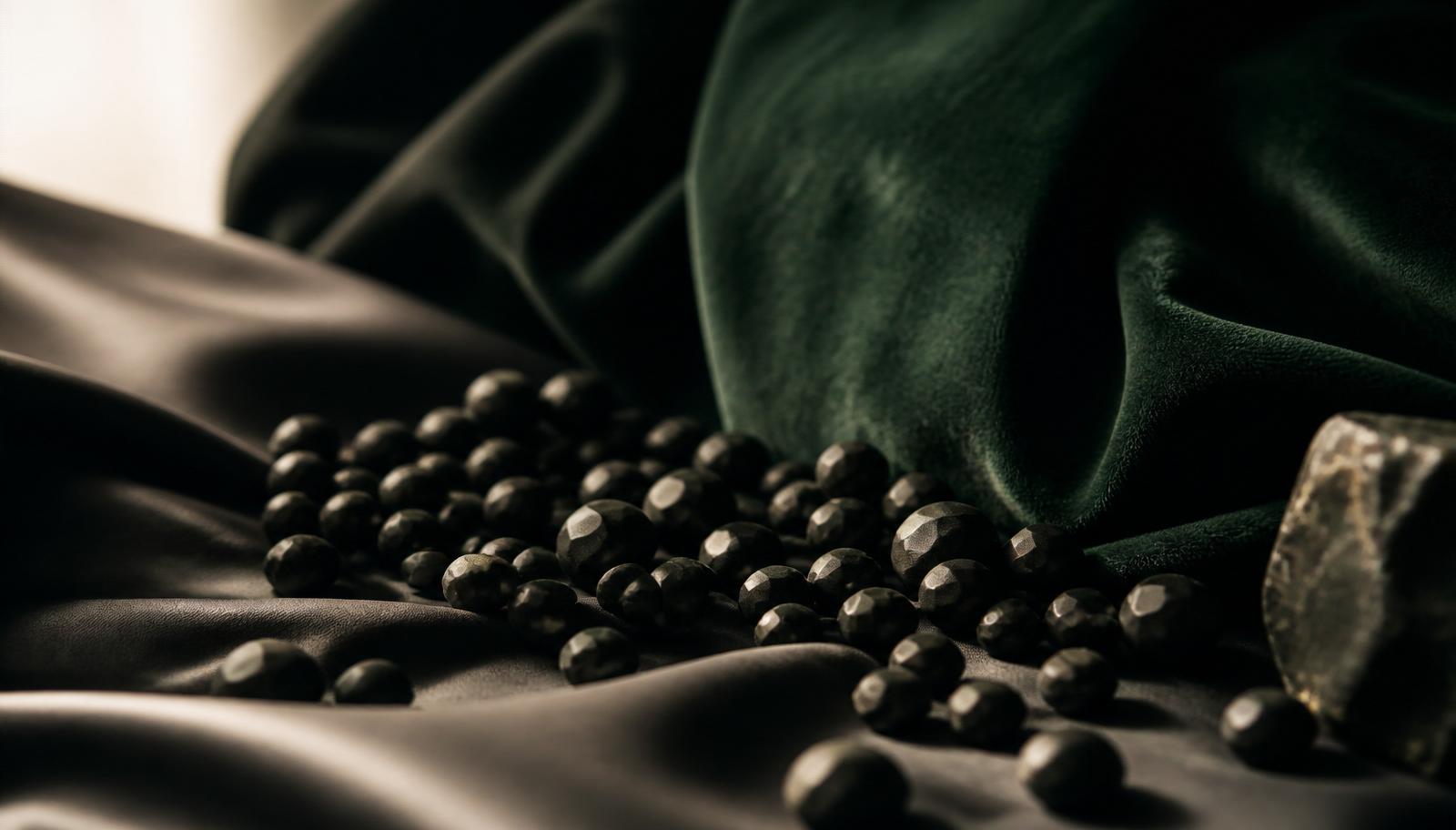
Whitby, on the Yorkshire coast, 1870s. In a workshop near the harbour, fossilised wood — black, light, easy to turn — is crafted into brooches, necklaces, and rings. Since Queen Victoria lost her husband in 1861 and mourned for four decades, the demand for Whitby jet has been so great that the town boasts dozens of workshops. Each piece receives a velvety polish that glows black in candlelight, without the harsh sheen of glass. When mourning fashion fades around 1900, most workshops close; what remains is a collector's market where the distinction between real jet and its many imitations is at the heart of the matter.
Jet is fossilised, highly compressed wood — usually Araucaria — that has been metamorphosed over millions of years into a soft, coal-like substance. Hardness is only 2.5 to 4 on the Mohs scale, density around 1.3 (significantly lighter than glass or onyx). The best material comes from Whitby; cheaper Spanish jet is more brittle and darker.
The gemstone in brief
In vintage jewellery, jet is predominantly found in the second half of the nineteenth century as a mourning gemstone. See the guide to mourning jewellery. Brooches with hairwork or miniature portraits, long necklaces (chatelaines), faceted drop earrings, and cufflinks are common forms. After 1900, demand sharply declines; what is still produced is usually no longer true Whitby jet but French jet, vulcanite, or pressed glass imitation pearl.
For the broader logic of pattern recognition: identifying reproductions. For specific value inquiries: price guides.
Periods in which this gemstone appears
Early and mid-Victorian work (1837–1880) shows jet as hand-carved and polished brooches, necklaces, and drop earrings, often with floral, scroll, or cross motifs. See the Victorian style guide. These pieces are almost always true Whitby jet; the quality of the handcraftsmanship is the primary value factor.
Late Victorian and Edwardian work (1880–1910) increasingly shows imitations. French jet (Vauxhall glass, made in French and English glass factories) appears from around 1870 as a cheaper alternative. Vulcanite (vulcanised rubber) emerges from 1855, later also ebonite; both are plastic and lighter than glass. During the same period, workshops use faceted onyx for colder, harder-glowing variations in half-mourning and memorial work.
Art Deco and later periods use black materials again — now almost exclusively onyx or black enamel — but this falls outside the actual jet tradition. For this context, see the Art Deco style guide.
Early and mid-Victorian work (1837–1880) shows jet as hand-carved and polished brooches, necklaces, and drop earrings, often with floral, scroll, or cross motifs.
Old vs. modern — the four confusions
True Whitby jet: extremely light in hand (density ~1.3), warm to the touch (does not feel cold like stone or glass), and velvety smooth when polished. Under a 10× loupe, fossil wood structure is sometimes visible; in hand-worked pieces, the facets are slightly irregular. Electrostatic: if you rub jet briefly on wool, it will attract lint (electrostatic charge).
French jet (black glass, Vauxhall glass): noticeably heavier than true jet, cold to the touch, hard glass-like lustre. Under a loupe, small air bubbles are often visible. Facets are mechanically identical — often a geometric chequerboard pattern typical of French and English pressed-glass production after 1870.
Vulcanite and ebonite: vulcanised rubber, in use from 1855. Lighter than glass but heavier than true jet, feels lukewarm (plastic), shows a smoother structure under a loupe without the fossil texture of jet. Vulcanite discolours brown over decades due to UV exposure — a sign of age that true jet does not exhibit. If you gently heat a small, inconspicuous spot (for example, with a heated needle tip in a hidden corner), vulcanite smells like rubber; jet smells like coal. Only do this if there is obvious doubt and in a hidden spot.
Onyx: faceted black chalcedony, heavier than all the above (density 2.65), cold to the touch, hard mirror-like lustre without the soft depth of jet. Under a loupe, razor-sharp facet edges without the soft polish of jet. Onyx is predominantly found in Art Deco work.