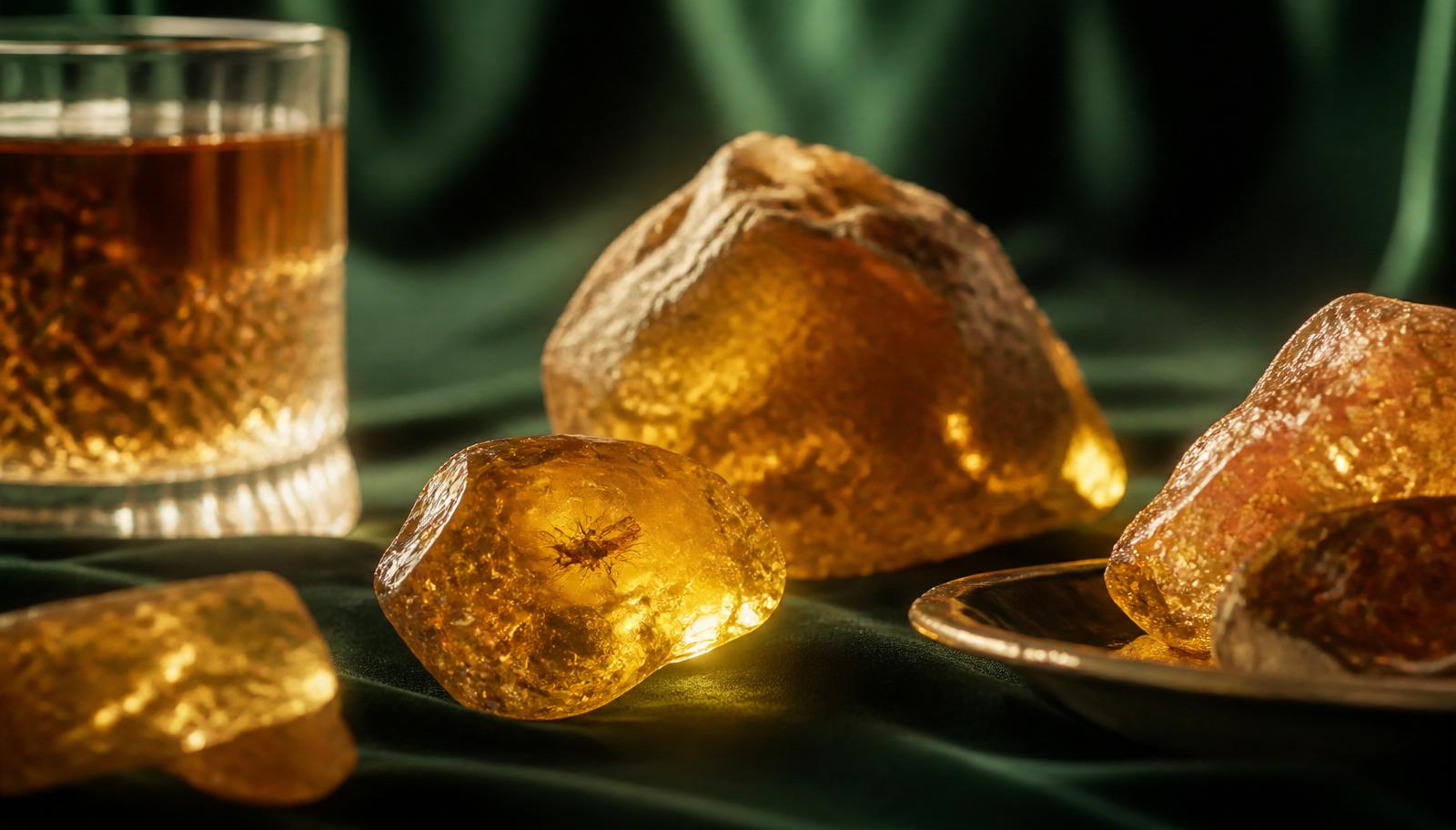
Gdansk, 1930s. In a workshop by the harbour, amber from the Baltic Sea is sorted: honey-yellow, dark cognac, rare milky-white, occasionally a lump with an insect inside. The larger pieces are cut into brooches and cabochons; the smaller pieces and fragments are heated and pressed together into ambroid — 'pressed amber', chemically identical but composed of granules. In the same years, Bakelite entered the market, and cheap amber-coloured plastics appeared, sold as 'amber'. Distinguishing between natural, pressed, and synthetic has since been at the core of the issue.
Amber is fossil resin, solidified sap from conifers from the Eocene era (roughly 35–50 million years ago). Its hardness is only 2 to 2.5 on the Mohs scale — very soft, easily scratched. Its density is between 1.05 and 1.10 — noticeably lighter than most plastics (except Bakelite), and the basis of the classic float test.
The gemstone in brief
In vintage jewellery, you mainly encounter amber in two traditions. The Baltic, dominant in Poland, Lithuania, and Germany, used amber in necklaces, brooches, and pendants from the nineteenth century continuously to today. The Chinese and Tibetan, used amber (often Burmese amber) in prayer beads and meditation objects. Both are period-correct within their own era and culture.
For context on early plastics circulating as amber: the Bakelite and early plastics guide. For the broader logic of pattern recognition: identifying reproductions.
When you encounter this gemstone
Nineteenth-century Baltic amber appears in long necklaces, in brooches with a central large cabochon, and in drop earrings. The mounting is typically low-carat gold (8–10 carat) or gold-plated brass; high-carat work is rare because the stone itself was not considered 'precious'. Inclusions (insects, plant remains) were less valued then than they are today — a large clean honey sphere was more highly valued in the nineteenth century than a stone with a spider in it. That taste has thoroughly changed.
Art-nouveau work (1890–1910) uses amber in smaller cabochons in elaborate gold settings, often in combination with pearls or enamel. See the art-nouveau style guide. In the same period, the amber industry in Königsberg (now Kaliningrad) became large-scale; ambroid was industrially produced from around 1880.
Post-war Baltic necklaces are a category in themselves. Many old necklaces have been restrung — sometimes multiple times — because the thread wears out. This is not a defect but common practice; however, it is important whether the beads themselves are original and whether the stringing order (large to small, or gradually changing in colour) is intact.
Nineteenth-century Baltic amber appears in long necklaces, in brooches with a central large cabochon, and in drop earrings.
Old vs modern
Natural amber versus ambroid. Natural material shows an even internal structure under a 10× loupe, sometimes with small air bubbles or flow structures. Ambroid (pressed) often shows characteristic 'clumps' where the granules have been fused together — a slightly cloudy texture not present in natural work. Under polarized light, ambroid shows typical interference patterns. Both are chemically real resin; ambroid is period-correct from around 1880 and has its own collector's value but is a level below natural.
Plastic imitations at a pattern level. Early twentieth-century Bakelite imitations (from around 1910) show an even, slightly flatter structure under a loupe; they are heavier than amber (density 1.25–1.4) and sink in saltwater. Post-war celluloid, acrylate, and polystyrene imitations are lighter and often have too uniform a colour without the natural variation of amber.
The salt water float test is the classic first indication, with limitations. Dissolve approximately 25 grams of salt in 200 ml of water (saturated solution). Natural amber and ambroid float; most plastics (except polystyrene foam, which also floats due to its structure) sink. The test fails with hollow beads, settings with metal (which pulls them down), and polystyrene. Consider it an indication, not proof; for certainty in significant purchases, a gemmological report is necessary.