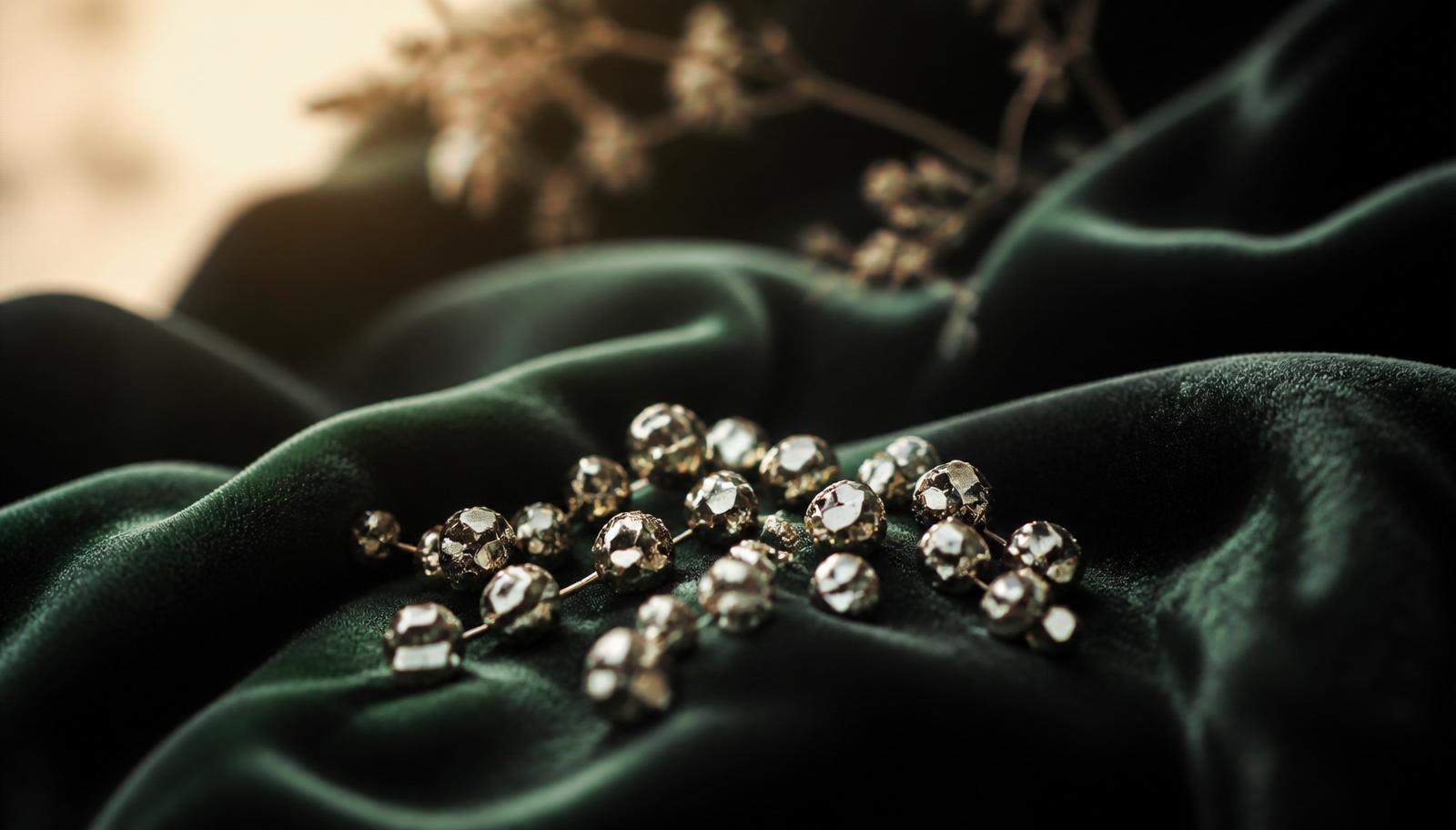
Pforzheim, 1930s. In a medium-sized workshop, dozens of marcasite brooches and clips are made daily: small triangular or square pyrite facets hand-set in forged silver mounts, geometrically arranged in rays, fans, and up-and-down patterns. The client is a middle-class woman who wants the art-deco look without the diamond price; the workshop delivers a well-finished jewel with a genuine precious metal base. Seventy years later, that same brooch lies in a display cabinet at an antique dealer — often less than a tenth of the value of a comparable diamond piece, but with its own collecting market that is slowly awakening.
Marcasite in the jewellery trade is almost always pyrite (iron sulphide), not mineralogical marcasite (which is unstable and oxidises). The trade name is confusing but has grown historically and is standard worldwide. Small triangular, square, or round facets are set in box or tube settings, usually in forged silver mounts — the combination is so consistent that marcasite in gold is virtually non-existent.
The stone in brief
In vintage jewellery, marcasite is encountered primarily in two waves. The first is Georgian and early-Victorian (1780–1840) where marcasite is set as a cheaper alternative to diamond in small sterling silver brooches and buckles. The second and by far the most important is art deco (1920–1935) in which the geometric order of the style perfectly suits the rectangular facets of marcasite.
For the broader style context, see the art-deco style guide. For value questions regarding brooches and brooch clips: the vintage brooches price guide. For the silver mount aspect: the hallmarks guide.
Periods in which this stone is found
Georgian and early-Victorian work (1780–1840) features marcasite in forged sterling silver brooches, shoe buckles, and drop earrings. Hand craftsmanship is visible: each facet is hand-set, the silver mount is slightly irregular, the back often not flat. These early pieces are rarer than later work and carry their own premium.
Art deco (1920–1935) is the peak. See the art-deco style guide. Marcasite now comes in two quality levels: hand-set work in fine silver mounts (mostly German Pforzheim or French Paris) and cast work in which the marcasites are inlaid in bulk. Hand-set work shows individually polished facets that differ slightly under magnification; cast work shows uniform facets without manual character. Both are period-correct; hand-set work is considerably more highly valued.
Post-war (1950–1970) marcasite remained in production, especially in Germany and Thailand. Quality is variable — most work is machine-made and has thinner mounts. Retro marcasite is period-correct for that era but is a level below art-deco workshop work.
Georgian and early-Victorian work (1780–1840) features marcasite in forged sterling silver brooches, shoe buckles, and drop earrings.
Old vs. modern
Hand-set versus cast work is the core distinction. In hand-set work, individual marcasites are secured in small pots or box settings with tiny claws or foiled. Under a 10× loupe, you can see that each facet is set slightly differently, polished slightly differently, and that the claws are bent manually. In cast work, the marcasites are moulded into the model, and everything is mechanically uniform — recognisable by identical spacing and equal facet angles. For the broader logic of pattern recognition: recognising reproductions.
Why almost always silver? Pyrite oxidises on contact with gold alloys (which often contain copper) and causes staining. Silver itself also oxidises (darkening in the air), but the silver-pyrite combination is stable. Historical workshops discovered this through damage and endorsed silver as the fixed partner. A marcasite jewel in gold is almost without exception modern (post-war) mass-produced work or a repair.
Maintenance requires vigilance. Marcasites can come loose if the silver settings weaken; regularly check with a loupe that all stones are secure. Clean only with a soft dry cloth — ultrasonic cleaning and water baths can dislodge loose marcasites, which may then be irrecoverably lost.