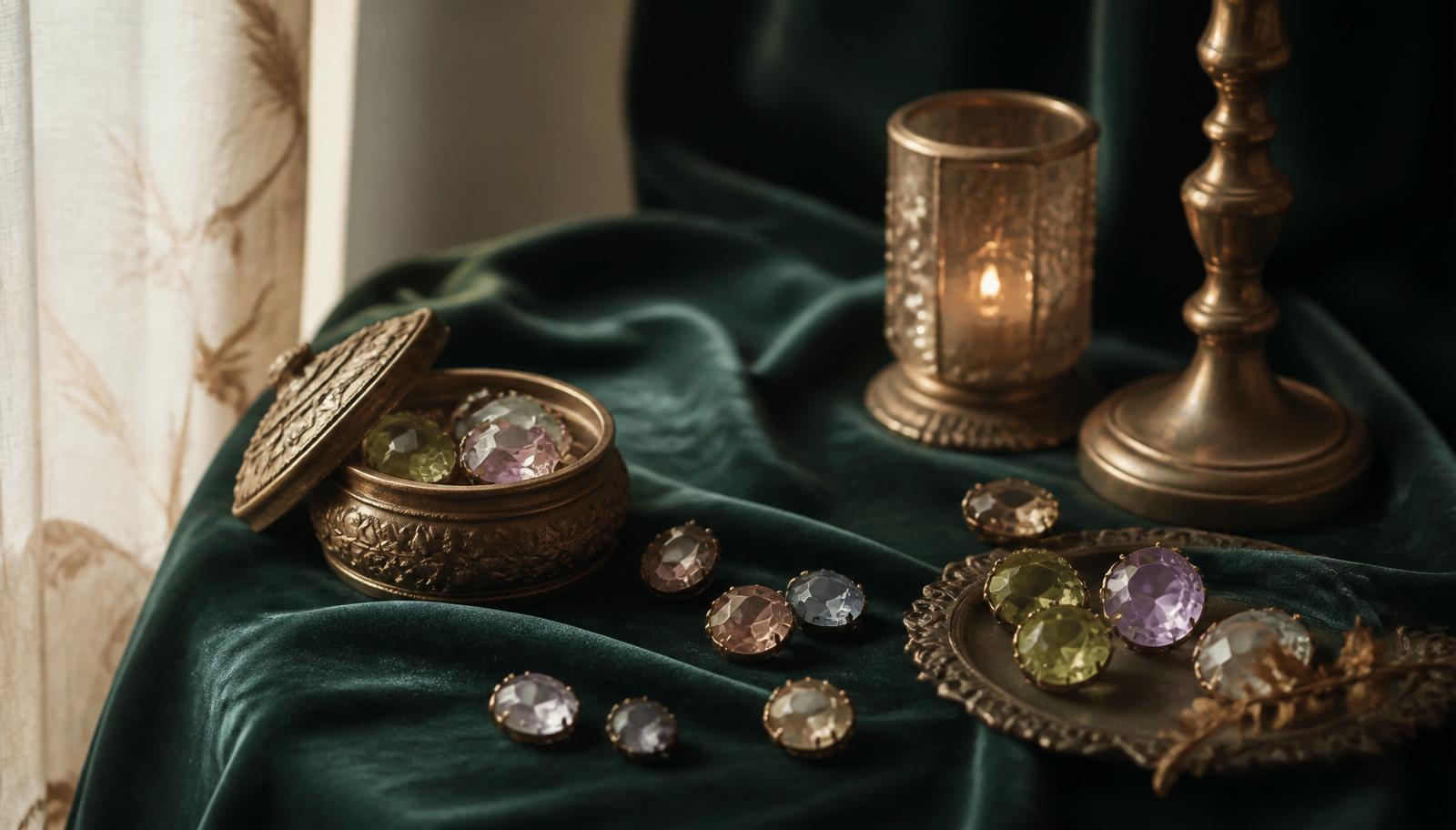
Paris, 1770s. In the workshop of Georges Frédéric Strass — the Alsatian jeweller whose name would become the generic term for lead crystal faceted stones — an apprentice hand-cuts facets into a block of glass. It is not imitation-diamond in the modern sense; it is a craft in its own right with its own aesthetic conventions. The stone is foiled (a thin layer of silver or tin foil against the back) to reflect light, and set in a closed pot of silver or low-carat gold that must not come into contact with water. Customers from the nobility and affluent bourgeoisie bought paste for formal occasions, for travel sets, and for work where diamond was not technically or financially suitable. Two centuries later, that work has become a collector's market.
Paste is lead crystal glass with a high refractive index — technically significantly higher than ordinary glass, close to that of quartz. Hand-cut facets, usually in old-brilliant or table-cut, give a deep and warm sparkle that differs from both diamond and modern machine-cut rhinestones. In good work, the facets are slightly irregular, which makes the sparkle less sharp but richer.
The stone in brief
In vintage jewellery, you encounter paste mainly in Georgian work (1770–1830) and in continuous French and English work until around 1900. From the 1920s, the terminology shifts to 'strass' and 'rhinestone'; post-war American costume jewellery from Providence and Attleboro (Trifari, Coro, Weiss) uses strass on an industrial scale in designs that are famous in their own right.
For the context of post-war American strass work: the costume jewellery guide. For maintenance of foiled settings: the maintenance guide. Key message: old paste is not 'fake' but a historic craft with its own collectible value.
Periods in which you will find this stone
Georgian work (1770–1830) shows paste in closed foiled settings, usually in forged silver or low-carat gold mounts, with individually faceted stones that show manual irregularity. See the context in recognising reproductions: be careful with the word 'reproduction' for Georgian paste — it is period-authentic, not imitation. These pieces now command their own premium at auction.
Victorian work (1837–1900) uses paste both in new finer work and in fashion jewellery. For broader setting conventions, see the Victorian style guide. In this period, black and coloured paste also appear — an '1880 black diamond' brooch is almost certainly paste with black foil backing, and that is authentic.
Post-war American rhinestones (1935–1970) are a category of their own. See the costume jewellery guide. These stones are machine-cut, usually in Austria (Swarovski, industrially active from 1892) or Czechoslovakia, and mounted on designs by Trifari, Coro, Weiss, and Eisenberg. It is a collecting area of its own that should not be confused with Georgian paste.
Georgian work (1770–1830) shows paste in closed foiled settings, usually in forged silver or low-carat gold mounts, with individually faceted stones that show manual irregularity.
Old vs. modern
Hand-cut paste versus machine-cut rhinestones. Under a 10× loupe, Georgian or early Victorian paste shows slightly irregular facets — no two stones are identically polished — and sometimes tiny air bubbles in the glass. Machine-cut rhinestones (post-1900, predominantly post-1935) show identical facets with sharp edges and without air bubbles. Both are period-correct within their own era.
Foil backing is a key characteristic of old work. With paste in a closed setting, there is a thin foil (usually silver, tin, or coloured metal) against the back that reflects light and enhances the sparkle. This is why old paste must NEVER be put in water: if moisture penetrates between the stone and the foil, the foil oxidises and the stone discolours irreparably (dark spots, dull areas). See the maintenance guide. Repairing damaged foil backing is specialist work; a modern jeweller usually 'solves' it by replacing the foil with an open setting, which destroys the authenticity.
Colour and coloured paste. In Georgian and Victorian work, green, blue, red, yellow, and black paste appear. The colour is in the glass AND in the foil backing; both contribute. An 'emerald-paste' brooch from 1810 is an authentic Georgian paste brooch, not a fake emerald. Valuation is within its own paste field, not in comparison with gemstones.