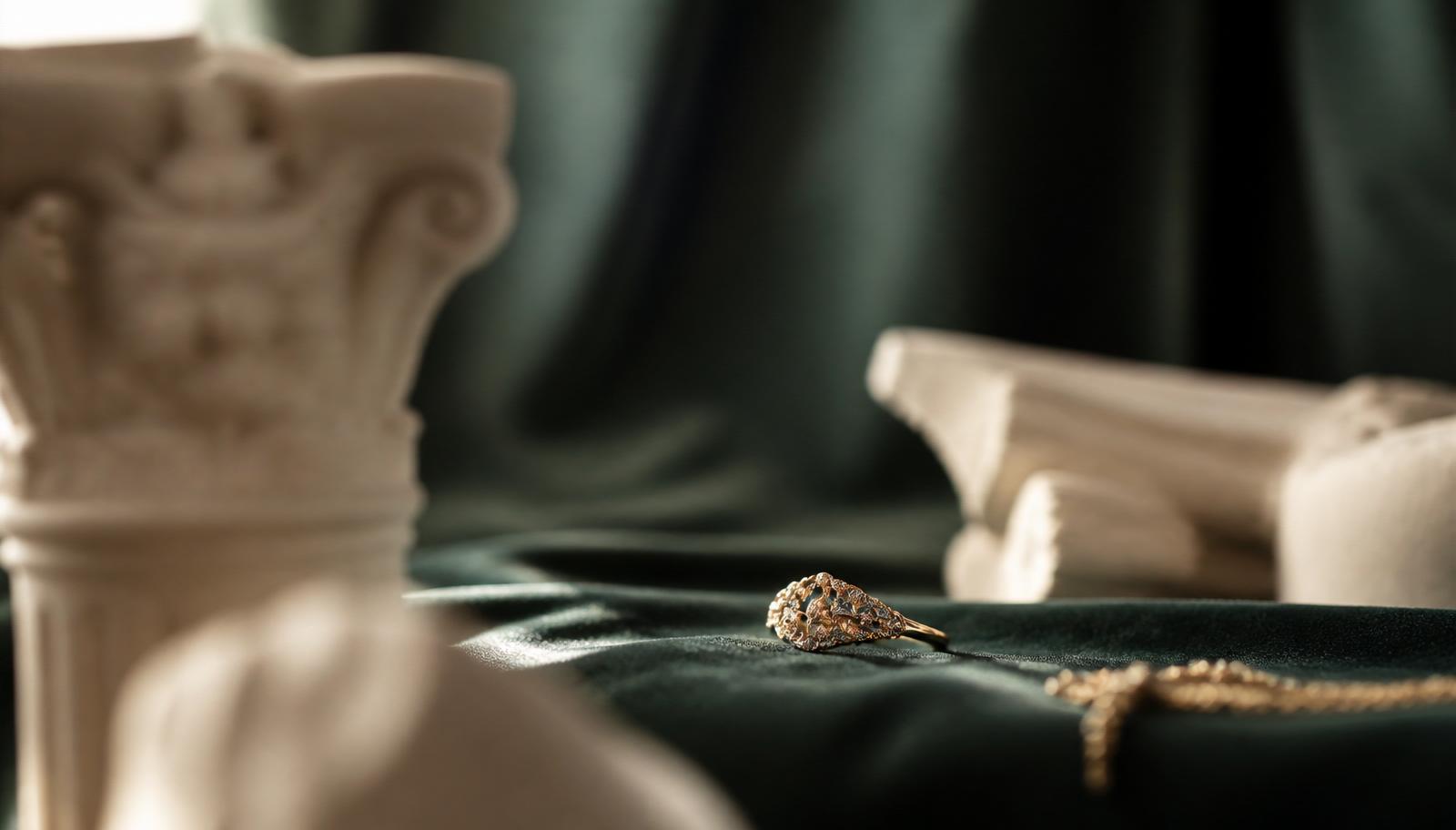
Somewhere in the Netherlands, 2026. From an estate emerges a finely carved brooch: a small relief of an angel, cameo-sized, set in a gold mounting from approximately 1890. The material question immediately arises: is this ivory, or bone, or a nineteenth-century imitation in celluloid? The legal question follows directly: if it is real ivory, can it still be sold or inherited, and if so, under what conditions? This guide answers the first question at a pattern level. The second question is a legal issue for which you should consult RVO and the Dutch CITES authority — this page provides no legal advice and explicitly refers you onward.
Ivory is the worked tusk of elephants (African or Asian); walrus, hippopotamus, and sperm whale historically also provided 'ivory' material in smaller quantities. Bone is usually bovine or whale bone and was used as a cheaper alternative. Both are organic materials, both soft (Mohs 2–3), and confusingly similar at a distance. Under a 10× loupe, however, they show different structures that allow for distinction.
The gemstone in short
In vintage jewellery, you mainly encounter ivory from the nineteenth century onwards in cameos, pendants, beads, carved flowers, and 'hand with a heart' pendants (miniature figure charms). Bone appears in cheaper work from the same period. From approximately 1870, celluloid ('French ivory' as a trade name) appears as a plastic imitation; from approximately 1910, Bakelite largely replaces the cheapest imitations.
For the framework of plastics: the Bakelite and early plastics guide. For the broader logic of pattern recognition: recognising reproductions.
Periods in which you encounter this gemstone
Nineteenth-century European work uses ivory in cameos (often imitations of classical Greek or Roman portraits) and in carved brooches with flowers, roses, or religious motifs. See the Victorian style guide. Most material came via trade routes from Zanzibar or Congo to European workshops; Dieppe and Erbach (Germany) were the main carving centres.
Art nouveau and Edwardian work (1890–1910) uses ivory in delicately carved pendants and cameos, often in gold mountings. In the same period, celluloid production increased exponentially; much of what was sold as 'ivory' was already 'French ivory' — celluloid with a striped structure that at a distance resembles real ivory.
Interwar and post-war (1920–1970) shows a gradual decline of real ivory due to scarcity and later due to regulations. CITES (the international convention on trade in endangered species of wild fauna and flora) came into force in 1975; the African elephant was placed on Appendix I in 1989 with an international trade ban. For EU rules since then, see below.
Nineteenth-century European work uses ivory in cameos (often imitations of classical Greek or Roman portraits) and in carved brooches with flowers, roses, or religious motifs.
Distinguishing ivory, bone, and celluloid at a pattern level
Ivory: under a 10× loupe, worked ivory surfaces show the so-called Retzius lines (also known as Schreger lines or engine-turning pattern) — fine crossed lines that manifest as a moiré pattern or a rotated checkerboard. In African elephant ivory, the lines cross at an angle of more than 115 degrees; in Asian, at less than 90 degrees. This is the definitive visual characteristic. Ivory also feels heavier and warmer than celluloid and has a slight, creamy natural colour variation.
Bone: under a loupe, worked bone surfaces show so-called Haversian canals — small round or oval pores where blood vessels ran through the bone matrix. These are most clearly visible on a cross-section; on a polished surface often as small dark dots or streaks. Bone completely lacks the Retzius lines of ivory. Colour is usually whiter and more homogeneous; texture slightly coarser.
Celluloid ('French ivory'): under a loupe, this typically shows regular parallel stripes pressed in during production to imitate ivory texture. The stripes are too uniform, too parallel; real ivory lines cross each other. Celluloid is also noticeably lighter, feels lukewarm (plastic), and smells of camphor when heated — only do the latter if absolutely necessary, in a hidden spot, with a heated needlepoint. Bakelite imitations are heavier than celluloid but show no ivory texture under a loupe and smell of formaldehyde when heated.