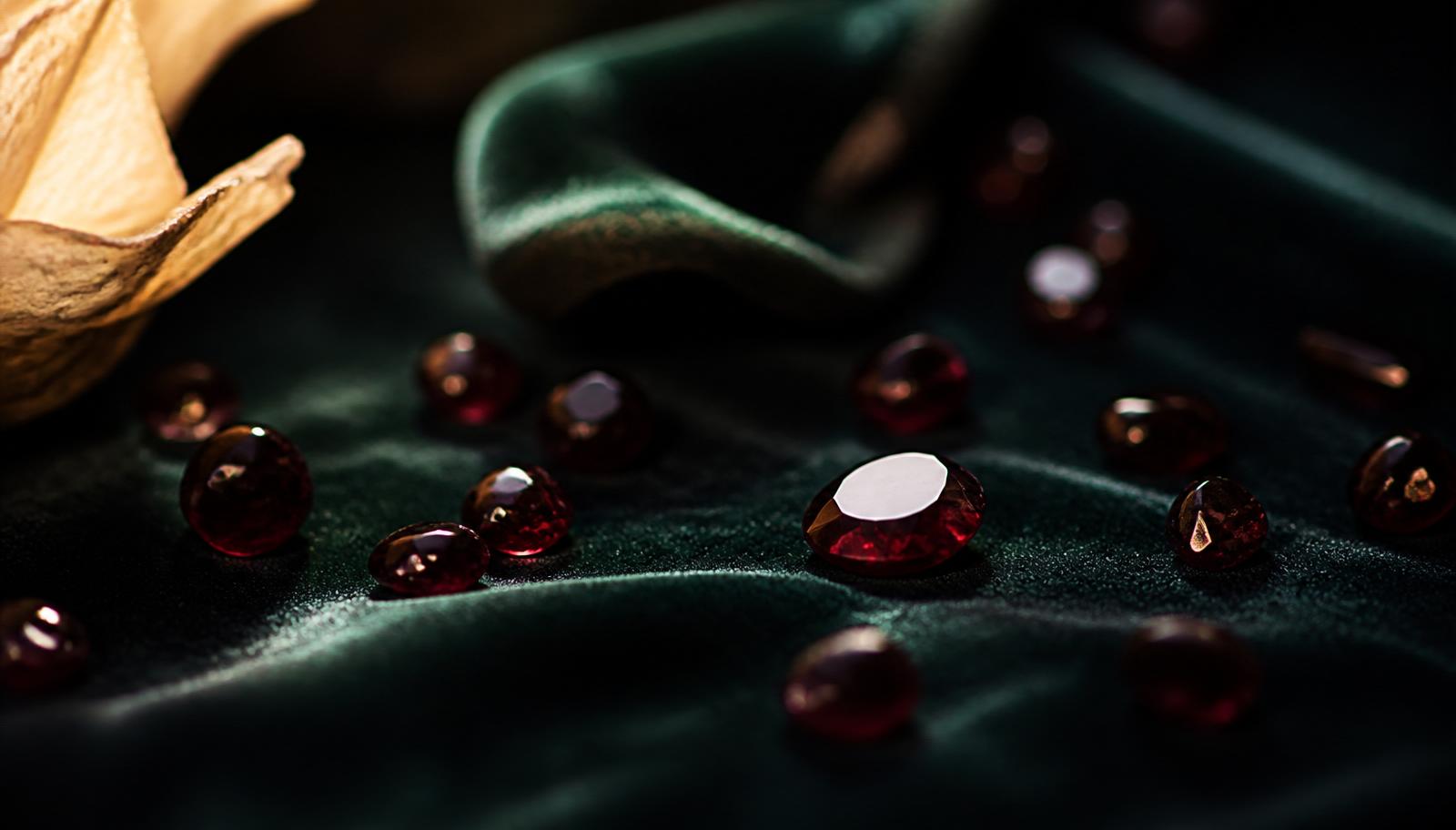
Turnov, Northern Bohemia, circa 1900. In a small cutting workshop by the river, two journeymen hunch over a table filled with trays of tiny red stones. Each stone is picked up with fine tweezers, turned against the light, and set into a thin tube of yellow-lacquered silver or low-carat gold. The tubes are mounted closely together on a casting in the shape of a flower, a star, or a heart; there is no foil beneath the stones, their own deep red is enough. What is being worked on here is shipped by the hundreds at the end of the week to Vienna, Berlin, and the resorts on the Adriatic coast: classic Bohemian garnet jewellery at its productive peak, somewhere between 1880 and 1915.
Garnet is not a single stone but a mineral family. For vintage work, there are three types that really matter: pyrope (the small, deep red-to-dark-red stones of Bohemian work), almandine (the larger, slightly browner and darker cabochons of Georgian and early Victorian work), and demantoid (the rare green garnet from the Russian Urals, a collector's stone). Other garnet varieties — spessartine, grossular, tsavorite — play a marginal role in vintage jewellery and belong to the modern market.
The stone in brief
The hardness of garnet ranges from 6.5 to 7.5 on the Mohs scale, depending on the type — hard enough for daily wear, but not indestructible. Pyrope and almandine share the classic garnet red with a slight brown or purple tinge; demantoid is green, with a dispersion that approaches that of diamond. Large garnets are rarer than small ones: pyrope naturally occurs mostly in small crystals, which explains the dense micro-mosaic of Bohemian work both technically and aesthetically.
This guide covers types and identification. For value and collecting levels, there is a separate garnet jewellery price guide: it covers bandwidths per period, style, and condition. The two guides are deliberately separated and link to each other without duplicating passages.
Periods in which you encounter this stone
Georgian and early Victorian work (before ±1860) mainly features almandine: larger oval or round cabochons in closed foil settings, in yellow gold or gold vermeil. See the Victorian style guide for the setting conventions of that period. The almandine cabochon as a central stone in rings and brooches has a deeper, warmer red due to the foil than if open-set — removing the foil during 'restoration' irrevocably alters the character of the stone.
Bohemian pyrope work experienced its absolute heyday between 1880 and 1915. Small, intensely red pyrope stones are set closely together in castings of tombac, low-carat gold (8 carat is common) or gilded base alloys; typical arrangements include flowers, hearts, stars, and clusters. This style runs parallel to late Victorian and Edwardian fashion; see also the Edwardian style guide. The micro-mosaic is a trademark: the metal is barely visible between the stones.
Demantoid emerged after its discovery in the Russian Urals (1860s) and circulated mainly between 1880 and 1917 in finer workshop pieces from St. Petersburg (think Fabergé generation), but also in Parisian and Viennese Edwardian rings. Demand fell after the Russian Revolution; the modern market for demantoid is a collector's niche. At a pattern level, the characteristic green sparkle (a lively, slightly apple-green tone with strong dispersion) is a trademark — the exact determination of origin remains laboratory work.
Georgian and early Victorian work (before ±1860) mainly features almandine: larger oval or round cabochons in closed foil settings, in yellow gold or gold vermeil.
Old vs. modern
Why garnet is almost always a deeper and browner red than ruby has to do with chromophore and density. Almandine and pyrope carry iron as the colourant, which gives a browner undertone; ruby is chromium-coloured corundum, which produces the typical lively, slightly blue red (pigeon blood). In practice: a red-brown or dark wine-red stone in old work is almost certainly garnet; a lively, slightly blue-tinted red is suspicious ruby (and deserves certification for significant purchases). For the ruby context: ruby in vintage jewellery.
Verneuil synthetic garnet does not exist as a product line — garnet has never been a primary synthesis target, as the material was cheap and abundant in its rough form. What you do encounter are glass imitations (red 'garnet glass' in nineteenth-century mass-produced items) and, in the second half of the twentieth century, created YAG and GGG which were sometimes labelled as 'garnet' without being so. For the pattern surrounding created and synthetic variants in a vintage context: identifying reproductions.
Cut: small pyrope stones are traditionally rose-cut or simply faceted — quick and efficient, focused on light still returning through the dense setting. Almandine cabochons, conversely, are carefully rounded and polished, sometimes hollowed out on the underside to increase transparency (hollow-back cabochon). Demantoid is more often faceted to bring out its dispersion. For the broader reading guide on cuts: cuts — a reading guide.