Paris, 1925. In the display case of an Art Deco workshop lies a long sautoir with a central pendant of translucent apple-green jade, flanked by black onyx and small rose-cut diamonds. The piece was made in the French capital, but the material comes from afar: this is jadeite from Upper Burma, traded via Hong Kong and Shanghai and cut in Europe by master lapidaries who adopted the ancient Asian tradition. In these same years, jade first entered Western fashion en masse — the Art Deco jade wave — and with that wave came a wave of imitations, treatments, and confusion that persists to this day.
Jade is a confusing name because it refers to two different minerals. Jadeite is a sodium-aluminium pyroxene; nephrite is a calcium-magnesium amphibole. Chemically, structurally, and optically, they differ fundamentally, yet both are tough, dense, and highly polishable, and both are traditionally denoted as 玉 (yù) in Chinese. For Western collecting, the distinction is essential: jadeite is rarer, more expensive, and the material of most high-quality Art Deco pieces; nephrite is more abundant, duller, and the material of much ethnographic and nineteenth-century work.
The stone in brief
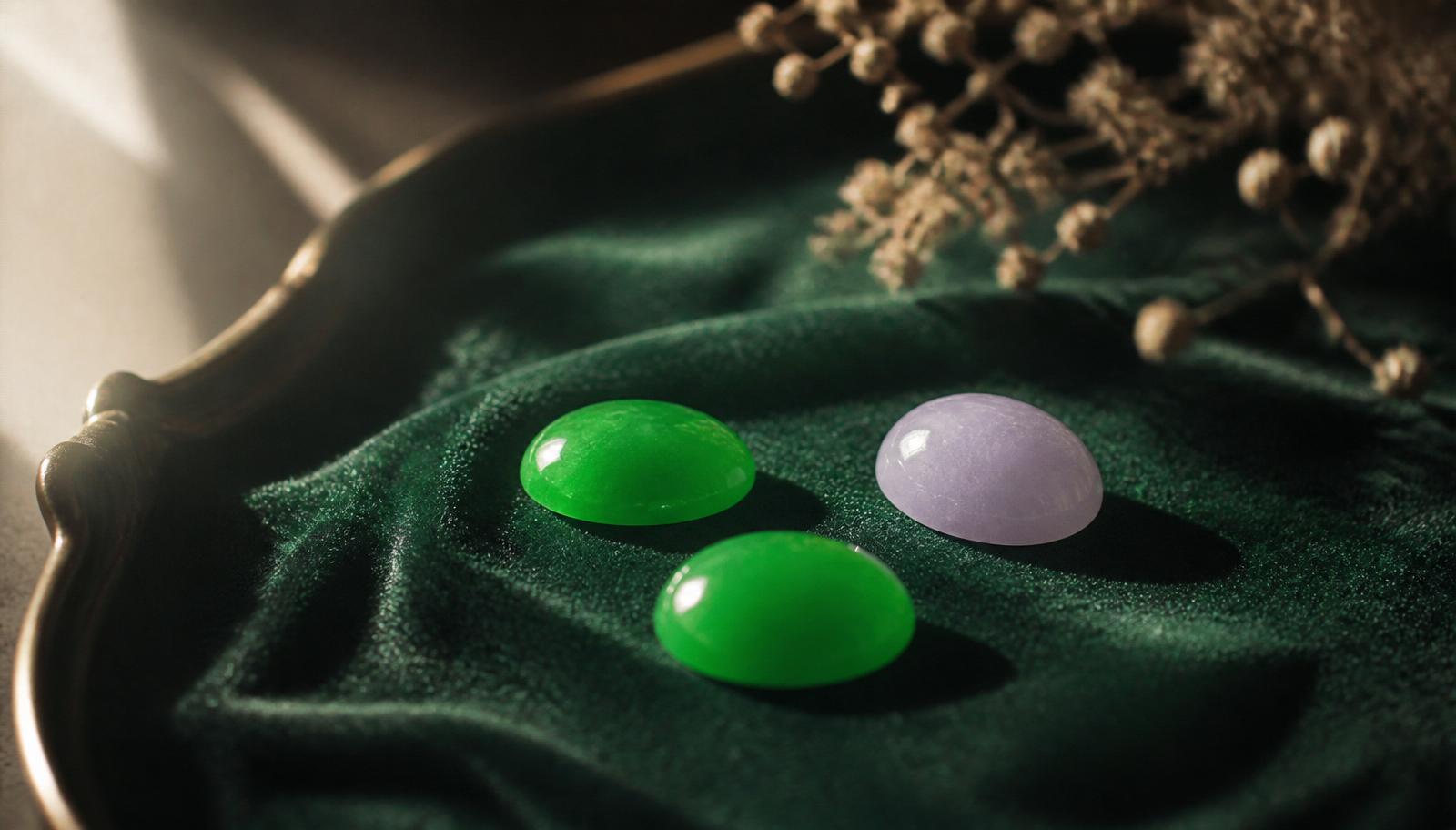
At a pattern level, jadeite is recognisable by a finer, more granular structure that shows a 'hammered' surface under magnification; good material is translucent and has a vibrant lustre. Nephrite is more compact, fibrous in structure, with an oily-smooth, slightly soapy lustre and is usually less translucent. The colours overlap: both exist in white, green, yellow, brown, and black, but the characteristic Imperial Green (vibrant, translucent apple-green) belongs to jadeite, and the classic 'spinach' and 'mutton fat' hues to nephrite.
The hardness for both is 6 to 7 on the Mohs scale — not extremely hard, but due to its dense structure, very tough (rarely breaks or cleaves). Precise determination between jadeite and nephrite and between jade and imitations (serpentine, chrysoprase, dolomite, glass) requires a refractometer, density measurement, or infrared spectroscopy; eye inspection only gives strong suspicions.
In which periods you encounter this stone
In Victorian work (1837–1901), jade appears as an exotic import material in curio pieces: cabochons in brooches, carvings in pendants, and sometimes as a central stone in Chinoiserie rings. Nephrite from North China or New Zealand (pounamu) dominates the supply; jadeite only structurally entered the Western market after the opening of the Burmese mines in the mid-nineteenth century. See the Victorian style guide.
Art Deco (1920–1935) is the heyday of jade in Western jewellery. See the Art Deco style guide. The geometric aesthetic of the period lent itself perfectly to carved or milled jade plaques combined with onyx, crystal, and diamond; Cartier, Boucheron, and Van Cleef & Arpels created iconic pieces in this vein. The translucent green jadeite cabochon in a platinum ring with a rose-cut diamond border is a hallmark of the period.
In Retro and Mid-Century work (1935–1960), jade remains popular, especially in cocktail rings and Asian-inspired parures. The material is then usually combined with yellow gold and more often has the more robust, slightly less translucent quality. From the 1970s onwards, treated and coloured material (see below) captured an increasing share of the market.
In Victorian work (1837–1901), jade appears as an exotic import material in curio pieces: cabochons in brooches, carvings in pendants, and sometimes as a central stone in Chinoiserie rings.
Old vs modern
Why jade is the most imitated and treated material on this list has a simple cause: good jadeite is rare and expensive, and the market is enormous. In trade today, three codes apply. A-jade is natural, untreated material (apart from a possible surface wax); this is the only material that retains its colour and lustre in the long term and is considered collectible. B-jade is natural jadeite that has been treated with strong acid to etch away impurities and then impregnated with polymer resin — the colour is real but the structure is damaged and the resin ages (discolours, becomes brittle). C-jade is natural jadeite that has been permeated with dye; the colour fades over years to decades. B+C-jade combines both treatments.
For vintage purchases, this means: for significant purchases, always ensure certification by a reputable gemmological laboratory, explicitly stating whether the material is A, B, C, or B+C and whether it is jadeite or nephrite. For the broader pattern of treatments and imitations in vintage: identifying reproductions.
Imitation materials that visually resemble jade are numerous: serpentine (New Jade, Bowenite), chrysoprase, green aventurine, artificial glass, dyed dolomite ('Malaysia jade'), and coloured quartzite. In vintage work, glass imitations and serpentine are most common; polymer resin treatments are a modern issue and are hardly found in pieces predating 1970. A 'jade' Art Deco ring with flawless colour and complete purity deserves suspicion; genuine A-material almost always shows internal variation.