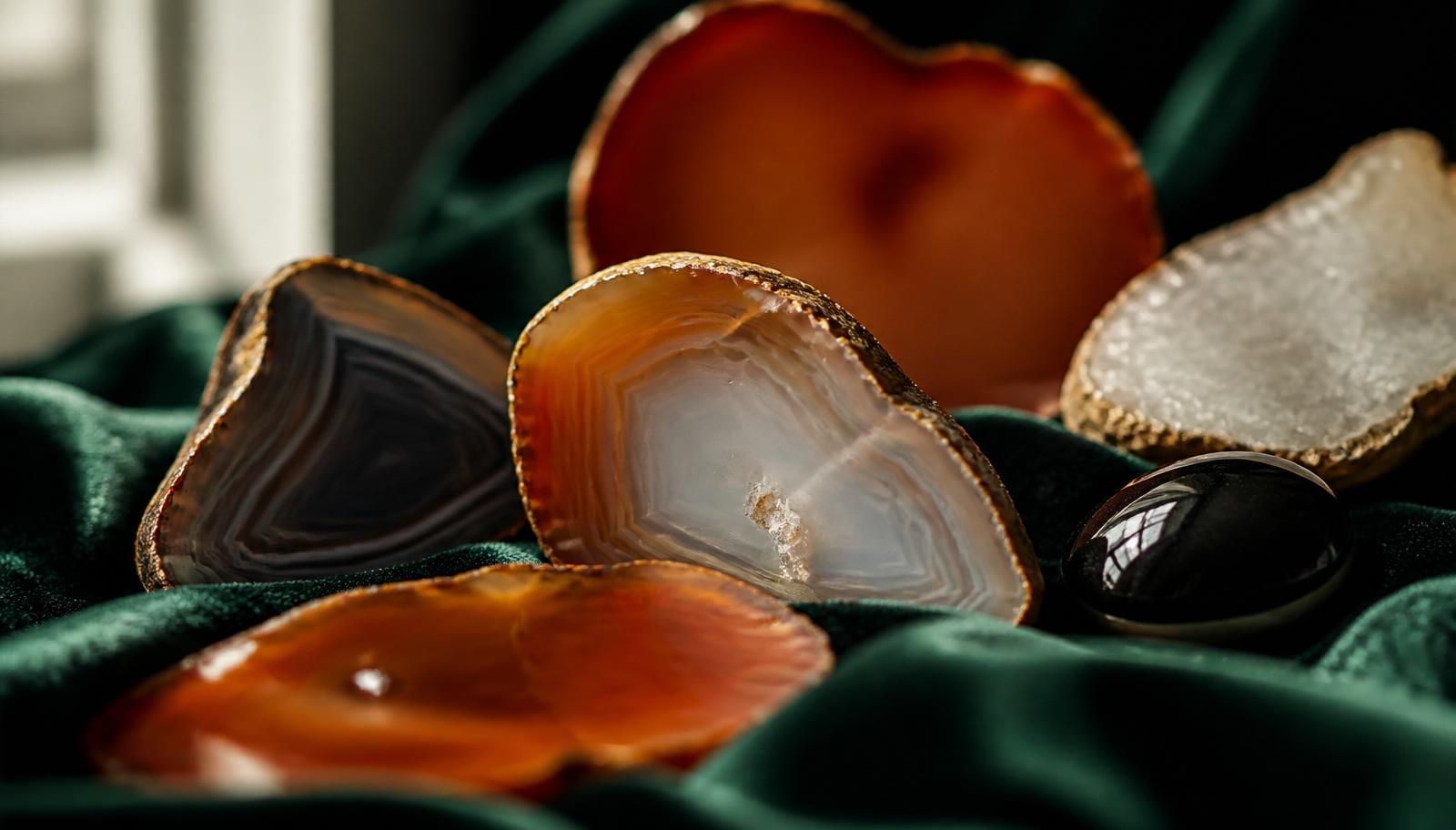
Idar-Oberstein, Germany, circa 1880. On the Nahe river, waterwheels clatter, powering the agate cutting workshops; since the sixteenth century, rough chalcedony from local mines (and later from Brazil) has been processed here into cabochons, seal plates, and cameos. It is the centre of a craft that serves all of Europe: from the black onyx plates that would later have a gold monogram engraved in Vienna or Paris, to the multi-layered striped sardonyx blocks on which Italian and German carvers create portrait cameos. Anyone acquiring a vintage signet ring or cameo is, with great probability, holding material that came onto the market via Idar-Oberstein or a Neapolitan workshop.
Onyx, agate, carnelian, and sardonyx belong to the same mineral family: chalcedony, a microcrystalline variety of quartz. What distinguishes them is colour and the presence of bands. Agate has concentric or wavy coloured banding. Onyx is agate with straight, parallel bands — traditionally black with white, but the trade name 'onyx' today is almost exclusively used for solid black material. Carnelian is orange to reddish-brown solid chalcedony. Sardonyx combines the straight bands of onyx with the warm hue of sard (brown-red).
The Stone in Brief
The hardness for the entire family is around 6.5 to 7 on the Mohs scale — hard enough for daily wear, tough enough to carve without splitting. This makes the family the historical material par excellence for carving: signet rings with coats of arms or initials, cameos with portraits or mythological scenes, and intaglio (sunken carving for wax seals). The dull, slightly greasy polishing lustre is characteristic and clearly differs from glass.
For the motif context: signet rings as family heirlooms and the cameo — portrait in layered stone discuss these stones from the perspective of their use. This guide is about the material itself.
In which periods you will encounter this stone
In Georgian and Victorian work (before 1901), the chalcedony family is prominently featured. Signet rings with a carnelian or sardonyx plate, into which a family crest or monogram is sunken, are the classic expression of authority and provenance; the sardonyx cameo with a portrait in relief gains ground from around 1820 and experiences a productive peak in Neapolitan work towards the middle of the century. See the Victorian style guide.
Onyx takes on a second role in the late-Victorian period: that of a mourning stone. Alongside jet, black onyx (sometimes called 'French jet', confusingly, as that is glass) is used in half-mourning jewellery, in lockets with a strand of hair, and in simple necklaces. The distinction from jet is essential: onyx is a stone (chalcedony, cold to the touch), jet is fossilised wood (organic, warm and light to the touch). For the broader black-material distinction: jet — the black of mourning culture.
In art deco (1920–1935), onyx experiences its absolute heyday. See the Art Deco style guide. Solid black onyx plates and baguettes are used as a graphic contrast against white platinum and diamond: the classic black and white combination in necklaces, sautoirs, brooches, and watch bracelets. Calibré-cut onyx lines along a platinum setting are a trademark of the period. Large onyx cabochons return in the retro rings of the 1930s and 1940s.
In Georgian and Victorian work (before 1901), the chalcedony family is prominently featured.
Old vs Modern
Coloured versus natural at the pattern level. Chalcedony has been a stone that undergoes colour treatment since Antiquity: boiling sugar or honey solutions followed by heating make agate and sardonyx more contrasting; alkaline solutions yield black onyx. These treatments are historical and fully accepted — almost all black onyx on the market (both modern and vintage) is treated natural chalcedony; untreated black onyx is rare. This does not make the material less authentic: it has been the norm since Roman times.
The same applies to carnelian: most carnelian on the market is heat-treated (naturally paler) chalcedony that has been transformed to a deeper orange-red. Untreated deep carnelian does exist, but is rare. Colour authenticity is not a strictly valid criterion for this family; identification as 'genuine chalcedony' is.
Substitute materials: black glass ('French jet'), coloured plastics (Bakelite, later), and black-dyed howlite all appear in later periods. The distinction: onyx feels cold and has a fine, slightly greasy lustre; glass feels warm more quickly and has a sharper, more brittle fracture (when an inspected damage point). For art deco onyx plates in finer work, glass is not a serious suspicion — that convention is clear. In mass-produced costume jewellery, it's different.