Sar-e-Sang, Afghanistan, somewhere high in the Hindu Kush. For more than six thousand years, lapis lazuli has been mined here — no mine in the world has produced for longer. From these mountains, the deep ultramarine blue travelled along trade routes to Egypt (Tutankhamun), to Rome, to Venice, and later to Vermeer's workshop, who reserved the expensive pigment colour for the mantle of his Madonnas. In the nineteenth and twentieth centuries, the same material, now more often as a polished slab or cabochon, found its way into Western jewellery — as a central gemstone in Edwardian rings, as graphic blue in Art Deco compositions, and, notably often, in substantial men's rings.
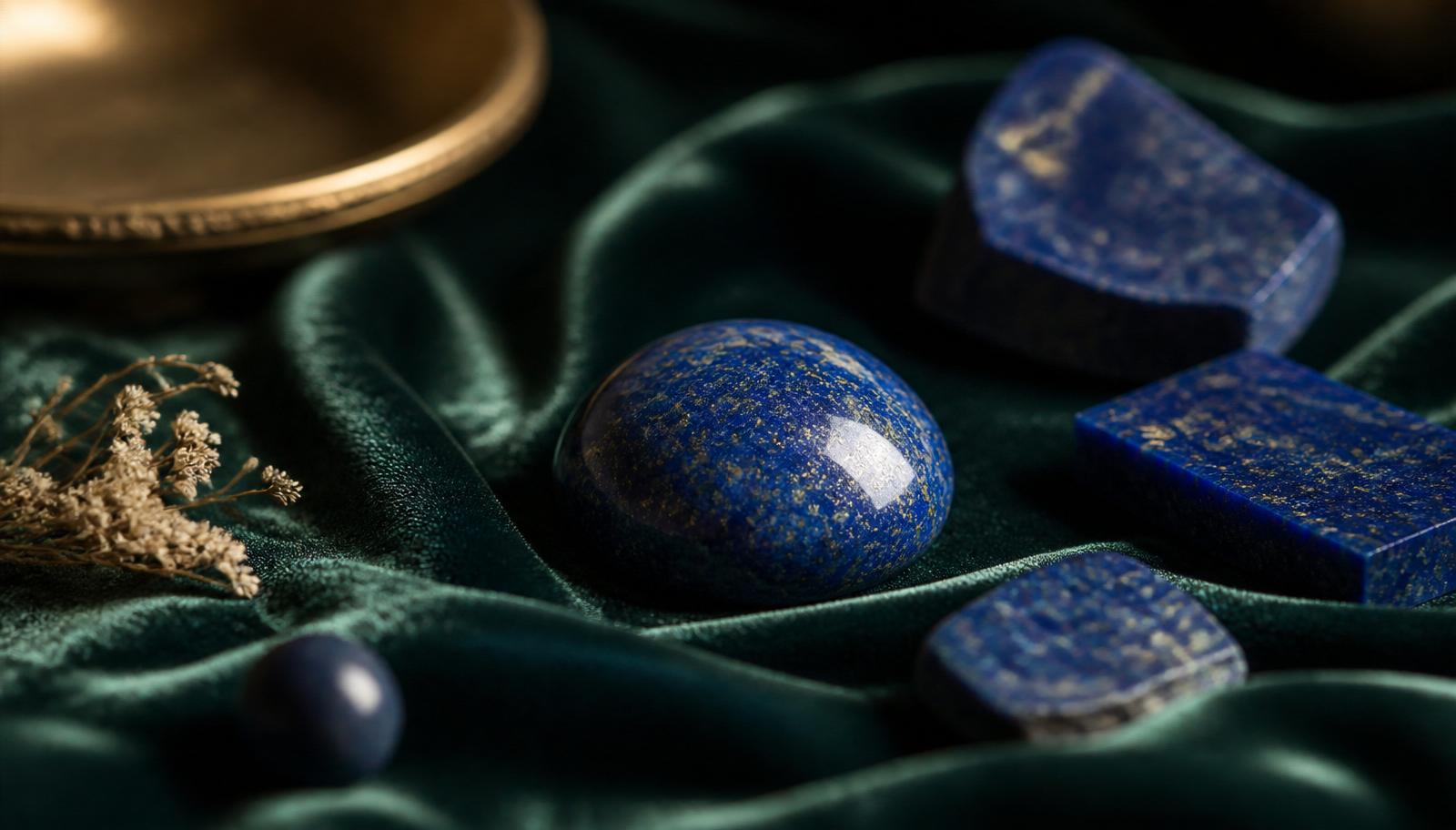
Lapis lazuli is not a single mineral but a rock. It consists predominantly of lazurite (the carrier of the deep blue colour), with admixtures of calcite (white streaks) and pyrite (golden metallic flecks). Quality is assessed by the intensity and uniformity of the blue, the amount of calcite (less = better), and the way the pyrite is distributed (fine and dispersed = beautiful; large clumps = less desirable). The classic Afghan quality has a vibrant 'royal blue' with finely distributed golden pyrite points.
The gemstone in brief
The hardness of lapis lazuli is between 5 and 5.5 on the Mohs scale — softer than quartz. This makes the material susceptible to scratches and loss of polish; old lapis cabochons almost always show a slightly worn surface, which is expected patina. Chemically, the gemstone is somewhat porous and sensitive to acids and soap residues, which can dull the colour over time.
For style context, see the Art Deco style guide (graphic inlay as a contrast block) and the Victorian style guide (Etruscan and archaeological style period from 1860-1880 in which lapis played a central role in Castellani and Giuliano emulations).
Periods in which you will encounter this gemstone
In the second half of the nineteenth century (the so-called archaeological revival, 1860–1885), lapis lazuli played a prominent role. Italian workshops like Castellani in Rome and Giuliano in London used the gemstone in imitation of Etruscan and Greco-Roman jewellery — in granulation-bordered cabochons, in scarabs, and in clean linework. See the Victorian style guide for the broader revival scene.
In Edwardian work (1901–1910), lapis appears as a colour-providing contrast in platinum and diamond compositions: a cabochon in a halo of rose-cut diamond, or a lapis slab behind open filigree work. See the Edwardian style guide. The choice of lapis is then consciously exotic — a break from the dominance of colourless diamond and white pearl.
Art Deco (1920–1935) primarily reused lapis graphically. See the Art Deco style guide. Deep blue slabs and cabochons are used as colour blocks against white platinum, black onyx, and yellow gold lines. Notably: lapis became a beloved material for men's rings during this period — wide signet rings with a polished lapis slab, sometimes with recessed initials or coats of arms, appear in both European and American work.
In the second half of the nineteenth century (the so-called archaeological revival, 1860–1885), lapis lazuli played a prominent role.
Old vs modern
Pyrite flecks as a sign of naturalness. Genuine Afghan lapis lazuli almost always contains visible pyrite inclusions, scattered throughout the deep blue as small golden dots. In good quality, they are fine and evenly distributed; in lesser quality, they clump together or are accompanied by many white calcite streaks. Completely uniform, calcite-free, pyrite-free 'lapis' without any internal variation deserves suspicion — that is almost always an imitation or a heavily dyed inferior natural material.
'Swiss lapis' is the classic example of imitation at a pattern level. It is not lapis lazuli but dyed jasper (or fractured agate) that gets a deep blue colour through chemical dyeing. Recognisable by an overly uniform, slightly artificial colour without pyrite, and sometimes by colour accumulation in cracks during close loupe inspection. The trade name originated in the late nineteenth century and has been used for decades in fashion jewellery and tourist jewellery. For the broader pattern regarding imitations: recognising reproductions.
Colour treatment of real lapis is a common issue: moderately blue natural material is impregnated with wax or resin and sometimes re-dyed to suggest deeper colour. This treatment is not permanent; over years, the colour intensity fades and white spots appear. For significant purchases: have it certified or ask the dealer for an explicit statement about treatment.