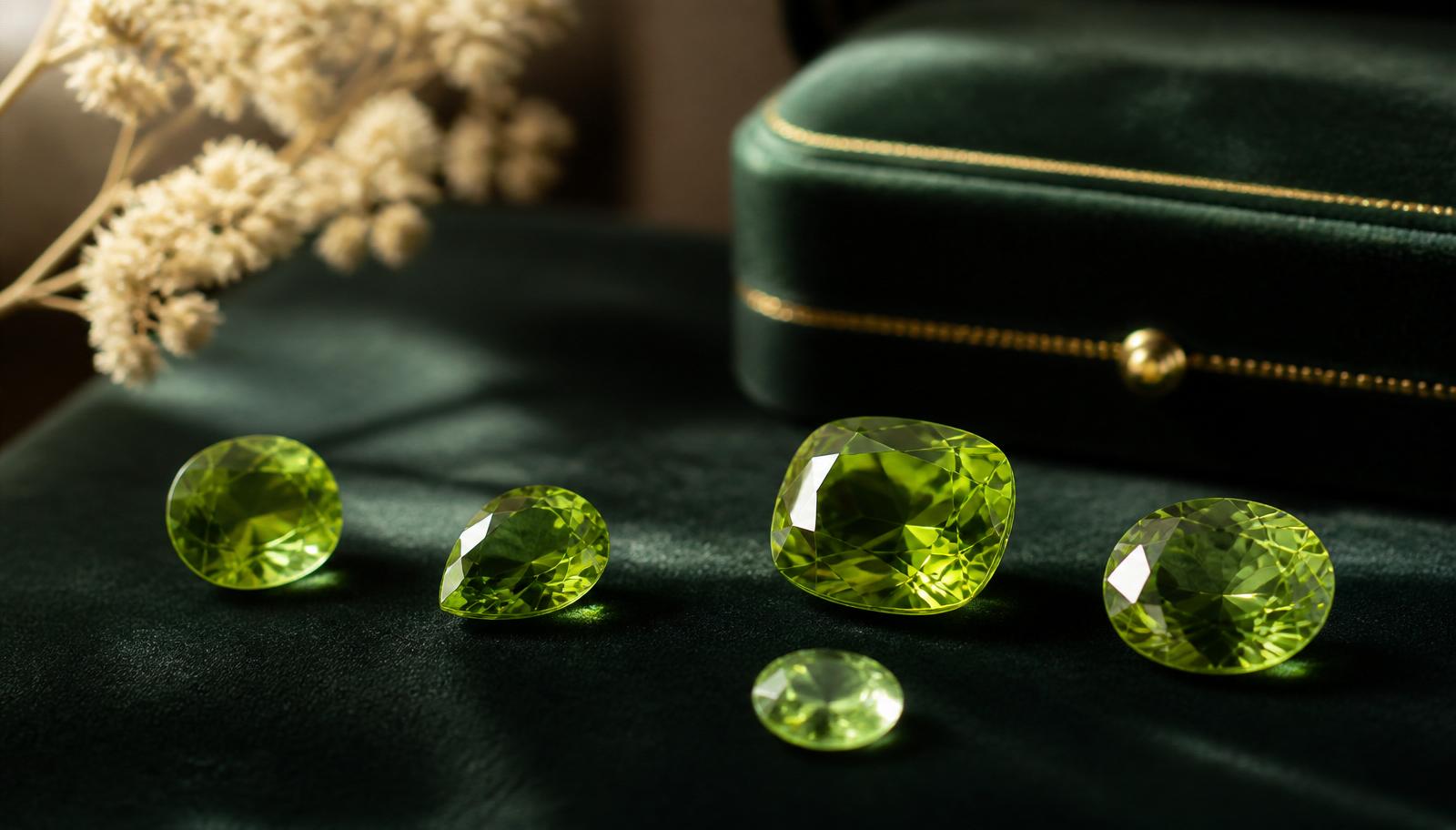
Zabargad, a small volcanic island in the Red Sea off the coast of Egypt, sometime in classical antiquity. Egyptian miners extract olive-green crystals by torchlight from fissures in the rock — the island was kept so secret that every crewman who landed there was sworn to silence about its location, under penalty of death. Ptolemaic kings kept the crystals as sunstones; the Romans called them topazios. Almost two thousand years later, in the England of King Edward VII, the same stone returns to fashion — now in fine platinum and gold mountings, flanked by diamonds and pearls, worn as a midday brooch or evening ring. Peridot has always had an aura of venerable simplicity.
Peridot is the gemstone variety of olivine, a magnesium-iron silicate. Its colour is caused by iron, not by trace elements — the stone is thus 'idiochromatic': its colour is inherent in the basic mineral itself and only varies in intensity, not in hue. This explains why peridot is always green, from pale olive to saturated apple green, but never blue, yellow, or red. Important historical sources include Zabargad (Egypt), Mogok in Burma (fine quality), and since the 1990s, Pakistan (Suppat) and Arizona.
The stone in brief
Peridot's hardness is 6.5 to 7 on the Mohs scale — hard enough for rings, but not as hard as sapphire or ruby. The stone is somewhat sensitive to pressure (it has a tendency to cleave along crystal planes) and to sharp temperature changes. Ultrasonic and steam cleaning are not recommended.
For style context, the Edwardian style guide is the standard reference — peridot is the characteristic coloured stone of this period. As an August birthstone, it also appears in the birthstone guide.
In which periods you'll encounter this stone
In Victorian work (1837–1901), peridot plays a modest role, especially in the archaeological revival of 1860-1885, where classical gemstones (peridot, garnet, carnelian) are reused in Etruscan style. Larger peridots from Zabargad are already rare on the market by then and appear mainly in Italian revival work (Castellani, Giuliano) and in English jewellery with a classical reference.
Edwardian (1901–1910) is the absolute heyday of peridot. See the Edwardian style guide. King Edward VII personally popularised the stone — he wore peridot in his cufflinks and watch chain, and a fashion spread where peridot was used as a vibrant green contrast against white platinum and diamond. Round and oval cuts, halo settings with diamonds, and soft, ethereal constructions are characteristic. Fine quality from Burma-Mogok reached the European market during these years.
In Art Nouveau (1890–1910), peridot appears in the period's natural colour palette — often in leaf shapes, butterflies, or dragonfly brooches, combined with enamel and freshwater pearls. See the Art Nouveau style guide. After World War I, peridot largely faded into the background and only returned to the modern market through Pakistani and Arizonan material from the 1990s.
In Victorian work (1837–1901), peridot plays a modest role, especially in the archaeological revival of 1860-1885, where classical gemstones (peridot, garnet, carnelian) are reused in Etruscan style.
Old vs. modern
Why peridot is an honest gemstone: the material is rarely treated. Unlike sapphire, ruby, aquamarine, or amethyst, heat treatment is not effective for peridot (the colour does not react), and there are no commercially common colour enhancements. Virtually all peridot on the market — vintage and modern — is natural, untreated stone. This is a rarity and explains why peridot has a 'clean' reputation in gemmological circles.
The double refraction is an authenticity mark at the pattern level. Peridot has strong double refraction (birefringence): look through the table of a cut stone at the opposite facet edges, and you will clearly see them doubled. No glass imitation or synthetic green quartz (sometimes offered as a peridot imitation) exhibits this effect. For the broader reading guide on cuts and material behaviour: cuts — a reading guide.
Synthetic peridot exists as a laboratory curiosity but has no commercial distribution — there is simply no market for it because natural material is abundant and affordable. Imitations include glass (classic) and green YAG or GGG (modern synthetic garnets that resemble peridot in colour but lack double refraction). For the broader imitation pattern: recognising reproductions.