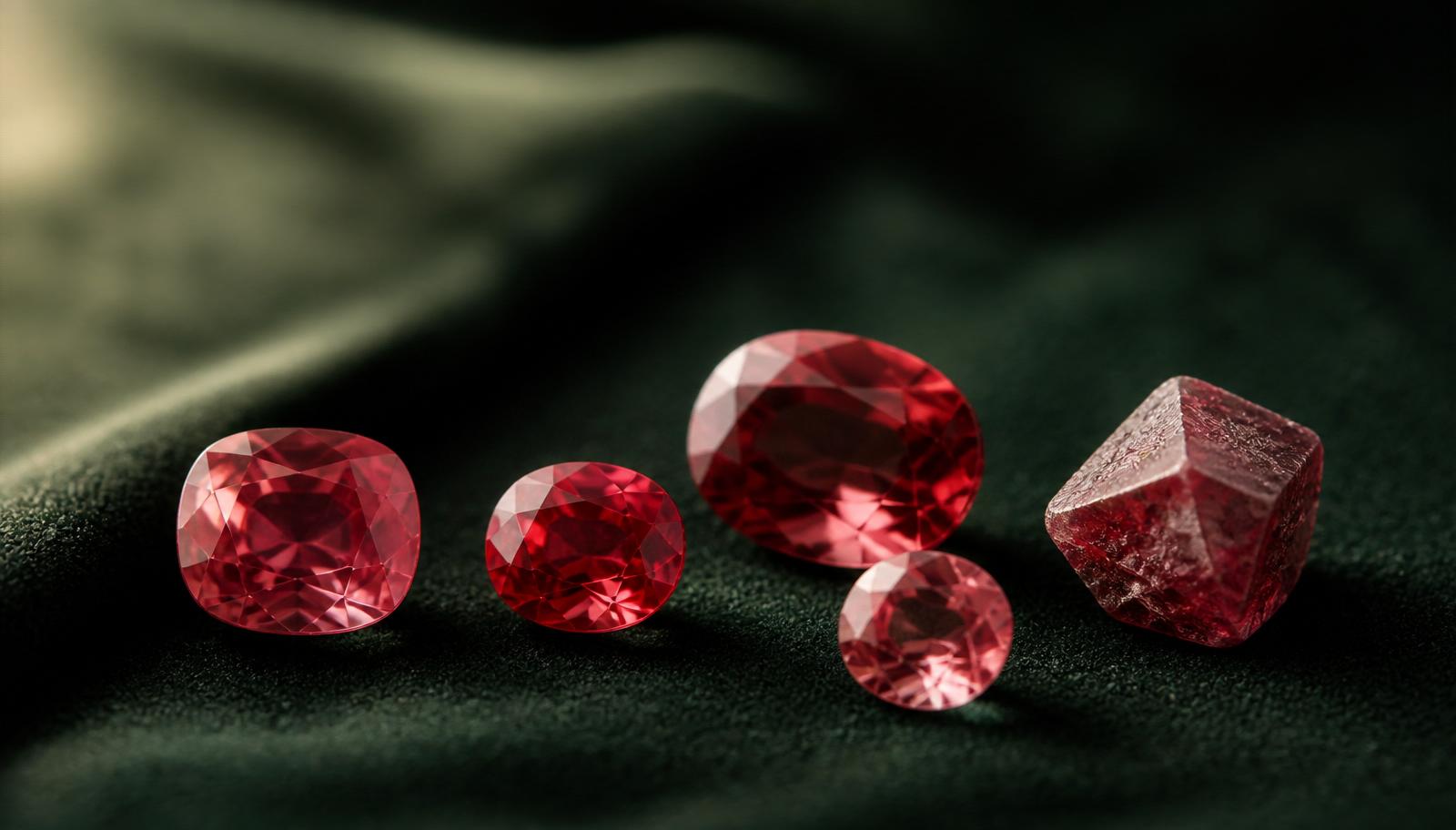
Somewhere in the nineteenth century, in a European crown cabinet. A curator inspects a large red gemstone that has been documented as a 'ruby' for centuries — a central jewel in one of the crown pieces. A new generation of gemmological instruments, shortly after the introduction of refractometry and density measurement, indicates something different: it is spinel, not corundum. This scene repeated itself several times in the nineteenth and early twentieth centuries. Historical crown jewels that had been registered as rubies for centuries were regularly found to be spinel upon reappraisal. At a pattern level, without specific claims about individual pieces, it is a recurring pattern: red spinel and ruby are almost indistinguishable to the naked eye.
Spinel is magnesium-aluminium oxide, a mineral family of its own. Colours range from deep red through pink, orange, purple and violet to blue, black, and colourless. The hardness is 8 on the Mohs scale — hard enough for daily wear. What essentially distinguishes spinel from ruby (chemically a corundum): spinel is singly refractive (isotropic, like diamond and garnet), ruby is doubly refractive. A refractometer or polariscope makes the distinction in seconds; with the naked eye, this is not possible.
The gemstone in brief
Natural spinel is increasingly recognised today by collectors as an undervalued gemstone field. Large, clean red or pink spinels from historical origins (Burma-Mogok, Tajikistan, Sri Lanka, Vietnam) are rarer than rubies of comparable quality, but still fetch a fraction of the ruby price — a market lag that is slowly being closed. For vintage jewellery this means: a 'ruby' ring that turns out to be spinel upon reappraisal is no less valuable than thought — it is a different gemstone story with its own collecting logic.
For the ruby context: ruby in vintage jewellery. For the broader pattern around imitations and recognition: identifying reproductions.
In which periods you encounter this gemstone
In Georgian and early Victorian work (before 1860), natural spinel appears as 'balas ruby' (pink-red spinel from the historical Balas region, today Tajikistan) in closed foil settings. The designation 'balas' disappeared from trade over the course of the nineteenth century; the material itself continued to circulate in pieces registered as ruby. See the Victorian style guide for setting conventions.
In art deco (1920–1935), the story fundamentally changes. See the Art Deco style guide. From 1908, Verneuil synthetic spinel became commercially available, and within two decades it took on a huge role as an imitation and calibré gemstone. Synthetic spinel is produced in almost all colours: red (ruby imitation), blue (sapphire imitation), light blue (aquamarine imitation), light green (peridot or emerald imitation). In costume jewellery and middle-class workshops from the 1920s-1950s, Verneuil synthetic spinel is ubiquitous.
After World War II, synthetic spinel remained the dominant imitation material until cubic zirconia gained popularity in the 1970s. Natural spinel returned to the collector's market from the 1990s onwards, partly due to new finds in Vietnam (Luc Yen) and Tanzania (Mahenge — renowned for vivid pink material).
In Georgian and early Victorian work (before 1860), natural spinel appears as 'balas ruby' (pink-red spinel from the historical Balas region, today Tajikistan) in closed foil settings.
Old vs modern
Verneuil synthetic spinel is the imitation material of the early twentieth century. From around 1908 (for blue imitations) and 1920 (for red), the material appeared en masse in costume jewellery, in watch bracelets with 'sapphire' baguettes, in cluster rings, and in class rings. It is chemically real spinel — not glass, not plastic — but synthetically produced via Auguste Verneuil's flame-fusion process. For the customer of that era, it was an affordable alternative to the expensive natural gemstones it imitated; for today's collector, it is period-correct material with its own historical status.
Recognition at a pattern level. Under a 10× loupe, Verneuil synthetic spinel often shows curved colour banding (curved striae) and sometimes gas bubbles — the same pattern as in Verneuil sapphire and ruby, because the process is identical. Natural spinel shows angular mineral inclusions (octahedral crystals are characteristic) and sometimes liquid feathers. Determining between natural and synthetic spinel is difficult to the eye; a certificate is the norm for significant purchases. For the broader imitation pattern: identifying reproductions.
Confusion with ruby and sapphire. Red spinel is confused with ruby due to colour similarity; blue synthetic spinel is confused with sapphire for the same reason. The distinction is made via optical properties (spinel isotropic, corundum anisotropic) and density (spinel 3.6; corundum 4.0). A 'ruby' that turns out to be spinel upon reappraisal: not a loss, but a different appraisal story — especially if it concerns natural spinel of historical origin.