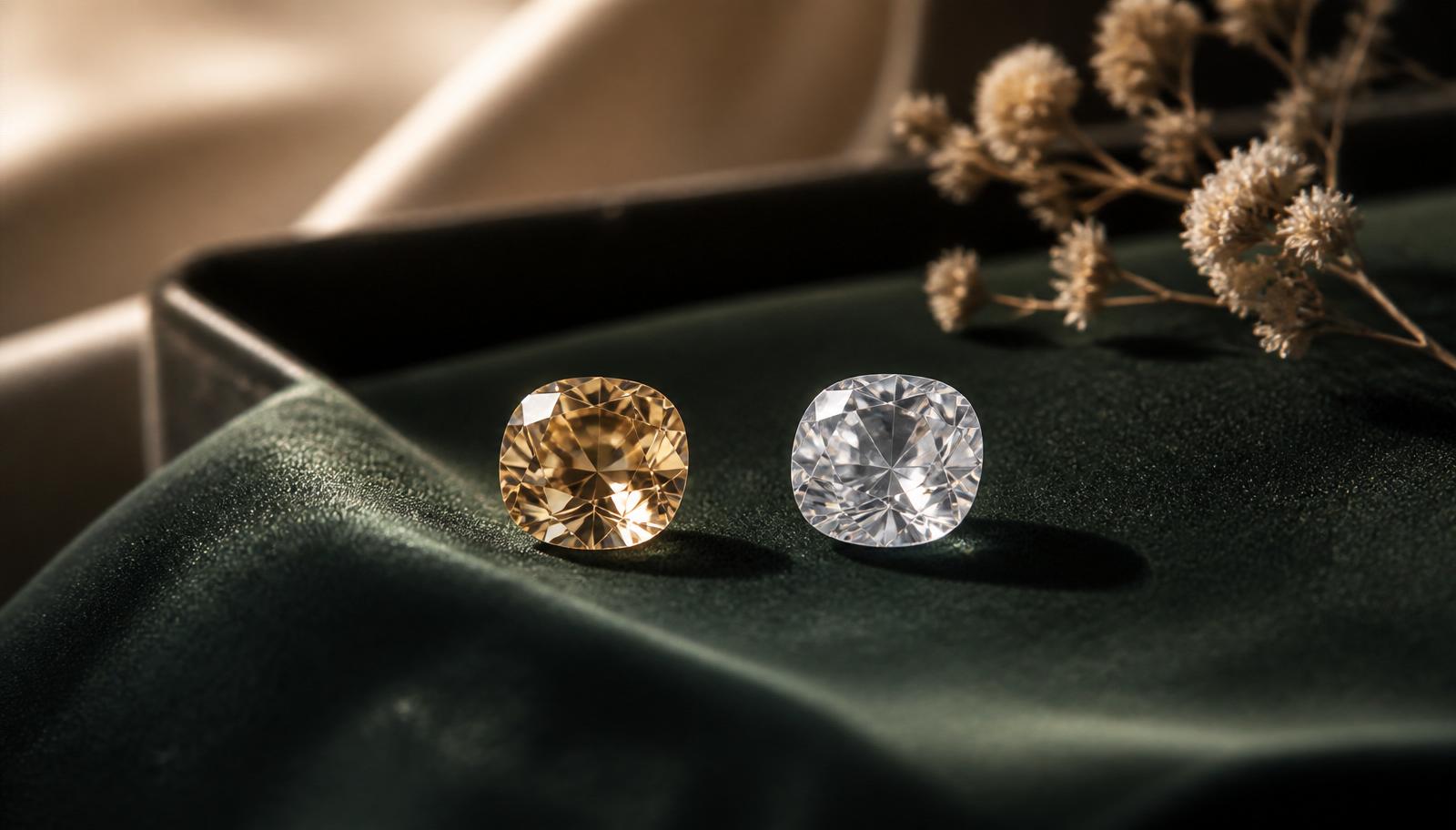
Paris, 1929. In an Art Deco display case lies a brooch with a central sky-blue stone so bright and sparkling that a modern viewer would immediately think of a coloured diamond or aquamarine. It is neither: it is blue zircon, a natural gemstone favoured in the 1920s and 1930s as a vibrant alternative to more expensive blue stones. Four decades later, sometime in the 1970s, a synthetic material called cubic zirconium oxide — cubic zirconia, or CZ for short — came onto the market from a Soviet laboratory. From that moment on, it became impossible to speak of 'zircon' without people thinking of the diamond imitation.
The two stones have nothing to do with each other mineralogically. Zircon is zirconium silicate (ZrSiO4), a natural mineral that has been present in the Earth's crust for billions of years and has been traded as a gemstone since the Middle Ages. Cubic zirconia (CZ) is zirconium oxide (ZrO2) in its cubic crystal form, a synthetic material that was only commercially produced in the 1970s. The naming confusion is an accidental side effect of the shared element zirconium — chemically, historically, and visually, they are two completely different gemstone stories.
The stone in brief
Zircon has a hardness of 6.5 to 7.5 on the Mohs scale and a high refractive index with strong dispersion — the 'fire' of good zircon approaches that of diamond. Colours occur in white (colourless), blue (almost always heat-treated), golden yellow, orange, brown, and green. Blue zircon (starlite or jargoon) is the classic Art Deco colour and is mined in Cambodia and Burma.
Cubic zirconia has a hardness of 8 to 8.5 (harder than zircon), a refractive index between that of zircon and diamond, and strong dispersion, which made it embraced as an affordable diamond alternative. The material does not occur in nature and has no place in vintage jewellery from before circa 1975. In work after 1980, CZ is ubiquitous.
Periods in which you encounter this stone
Zircon appears in vintage jewellery from the nineteenth century as golden yellow or orange 'hyacinth' (a historical trade name), and peaks in Art Deco (1920–1935) as blue zircon. See the Art Deco style guide. The sky-blue colour was achieved by heat treatment of brown zircon from Cambodia — a practice that was standard from the early twentieth century and is period correct for Art Deco work. In fine platinum and white gold brooches and earrings from this period, blue zircon is a popular alternative to more expensive aquamarine.
In retro and mid-century work (1935–1960), zircon continues to appear incidentally, especially in cocktail rings with warm orange or golden-yellow stones ('mandarin zircon', 'imperial zircon' as trade names). After World War II, the stone largely fades into the background; blue zircon today only comes from specialist suppliers.
Cubic zirconia enters the market from circa 1976 (commercial production in the Soviet Union, later in the West) and spreads rapidly in fashion jewellery and mid-range jewellery. CZ does not appear in vintage work from before 1975; anyone finding a CZ stone in an 'Art Deco' brooch is most likely holding a modern reproduction or a later restored piece. For the broader pattern: recognising reproductions.
Zircon appears in vintage jewellery from the nineteenth century as golden yellow or orange 'hyacinth' (a historical trade name), and peaks in Art Deco (1920–1935) as blue zircon.
Old vs modern
Why 'it's just zircon' is often unfair. In modern trade, 'zircon' is regularly used as a synonym for the cheap diamond imitation CZ, meaning natural zircon in vintage work is sometimes dismissed as 'fake diamond'. This is incorrect. Natural zircon is a historical gemstone with its own appreciation, its own collector's notes and — in the case of fine blue zircon in Art Deco work — with a specific period character that CZ cannot possibly reproduce. If in doubt about identification in an old piece: refractometer or certificate.
The high double refraction of zircon is an authenticity mark at a pattern level. Zircon has one of the strongest birefringence values among gemstones; look through the table of a faceted zircon at the opposite facet edges and you will see them very clearly doubled — more than with peridot. CZ is singly refractive (isotropic, like diamond and garnet) and shows no double facet edges. For the broader reading guide on material behaviour and cuts: cuts — a reading guide.
Heat treatment of zircon (blue from brown) is historical and period correct for Art Deco. Standardised since circa 1900; fully accepted. Other treatments rarely occur with zircon. For CZ: the material is by definition synthetic, and that is not a treatment but its very identity.