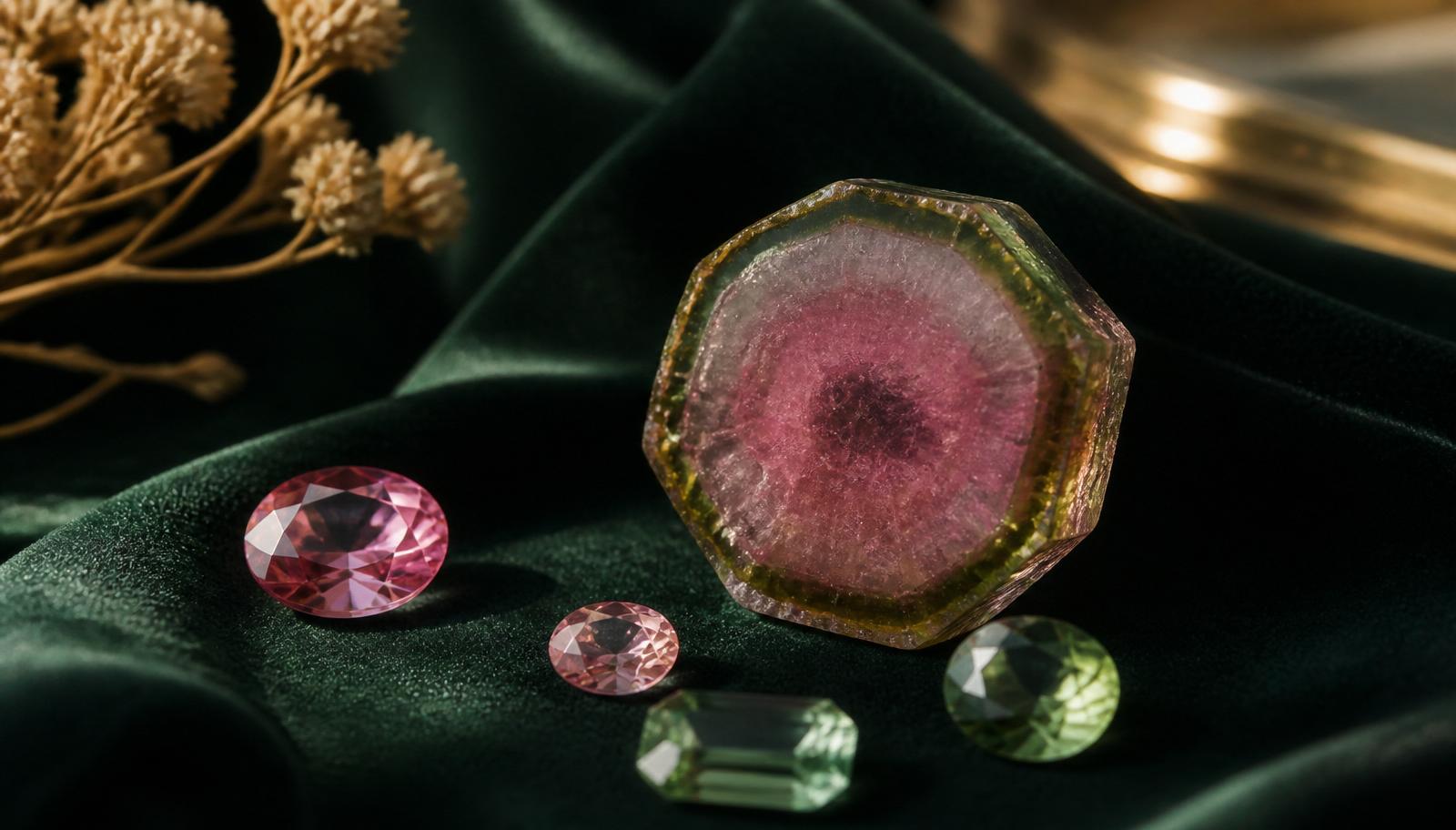
Ouro Preto, Brazil, sometime around 1900. In a small lapidary workshop, long crystals are delivered, pink on one side, green on the other, and showing a light transition in the middle — 'watermelon' they will later be called in English. The lapidaries wonder how such material should be processed: as slices with the colour banding intact, or as traditional faceted cuts per colour section? Both choices are made, and both find their way to Europe, where the slices sometimes end up on old appraisal lists as anonymous 'green stone with pink rim'. Tourmaline has for centuries been the stone without a name — only around the end of the nineteenth century did the material become widely recognised as its own mineral.
Tourmaline is a collective name for a group of borosilicates with a highly variable chemical composition. This explains its broadest colour spectrum of all gemstones: pink, green, blue, yellow, orange, red, brown, black, colourless, and all transitions and combinations in between. Elbaite is the main colour-bearing variety in vintage jewellery; schorl is the black variety found in mourning jewellery. Rubellite (red-pink), indicolite (blue) and verdelite (green) are trade names for specific colour groups; watermelon tourmaline (pink inside, green outside in one crystal) is the most well-known mixed variety.
The stone in brief
The hardness of tourmaline is between 7 and 7.5 on the Mohs scale — comparable to quartz, hard enough for rings and daily wear. The stone has strong pleochroism (different colours depending on the viewing direction) and sometimes slight double refraction, which facilitates determination at a pattern level.
For style context: Victorian style guide (late-Victorian use) and the style guide on vintage 1970s-80s (large informal cocktail rings). Also included as an alternative October birthstone in the birthstone guide.
Periods in which you encounter this stone
In Victorian work (1837–1901), tourmaline is present but rarely named. Large pink tourmalines (rubellite) appear in cluster-brooches and drop earrings; green material occurs in snake rings or as a headstone. On nineteenth-century appraisal lists and jewellers' inventories, the material is often listed as 'pink stone', 'green stone' or 'gemstone' — the precise mineralogical designation only became common around 1900. See the Victorian style guide.
In Art Nouveau and Edwardian work (1890–1910), tourmaline appears as a colour-bringing stone in nature motifs — leaf shapes, insects, flower brooches — and in delicate platinum rings with rose-cut diamond halos. Large green tourmalines are sometimes used as a cheaper alternative to emerald, which again leads to confusion on old labels.
In vintage 1970s and 80s work (1968–1985), tourmaline experiences a second boom. In this period, large, informal cocktail rings appear with watermelon slices, rubellite cabochons and green tourmaline baguettes; the stones are usually set in yellow gold and the aesthetic is distinctly colourful and unconventional compared to the strict mid-twentieth-century convention. The rise of 'Paraíba' tourmaline (vivid neon-blue from Brazil, discovered 1989) also belongs to this broader revival, although Paraíba itself falls just outside the vintage period.
In Victorian work (1837–1901), tourmaline is present but rarely named.
Antique vs modern
Why tourmaline long remained anonymous in antique jewellery. Until the late nineteenth century, the mineralogical identification of gemstones was less stringent than today. Stone was traded on colour and origin, not on mineral name: 'green stone', 'pink stone' or 'Brazilian emerald' (for green tourmaline) were common designations. Only after 1900 did the use of precise mineralogical names become standard, partly influenced by the emerging gemmological institutes (British Gemmological Association, later GIA). Anyone reading an old appraisal report stating 'green stone' must consider the possibility that it is tourmaline, emerald, peridot, chrysoprase or demantoid — the context of period, setting and price can help in choosing.
Heat treatment of tourmaline (to make pink material brighter or blue material purer) is a modern practice that became common from the second half of the twentieth century. For vintage work from before 1950, it can be assumed that the material is untreated; for later work, and certainly for 1970s pieces, heat treatment is more often the case. Irradiation for colour enhancement is a post-war practice and does not occur in period material from before 1960.
Distinction from other green stones: tourmaline often has a slight yellow or brown secondary colour that emerald does not; peridot is distinctly olive; demantoid has its characteristic dispersion. Under magnification, tourmaline often shows parallel fluid feathers ('trichites') characteristic of the material. In case of doubt about identification on old appraisals: have it identified by a gemmologist.