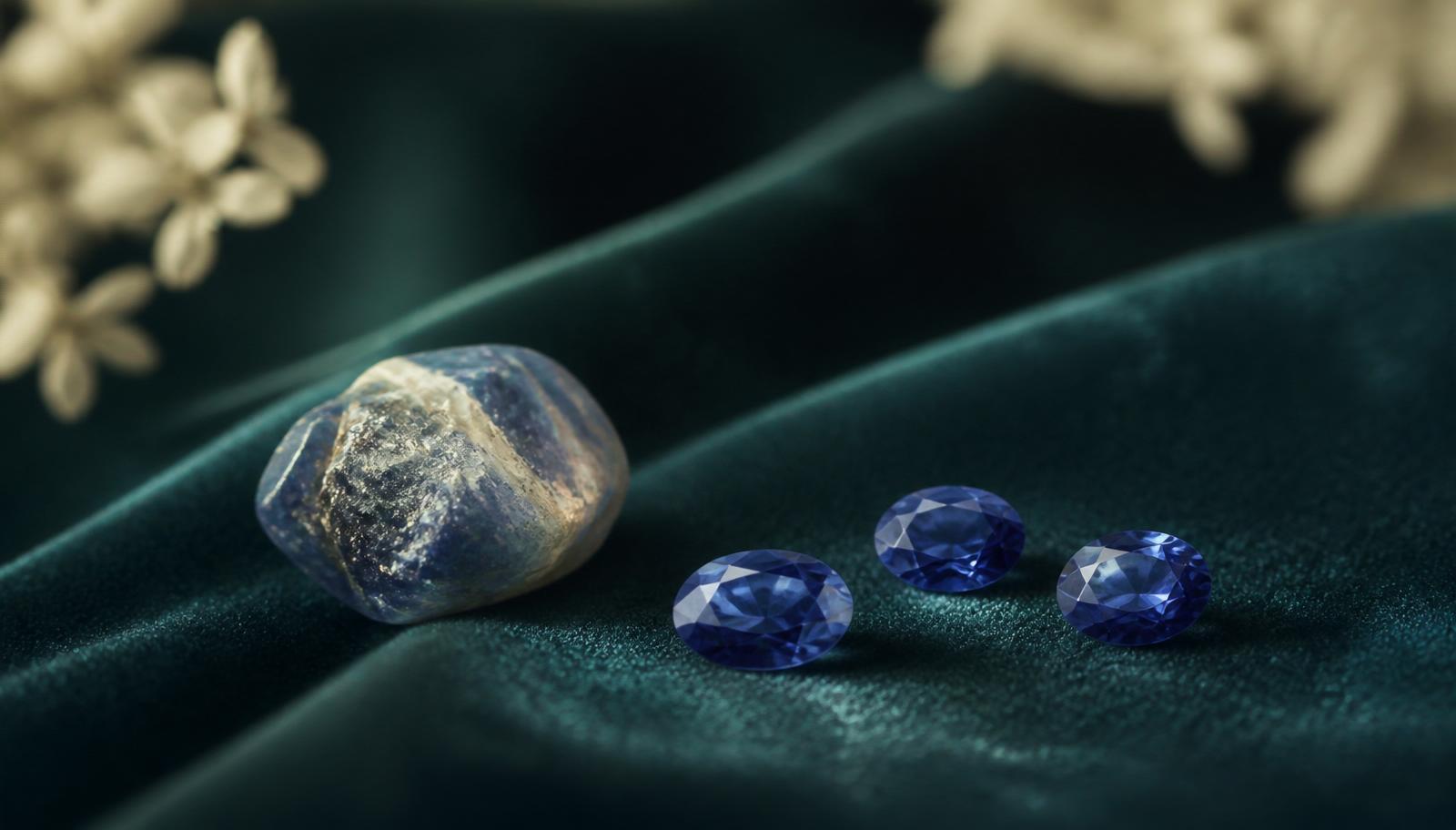
Colombo, between the World Wars. On the veranda of a Ceylonese lapidary, rough crystals are sorted by hue: steel blue for London, cornflower blue for Paris, pink and orange for the American customer. An old cutter turns a stone between thumb and forefinger, holds it up to the light, and silently decides how the facets will fall. This is handicraft as it has been for centuries: the heart of the stone determines its shape, not market demand. Whoever holds a vintage sapphire almost always holds a piece that has passed through such hands — with a table that is not perfectly flat, a pavilion that sits a little deeper, and a colour that is never entirely uniform.
Sapphire belongs to the corundum family, the same mineral family as ruby. Chemically, there is little difference; only trace elements determine whether we call it blue or red. What makes sapphire in vintage jewellery special is not the material itself but the way it was processed: even before the modern diamond sector dictated its strict cutting standards, and often still foiled in closed settings that enhanced every colour tone. This makes old sapphires undeniably different from today's sharply cut, open-set stones.
The stone in brief
Sapphire is corundum (aluminium oxide) in any colour except red. Traditionally, 'sapphire' refers to the blue variety, but pink, yellow, green, colourless, and fancy sapphires also appear in vintage work. Its hardness is 9 on the Mohs scale — just below diamond — which made the stone eminently suitable for daily worn jewellery.
Important historical origins include Ceylon (present-day Sri Lanka), Burma (Myanmar), Thailand, Australia, and — for the very rare cornflower-blue quality — Kashmir. Kashmir sapphires were on the market between 1880 and 1935 and hold a quasi-mythical status among collectors; anyone who possesses one should have it certified by a reputable laboratory, as without documentation, its trade value is almost impossible to determine.
Periods in which this stone is found
In Victorian work (1837–1901), sapphire appears mainly in the late phase. Small cabochons or old brilliant-early cuts, often foil-backed in closed mounts to enhance the colour. See the Victorian style guide for setting conventions. Cluster rings with a central sapphire and a halo of rose-cut diamonds are iconic for this period — the so-called daisy or halo, of which Princess Diana's engagement ring is a direct descendant.
Edwardian (1901–1910) is the heyday of the fine sapphire. Platinum mounts allow the stone to be set almost floating; millegrain edges and openwork create lace from metal. See the Edwardian style guide. The stone is now open-set, without foiling, and the demand for purity of colour and clarity increases. Kashmir material circulated freely on the Parisian and London markets.
In art deco (1920–1935), sapphire is set flat, calibré-cut, and in strict rows alongside diamond. See the art deco style guide. The shape — baguette, carré, calibré — serves the geometric design, no longer the individual stone. This period is also when Verneuil synthetic sapphire (commercially available from circa 1908) found widespread acceptance in costume jewellery and in finer work; more on this in Old vs modern.
In Victorian work (1837–1901), sapphire appears mainly in the late phase.
Old vs modern
The most striking difference lies in cutting style and colour effect. Old sapphires were cut to preserve and enhance colour; not to show maximum sparkle. The table is small, the pavilion deeper than is modern practice, the crown often more lightly faceted. Under magnification, you'll see irregularities in facet size — it's handmade. In a modern sapphire, the facets are mechanically identical, and the proportion is optimised for maximum brilliance. For a broader guide on old cuts, see cuts — a reading guide.
Foil backing is a second characteristic. Until approximately 1880, sapphires were regularly set on a thin layer of silver or gold foil in a closed setting cup. The foil enhanced the colour and gave the stone a deeper, warmer appearance. Turn an old piece of jewellery over: if you see a solid metal base under the stone, foil is likely involved. Replacing foil with a modern open setting is a common 'restoration' that irreparably changes the original colour — if in doubt, seek advice before tampering with the mount.
And then Verneuil. Auguste Verneuil introduced the flame-fusion process to the market in 1902, allowing synthetic sapphire to be produced commercially. From approximately 1908–1910, Verneuil sapphires were available commercially and also appeared in finer workshop pieces from that era. A Verneuil sapphire in an Edwardian or art deco ring is therefore not proof that the jewellery is a 'fake' — the stone can be period-correct, provided the ring is. Verneuil material can be recognised under magnification by curved colour streaks (curved striae) and gas bubbles; natural sapphire shows straight, angular colour banding and mineral inclusions such as rutile needles or zircon crystals.
Heat treatment is both an old and modern practice. Almost all blue sapphires in the modern market are thermally treated to improve their colour; with vintage stones, the chance of unheated material is considerably higher, which collectors pay extra for. Only a gemmological laboratory can determine with certainty whether a stone has been treated; for significant purchases, a certificate is advisable.