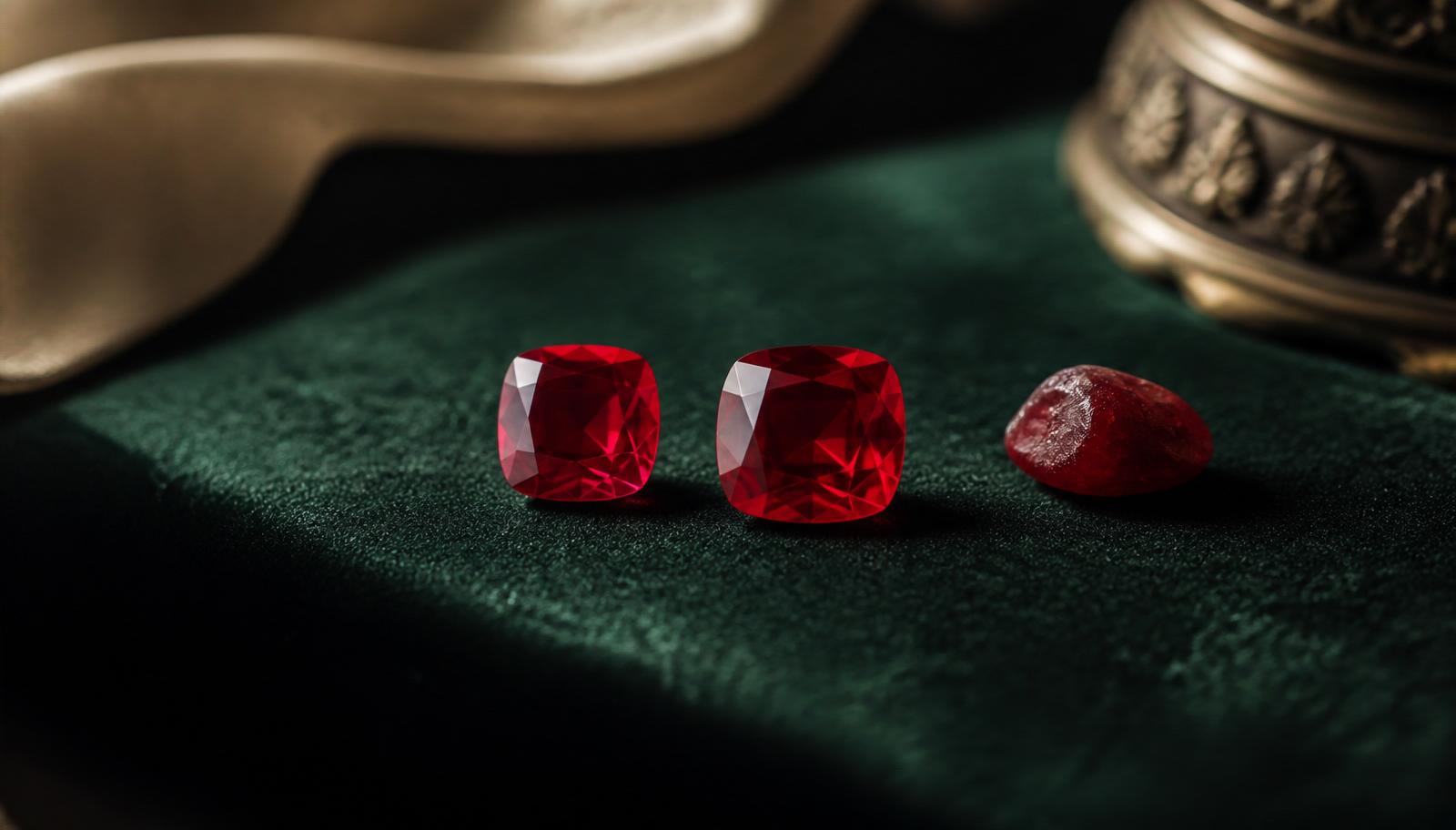
Mogok, in the northeastern highlands of Burma, sometime in the 1920s. A gravel-washer squats by a stream, rinsing handfuls of red-grey grit in a wooden pan. Each time he pours off the water, he drops a little stone on the rim — a dull red, an orange, once a true pigeon blood. That last one, the size of a grain of rice, will end up via merchants in Rangoon and Bombay in a Parisian or London workshop where it disappears as the central stone in a platinum ring. Ruby has always made this journey: from a remote mine to the most refined workshops of Europe. Whoever holds a vintage ruby holds the endpoint of that journey.
Chemically, ruby is the same corundum as sapphire. Only the traces of chromium determine the red. What makes ruby in vintage jewellery so specific is that the largest quantities for a long time came from one region — Mogok in Burma — and that the quality standards were strict: colour first, then clarity, then size. Large rubies of pure quality are rarer than large diamonds of comparable quality; they sometimes fetched more per carat in historical auctions.
The stone in brief
Ruby is the red variety of corundum, with a hardness of 9 on the Mohs scale. The classic, most sought-after colour is called 'pigeon blood': a pure, deep red with a very slight blue or purple tinge, which makes the stone vibrant instead of brownish. Other qualities vary from pinkish-red (Ceylon) to dark garnet-red (Thailand, Siam).
The main historical origins are Burma (Mogok), Thailand (Chanthaburi), Ceylon, and — for the modern market — Mozambique. In vintage jewellery, Burma dominates; Ceylon material is pink-tinted and was often used in cluster work. Large, natural rubies over five carats are extremely rare and always warrant a gemmological certificate upon purchase.
In which periods you encounter this stone
Georgian (before 1837) and early-Victorian (1837–1860) work features ruby in closed foil-backed settings, often with round-cut or table-cut stones. For later Victorian setting conventions, see the Victorian style guide. Symbolically, red was worn as a heart symbol and as a sign of mourning for certain phases.
In late-Victorian and Edwardian work (1885–1910), ruby becomes a central stone in cluster rings and in three-stone rings, usually flanked by old brilliant or old European cuts. See the Edwardian style guide. Platinum mounts make their appearance, enhancing the warmth of the ruby against the cool metal.
Art Deco (1920–1935) uses calibré-cut rubies in neat rows, or as a central cabochon in Cartier's famous 'Tutti Frutti' compositions where carved rubies, sapphires, and emeralds together form leaf shapes. See the Art Deco style guide. Verneuil synthetic ruby has by then been commercially available for two decades and appears in virtually every price range of jewellery — from mass-produced items to affluent workshops.
Georgian (before 1837) and early-Victorian (1837–1860) work features ruby in closed foil-backed settings, often with round-cut or table-cut stones.
Old vs modern
Verneuil synthetic ruby is the classic pitfall in vintage purchases. Auguste Verneuil published his flame-fusion process in 1902 for ruby (even earlier than for sapphire); from around 1905, Verneuil rubies became widely available. They are too bright, too clean, and too uniform in colour for natural material. Under a loupe, you can see curved colour striations and sometimes gas bubbles; natural ruby shows rutile needles ('silk'), calcite inclusions, or liquid feathers. A Verneuil ruby in a period-correct Art Deco mount is not fake — it is period-correct, which fundamentally changes its appraisal.
Foil-backing is at least as important as for sapphire. In early work, a thin layer of foil is placed under the stone to enhance its colour. If the foil is affected by moisture, the stone paradoxically discolours — it becomes duller or develops spots that are not in the material itself. Repair must then be done by a specialist who can work with vintage foil-backings; standard 'cleaning' at a modern jeweller usually aggravates the problem.
Cut: old rubies are cut to maximise colour retention. Cabochon cut is classic for the best raw material with strong chromium signal; brilliant cut follows for clearer stones. The distribution reflects aesthetic choices of the period, not inferiority. For the reading guide on old cuts: cuts.
Treatment: heat treatment for colour enhancement has existed for centuries (even pre-industrial via wood fires). Modern beryllium diffusion and glass-filling are twentieth- and twenty-first-century treatments that do not occur on vintage material. An old, untreated Burma ruby is one of the most sought-after stones on the market and always warrants a laboratory certificate.