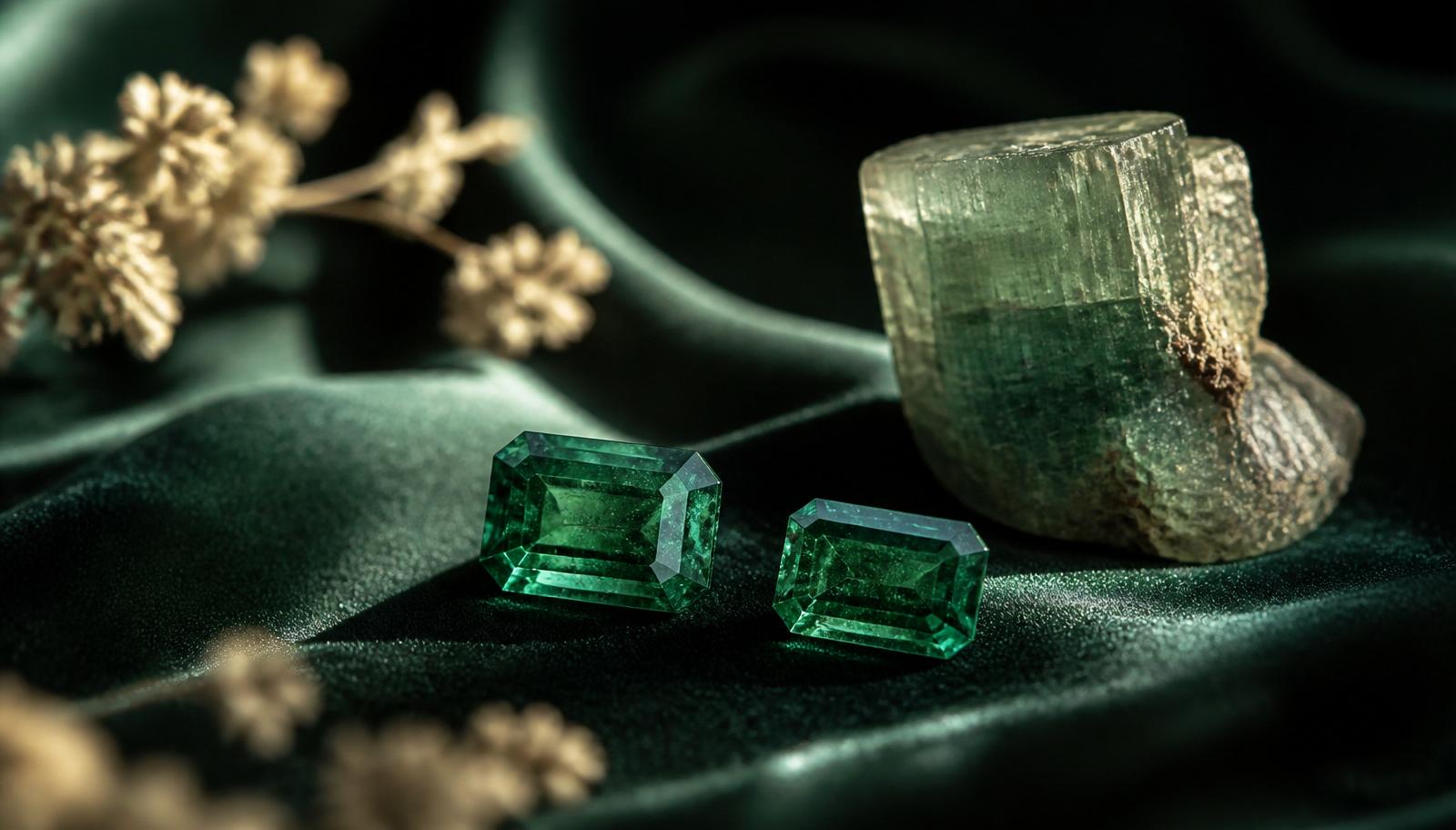
Muzo, high in the Colombian Andes, sometime in the seventeenth century. Spanish conquistadors have taken over the mine from the Muzo Indians, who had been extracting emeralds there for centuries. The rough crystals are shipped to Seville and onwards to the Mughal courts of India, where they end up in gold-set pendants. This same route would operate for three centuries. Anyone acquiring a vintage emerald almost certainly holds Colombian material — Muzo, Chivor, or Coscuez — which, via an old trade route, found its way to a European workshop and was cut there into the rectangular step-facet shape we now call the 'emerald cut'.
Emerald is the green variety of beryl, coloured by chromium and sometimes vanadium. What distinguishes the stone from sapphire or ruby is its characteristic brittleness and the almost guaranteed presence of inclusions. While diamond is valued by 'purity = better', for emerald, a completely clean stone is suspicious: it is then likely synthetic or glass. For emerald, inclusions are not a defect but a signature of authenticity.
The stone in brief
Emerald has a hardness of 7.5 to 8 on the Mohs scale — considerably softer than sapphire or ruby and susceptible to shocks. This brittleness, along with the almost universal presence of inclusions (French: jardin), makes emerald the most vulnerable of the four classic precious gemstones (diamond, ruby, sapphire, emerald).
Major historical origins include Colombia (Muzo, Chivor, Coscuez), Zambia, and Russia (Urals). Colombian material dominates vintage pieces and has the classic 'grass-green' hue with a slight blue tinge. Zambian emerald is darker and more blue-green; historical Russian emeralds are duller and rarer.
Periods in which you'll find this stone
In Georgian and Victorian pieces (before 1901), emerald often appears in cluster-brooches, as the main stone in snake rings, and in engagement jewellery. See the Victorian style guide. Cabochon-cut is classic; the emerald cut only began to dominate around the end of the nineteenth century.
Edwardian pieces (1901–1910) use emerald in platinum settings, often in three-stone rings with flanking diamonds, or as a central stone in fine openwork. See the Edwardian style guide. Colour and clarity gain importance; large clear Colombian stones enter the market.
In art deco (1920–1935), emerald experiences its absolute peak. The classic emerald cut — rectangular with truncated corners, step facets — becomes standardised, partly to protect the material's brittleness (straight corners without vulnerable points) and partly because the geometric shape perfectly matches the art deco aesthetic. See the art deco style guide. Cartier's 'Tutti Frutti' compositions with carved Indian emeralds are iconic for this period.
In Georgian and Victorian pieces (before 1901), emerald often appears in cluster-brooches, as the main stone in snake rings, and in engagement jewellery.
Antique vs modern
The emerald cut itself is partly an antique, partly a modern story. The basic shape has existed since the seventeenth century, but the precise step-facet proportions as we know them crystallised in the early twentieth century. Vintage emeralds often show slight irregularities in the corners and non-uniform facets — handcrafted, not flawed. See the guide cuts for the broader context of cutting evolution.
Treatment with oil, wax, or resin has been common for emeralds for centuries and is completely accepted. Cedar resin oil was already used in the nineteenth century to optically conceal surface-reaching inclusions and make the stone look better. Modern polymer resin treatments (Opticon, ExCel) are more strictly regulated and must be disclosed. For vintage emeralds, it can be assumed that oil or wax was once applied; this is not an objection provided it is known and the treatment has not gone so far as to fill large cavities.
Early synthetic emeralds appeared much later than synthetic ruby and sapphire. Chatham began hydrothermal synthesis in 1935; Gilson and others followed in the 1950s and 1960s. A synthetic emerald in a piece of jewellery from before 1935 is therefore by definition suspicious — either as a later replacement or as a dating issue with the jewellery itself. In modern vintage (after 1950), synthetic emerald can indeed be period-correct.
Reading inclusions. Under a loupe, Colombian material shows three-phase inclusions (solid, liquid, and gas in one cavity), 'jagged' fluid feathers, and sometimes pyrite crystals. Zambian emerald shows dark amphibole needles. Hydrothermal synthetic emeralds, in contrast, show chevron-shaped growth lines and sometimes 'nailhead spicules'. For doubtful cases: a laboratory report.