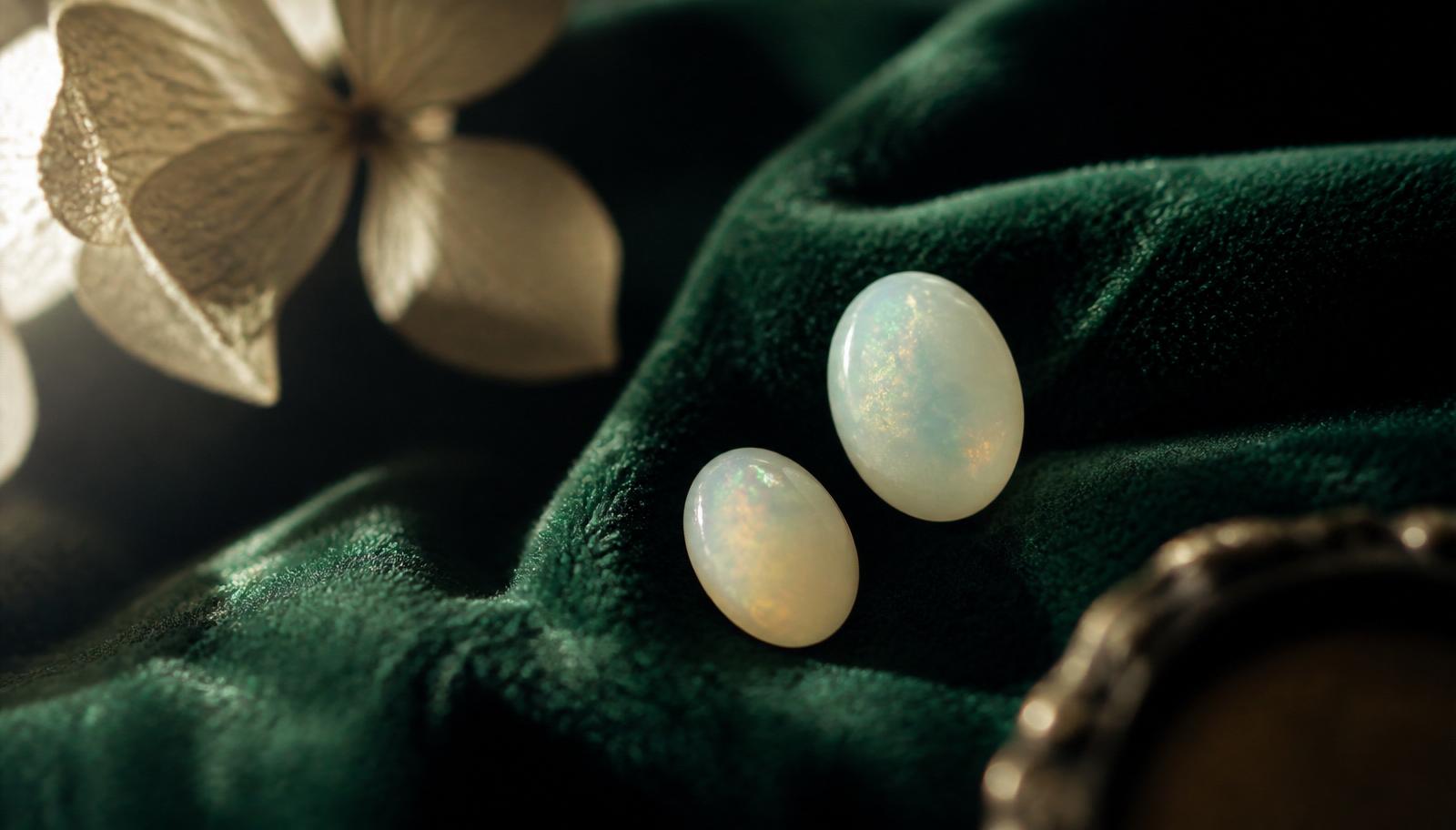
White Cliffs, New South Wales, 1890s. Australian miners in the yellow sandstone encounter something they have rarely seen: white opal with a play of red, green, and blue that seems to run through the stone. Within ten years, the supply of opal on the world market completely changes. While Hungary (Cervenica, in present-day Slovakia) had been the main source until then, after 1890 a flood of Australian material became available — first White Cliffs, later Lightning Ridge (black opal), Coober Pedy, and Andamooka. Anyone who finds an opal in a jewel from after 1890 is almost certainly holding Australian material; all European vintage opals from before that date are Cervenica.
Opal is not a crystal but amorphous silica (SiO₂·nH₂O) with up to 20 per cent water in its structure. This water content makes the stone both special and fragile. Loss of water — due to heat, drought, ultrasonic cleaning — leads to crazing: a network of fine hairline cracks that irreversibly damages the opal. Those who cherish an opal cherish a stone that literally contains moisture and must retain that moisture.
The stone in brief
Opal has a hardness of 5.5 to 6.5 on the Mohs scale — significantly softer than the classic precious gemstones. The characteristic play-of-colour ('play') is created by light diffraction on minuscule silica spheres in the structure. The colour, intensity, and pattern of this play determine the quality.
Important types: white opal (light body colour, subtle play), black opal (dark body colour against which the play-of-colour dramatically stands out — rare and most sought-after), boulder opal (opal embedded in ironstone, naturally with matrix), and fire opal (Mexican, orange-red, often without play-of-colour but with an intense body colour). Historic Cervenica opal (Slovakia) is usually white with a soft play; large Australian mines have dominated the global supply since 1900.
Periods in which you will encounter this stone
In late-Victorian work (1885–1901), opal quickly gained popularity — partly thanks to Australian production making the market accessible, partly because Queen Victoria herself was a pronounced enthusiast and gave opals as wedding gifts to her daughters. See the Victorian style guide. The attraction to the superstition 'opal brings bad luck' (partly based on Walter Scott's novel Anne of Geierstein from 1829) also persisted, making the market volatile.
Art nouveau (1890–1910), however, embraced the opal. Its indefinable play-of-colour perfectly matched the art nouveau aesthetic of fluid, lifelike, and sensuous motifs. René Lalique used opals in dragonfly wings and female profiles; see the art nouveau style guide.
Edwardian (1901–1910) integrated the opal into refined platinum settings with diamond, often as a central oval cabochon in a halo of small diamonds. See the Edwardian style guide. In art deco (1920–1935), opal largely disappeared; the geometric rigour of the period was less suited to the organic play-of-colour of the stone.
In late-Victorian work (1885–1901), opal quickly gained popularity — partly thanks to Australian production making the market accessible, partly because Queen Victoria herself was a pronounced enthusiast and gave opals as wedding gifts to her daughters.
Antique vs modern
Solid opal vs doublet and triplet. A solid is one piece of opal in cabochon form. A doublet is a thin layer of precious opal on a dark base (often iron oxide or glass) to visually intensify the play-of-colour. A triplet adds a protective dome of quartz or glass on top. Doublets have existed since the late nineteenth century and are not uncommon in vintage work; triplets are twentieth-century. Distinguish by looking at the side: with a solid, you will see the play-of-colour extending to the edge; with a doublet, you will see a sharp transition to the dark base material.
Synthetic opal has existed since 1974 (Gilson). They can be recognised under a loupe by a strictly regular pattern that shows 'columns' when viewed from the side, and by a uniform structure that natural opal never has. For vintage jewellery from before 1974, synthetic opal is by definition a later replacement. For the broader context of treated and synthetic materials, see recognising reproductions.
Crazing is the dreaded affliction. A network of fine hairline cracks in the opal, caused by loss of water content. Once it occurs, it is irreversible and significantly reduces the value. Some mines produce opal with a higher tendency to craze than others; sellers sometimes 'stabilise' opals by soaking them in water or glycerine for weeks before sale. This is ethically questionable, and crazing can still occur. When purchasing an expensive opal: ask about its origin and how long the stone has been in its current state.
Foil-backing in opal is less common than in corundum but occurs in early Cervenica stones to enhance the play. With Australian material, this is rarely necessary — the intrinsic colour is strong enough.